
Malay Language, Alphabets, and Pronunciation: A Guide in 2026
The Malay language alphabet is more than a school topic. It is a practical tool for travel, study, culture, and business across Southeast Asia. Malay, also called Bahasa Melayu, is the official and national language of Malaysia, and it is also used widely in Brunei, Singapore, and nearby parts of the region. Elite Asia also notes that the wider Malay language continuum reaches roughly 290 million speakers across the region, which makes Malay important for trade, customer service, education, and public communication.
For businesses, Malay matters because language choice shapes trust, clarity, and search visibility in multilingual markets. Readers who want a wider regional picture can start with What Are the Most Spoken Languages in Malaysia? and What Are the Most Spoken Languages in Singapore?.
Malay/Bahasa Melayu
Origin
Malay belongs to the Austronesian language family, one of the world’s largest language families by geographic spread. Within that family, it is usually placed in the Malayic group, which includes several closely related regional varieties. In simple terms, Malay grew in the maritime world of Southeast Asia, where trade, migration, and court culture helped it spread from port to port.
History
Malay began as Old Malay, influenced by India and including many Sanskrit words. The earliest evidence is the Kedukan Bukit inscription from South Sumatra, dated 1 May 683 and written in Pallava script. As Srivijaya expanded, Old Malay spread across the Malay world and served as a regional lingua franca. By the early 14th century, Classical Malay was clearly emerging, as shown by the Terengganu Inscription Stone, the earliest evidence of Jawi writing and Islam’s growing role. During the Malacca Sultanate, Classical Malay became the main language of trade, administration and literature, absorbing major Arabic influence alongside earlier Sanskrit and Tamil elements.
After the Portuguese captured Malacca in 1511, the Classical Malay literary tradition continued in other royal and trading centres, especially Johor-Riau. Malay remained a shared interethnic language, as seen in the 1521–1522 Ternate letters. In the 19th century, British and Dutch colonial expansion divided the Malay world into separate spheres and helped push the language toward more formal standardisation. Over time, that colonial split contributed to the development of distinct modern standards, especially Malaysian Malay and Indonesian.
If you want a broader cultural lens on long-lived languages, What Are the 20 Oldest Languages in the World? gives useful background on why language history still matters in modern communication.
Classification
Malay belongs to the Austronesian family of languages, including languages from Southeast Asia and the Pacific Ocean, as well as a few in continental Asia. Malagasy, spoken in Madagascar in the Indian Ocean, is also part of this family. These languages may not be mutually intelligible, but they are often quite similar. In more conservative languages like Malay, many roots have come with little change from their common ancestor, Proto-Austronesian language. There are many cognates in the words for kinship, health, body parts and common animals. Numbers, especially, show remarkable similarities.
The Malayic languages, including Malay, were spread by Malay traders from Sumatra. There is disagreement about which dialects of Malay should be classified as distinct languages. The vernacular of Brunei, for example, is not readily intelligible with the standard language. However, both Brunei and Kedah are quite close.
Writing system
Malay is now written using the Latin script (known as Rumi in Brunei, Malaysia and Singapore or Latin in Indonesia), although an Arabic script called Arab Melayu or Jawi also exists. Latin is official in Malaysia, Singapore and Indonesia. Malay uses Hindu-Arabic numerals.
Final pages of the Taj al-Salatin, a Malay “mirror for princes”, copied by Muhammad bin Umar Syaikh Farid on 31 July 1824 CE in Jawi script. Rumi (Latin) and Jawi are co-official in Brunei and Malaysia. Names of institutions and organisations have to use Jawi and Rumi (Latin) scripts in Brunei and some parts of Malaysia. Jawi is used fully in schools, especially the religious school,Sekolah Akidah, which is compulsory during the afternoon for Muslim students aged from around 6–7 up to 12–14.
Preserving Jawi in Malaysia is a current effort. Students can use Jawi when taking Malay language exams.
The Latin script is the most common in Brunei and Malaysia.
Malay has historically been written using various scripts. Before Arabic script was introduced to the Malay region, it was written using Pallava, Kawi and Rencong; these are no longer frequently used, but similar scripts such as the Cham alphabet are used by the Chams of Vietnam and Cambodia. Old Malay was written using Pallava and Kawi, as evidenced by inscription stones in the Malay region. Jawi replaced these scripts as the most commonly used script in the Malay region from the era of the kingdom of Pasai and throughout the golden age of the Malacca Sultanate. From the 17th century, under Dutch and British influence, Jawi was gradually replaced by the Rumi script.
Extent of Use
Malay and its related standard varieties are used across Brunei, Indonesia, Malaysia, Singapore, Timor-Leste, southern Thailand, and parts of the Philippines, although their role differs from country to country. Indonesia uses Bahasa Indonesia as its national language, while Malaysia makes Malay the national language; Brunei and Singapore also use closely related standard Malay forms in public life.
Indonesian also plays a wider international role, including use in media broadcasting and language education abroad, especially in Australia. Its status has grown further in recent years, showing how a Malay-based standard has developed beyond national use into regional and global communication.
For companies working across several markets, What Languages Does Elite Asia Singapore Translate? helps show how Malay fits into a broader multilingual strategy.
Phonology
Malay pronunciation is often easier than English pronunciation because many words are spoken close to the way they are spelled.
1. Consonants
Malaysian and Indonesian Malay have broadly similar consonant systems, while the consonants shown in brackets are mostly non-native sounds that appear in loanwords from Arabic, Dutch, and English.
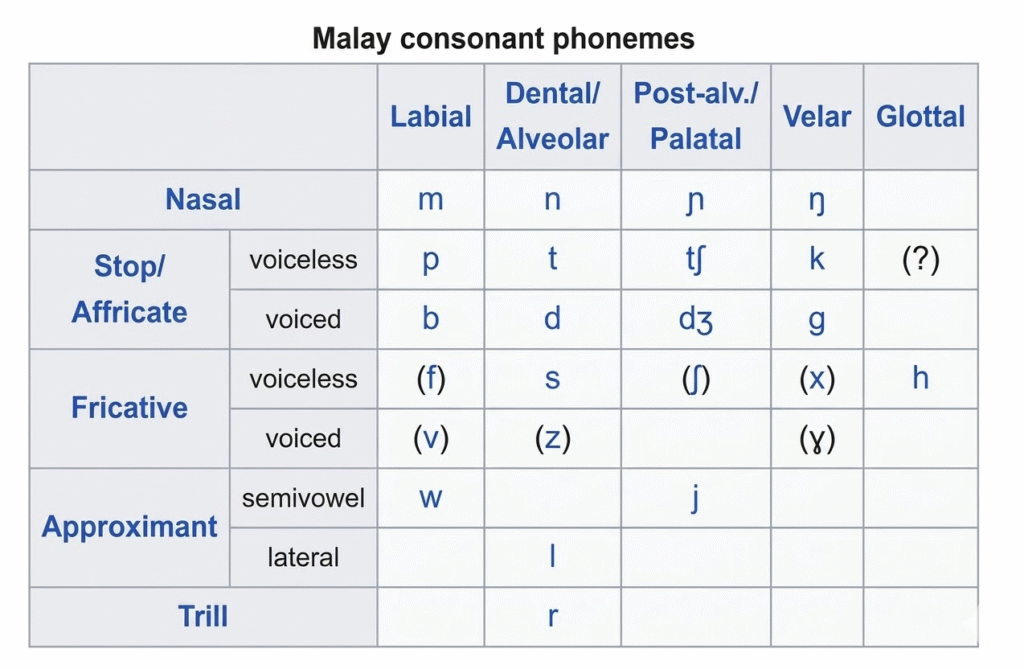
Orthographic note: The sounds are represented orthographically by their symbols as above, except:
- /ð/ is ‘z’, the same as the /z/ sound (only occurs in Arabic loanwords originally containing the /ð/ sound, but the writing is not distinguished from Arabic loanwords with /z/ sound, and this sound must be learned separately by the speakers).
- /ɲ/ is ‘ny’; ‘n’ before ‘c’ and ‘j’
- /ŋ/ is ‘ng’
- /θ/ is represented as ‘s’, the same as the /s/ sound (only occurs in Arabic loanwords originally containing the /θ/ sound, but the writing is not distinguished from Arabic loanwords with /s/ sound, and this sound must be learned separately by the speakers). Previously (before 1972), this sound was written ‘th’ in Standard Malay (not Indonesian)
- the glottal stop /ʔ/ is final ‘k’ or an apostrophe ‘ (although some words have this glottal stop in the middle, such as rakyat)
- /tʃ/ is ‘c’
- /dʒ/ is ‘j’
- /ʃ/ is ‘sy’
- /x/ is ‘kh’
- /j/ is ‘y’
- /q/ is ‘k’
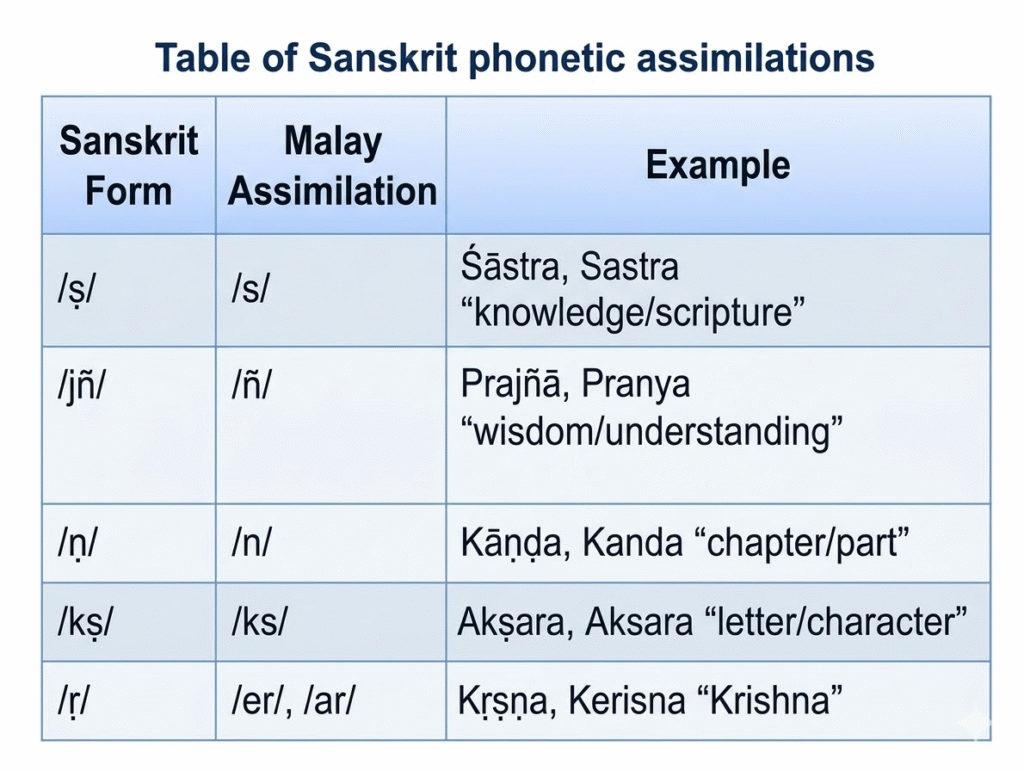
Loans from Arabic: Some Arabic loans have phonemes that speakers who know Arabic can pronounce distinctly. Otherwise, they are replaced with native sounds.
2. Vowels
Malay originally had four vowels, but many modern varieties, including Standard Malay, now use six because /i/ and /u/ have partly split into /i, e/ and /u, o/. In everyday speech, speakers often vary between high and mid vowels, so only a small number of words strictly require /e/ or /o/.
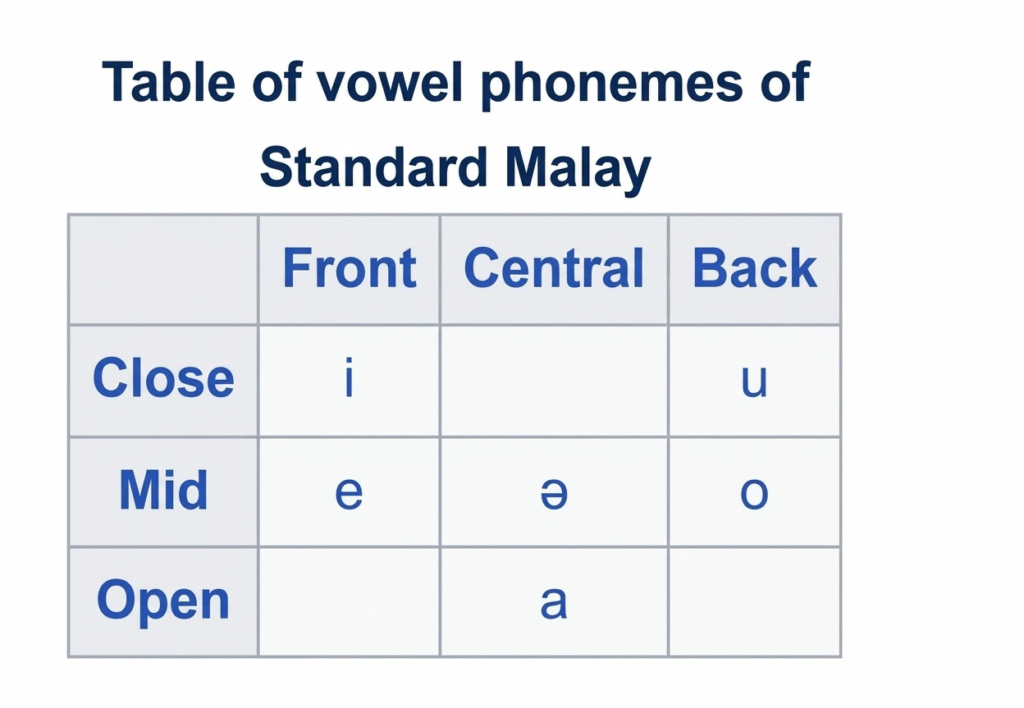
In Malay orthography, both /e/ and /ə/ are written as ⟨e⟩, though ⟨e⟩ usually represents /ə/. This can create homographs, such as perang, which can mean “war” or “blond.” Some scholars treat /ai, au, oi/ as diphthongs, but others analyse them as vowel-plus-approximant sequences /aj, aw, oj/, especially since true diphthongs only appear in open syllables. Malay also has a vowel harmony rule: in bisyllabic words, non-open vowels /i, e, u, o/ must match in height.
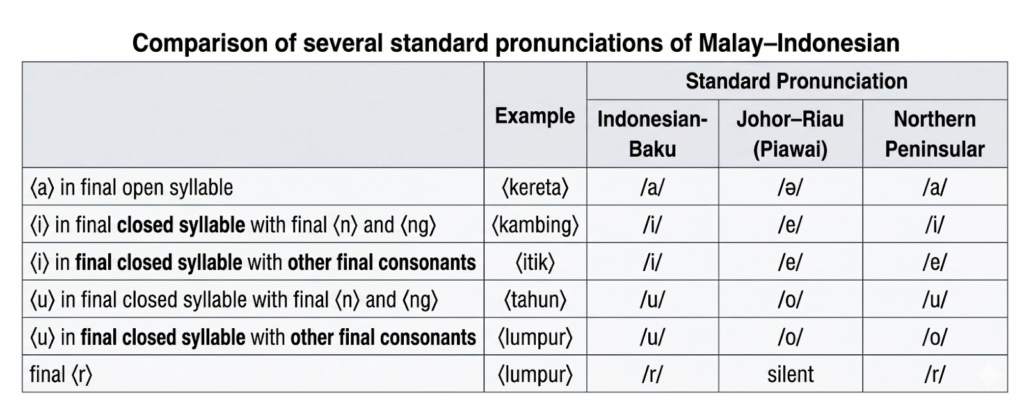
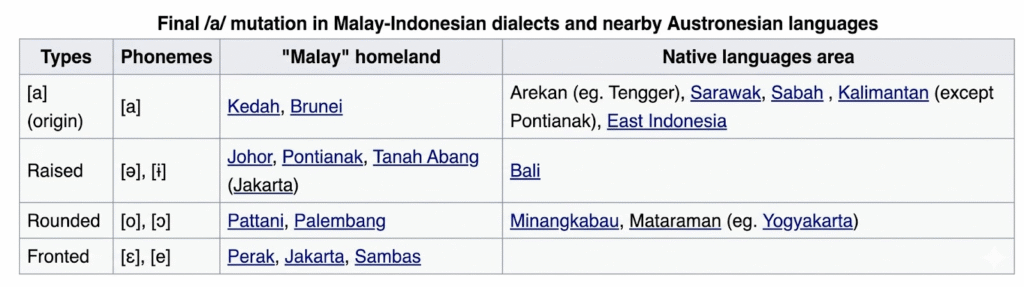
Uri Tadmor’s 2003 study shows that the mutation of ⟨a⟩ in the final open syllable is an areal feature, specifically of Western Austronesia. Tadmor classifies those types into four groups.
Grammar
Malay is an agglutinative language, and new words are formed by three methods: affixation, composition and reduplication. Nouns and verbs may be basic roots, but frequently they are derived from other words by means of prefixes, suffixes and circumfixes.
Malay does not use grammatical gender, and only a few words use natural gender. The same word can mean ‘he’ or ‘she’ (dia) and ‘his’ or ‘her’ (dia sesuai). There is no grammatical plural in Malay, so ‘orang’ can mean ‘person’ or ‘people’. Verbs are not inflected for person or number, and they are not marked for tense. Tense is instead denoted by time adverbs (such as ‘yesterday’) or by other tense indicators, such as sudah ‘already’ and belum ‘not yet’. However, there is a complex system of verb affixes to show nuances of meaning and to show voice or intentional and accidental moods.
Malay does not have a grammatical subject like English. In intransitive clauses, the noun comes before the verb. When there is an agent and an object, these are separated by the verb (OVA or AVO), with the difference encoded in the voice of the verb. OVA, commonly called “passive”, is the most common word order.
Vocabulary
Malay has absorbed many loanwords from Arabic, especially in religion, as well as from Sanskrit, Tamil, Chinese languages, Persian, Portuguese, Dutch, and English. Indonesian tends to form new words from Sanskrit influences, partly because of strong Javanese and Balinese linguistic influence, while Malaysian and Bruneian Malay more often use Arabic for neologisms due to the influence of Islamic tradition. In Indonesian, Arabic vocabulary is mostly limited to religious contexts, while Sanskrit-based terms in Malaysian and Bruneian Malay are often borrowed from Indonesian.
Vocabulary in fields such as administration, business, and law also reflects colonial history, with Dutch influencing Indonesian and English shaping Malaysian and Bruneian Malay. Although these varieties may follow similar principles for developing scientific terms, they often produce different results because of differences in vocabulary sources, meanings, and grammatical preferences. As a result, Indonesian and Standard Malay differ in systematic ways that go beyond ordinary dialect variation.
Varieties and Related Languages
A group of closely related languages is spoken by Malays and related peoples across Brunei, Indonesia, Malaysia, Singapore, Southern Thailand, Timor-Leste, and the far southern parts of the Philippines. They have traditionally been classified as Malay, Para-Malay, and Aboriginal Malay, but this reflects geography and ethnicity rather than proper linguistic classification. The Malayic languages are mutually intelligible, though the distinction between language and dialect is unclear in many cases.
Para-Malay includes the Malayic languages of Sumatra: Minangkabau, Central Malay (Bengkulu), Pekal, Talang Mamak, Musi (Palembang), Negeri Sembilan (Malaysia) and Duano’.
Aboriginal Malay is the name given to the Malayic languages spoken by the Orang Asli (Proto-Malay) in Malaya. They are Jakun, Orang Kanaq, Orang Seletar and Temuan.
The other Malayic languages, not included in these groups, are associated with the expansion of the Malays across the archipelago. They include: Riau-Johor Malay (Malaysian and Indonesian), Kedah Malay, Brunei Malay, Berau Malay, Bangka Malay, Jambi Malay, Kutai Malay, Terengganu Malay, Riau Malay, Loncong, Pattani Malay, Bacan Malay, andBanjarese. Menterap may belong here.
There are also several Malay-based creole languages, such as Betawi Malay, Makassar Malay and so on, which may be more or less distinct from standard Malay.
A Cape Malay community settled in Cape Town early on. They are now known as Coloureds and brought numerous Classical Malay words into Afrikaans.
Usages
Malay is used in different ways across Southeast Asia depending on each country’s history and culture. It is the national language in Malaysia, has a similar position in Brunei, and still holds symbolic national importance in Singapore even though English is more dominant; in southern Thailand and nearby areas, Malay-related varieties are spoken but have less or no official recognition.
In Indonesia, Indonesian, which is a standardised variety of Malay, became the main unifying language across the archipelago and functions as the country’s lingua franca. Its role grew as Dutch declined in everyday use, and Indonesian is also recognised as a working language in Timor-Leste.
Malay is also highly diverse, especially in Indonesia, where many regional varieties exist. Western varieties are common in Sumatra and Borneo, while eastern forms such as Manado, Ambonese, and Papuan Malay differ clearly in vocabulary, pronunciation, and grammar, including the meaning of words like kita and the way possession is expressed.
For business readers, Why Localisation is Important for Your Business in Singapore explains why the right language form improves trust and response rates.
Commonly Confused Letters
- E: learners often miss the two common vowel values.
- C: pronounced “ch”, not “k”.
- G: always hard, not soft as in “giant”.
- R: clearer and stronger than the English “r”.
- K: sometimes lightly closed or unreleased at the end of a word in some speech styles.
- NG and NY: these are very common and should be learnt as sound units.
Special Characters and Diacritics
Standard Rumi Malay usually does not need many diacritics in daily writing. In dictionaries, textbooks, or pronunciation guides, you may sometimes see marks that help show the difference between the two e sounds. Jawi, like Arabic script, also has vowel marks, but they are often omitted in normal running text once the reader knows the word.
Mastering the 26 Malay Alphabet Letters
If you are starting from zero, the good news is simple: the modern Malay language alphabet in Rumi uses the same 26 letters as English.
A, B, C, D, E, F, G, H, I, J, K, L, M, N, O, P, Q, R, S, T, U, V, W, X, Y, Z
That makes the Malay language alphabet feel familiar from day one. The challenge is not the letters themselves, but the sound values attached to them.
Getting Started with the Malay Alphabet
learning sound-first, not letter-first. Do not ask, “What does this letter look like?” Ask, “How do Malay speakers say it in real words?” That habit improves reading and speaking much faster.
1. Latin Alphabet for Malay (Tulisan Rumi)
Rumi is the dominant script in modern life. It is the script used for websites, contracts, product labels, media, public notices, and most school materials. If your company is localising digital content, What Are The Different Types of Website Localisation and 10 Software Localisation Best Practices 2026 are useful next reads because they show how written language must also fit platform design and user behaviour.
2. Jawi Alphabet (توليسن جاوي)
Jawi is the older Arabic-based writing system used for Malay. It has special added letters to represent Malay sounds that Arabic does not have. Today, Jawi is still important in religion, tradition, education, heritage publishing, and identity.
Sample text in Malay (Jawi alphabet):
ساي بلاجر بهاس ملايو
Sample text in Malay (Latin alphabet):
Saya belajar Bahasa Melayu.
The two lines above show the same simple sentence: “I study Malay.” Even if you never need to write Jawi for work, recognising it can help when you deal with heritage material, public signage, cultural brands, or educational content.
Vowels (A, E, I, O, U)
- A usually sounds open, like the “a” in “father”.
- E has two common pronunciations, which learners must pick up through listening.
- I is usually clear and short, like “ee”.
- O is rounded and stable.
- U is like “oo” in “food”.
Common Consonants (B, D, F, G, H, L, M, N, P, R, S, T).
- These are usually steady and predictable.
- H is often pronounced clearly.
- R should not be swallowed.
- S stays sharp, not “z”.
Tricky Consonants (C, J, K, Q, V, W, X, Y, Z).
- C = “ch”, as in cari.
- J = English “j”, as in jalan.
- K is clear at the start of words, but can sound lighter at the end.
- Q, V, X, and Z appear mostly in loanwords.
- Y is usually a consonant sound like “y” in “yes”.
- W is stable, but many learners over-round it.
For marketers and content teams, spelling alone is not enough. The same term may need a different tone in a website menu, ad headline, medical form, or support script. That is why Business Localisation, Marketing Localisation, and 20 Best Localisation Strategy Company Examples in 2026 are relevant support reads for language-led growth.
Modern Malay Language
Modern Malay is practical, flexible, and highly adaptable. It works in classrooms, chat apps, government notices, sales pages, and cross-border business. This flexibility is one reason it remains important in multilingual Southeast Asia.
- Malay borrowed terms: Modern Malay uses many borrowed words, especially in education, law, faith, science, and technology. You can hear this in words such as telefon, universiti, polis, stesen, budaya, and waktu. Borrowing does not make Malay weaker. It shows how the language has grown through contact and use.
- Bahasa Indonesia and Brunei: Malay in Malaysia, Brunei Malay, and Indonesian are closely related, but they are not fully interchangeable in business use. Elite Asia notes that Malay and Indonesian are similar enough for partial mutual understanding, but market-facing communication still needs local wording and review. This matters for product copy, customer help, legal instructions, and SEO because one market’s “normal” wording may sound odd in another.
If your website targets more than one country, International SEO: Best Practices for Global SEO Strategy and How to Create Multilingual Website Contents That Actually Speak to Your Audience explain why language versioning should be planned, not improvised. If your team is choosing a workflow, Which is the Best Way to Translate Your Website, Manual File Transfer or CMS Integration? shows why process design affects speed, consistency, and publishing quality.
Language accuracy matters even more in regulated sectors. Supporting Legal Documents Required? Translate it Professionally, Medical Translation Services in Malaysia’s Multicultural Healthcare, and Multilingual Challenges Faced in Telemedicine show how small wording errors can affect compliance, care, and user understanding.
Common Mistakes and Pronunciation Tips
Reading c as “k” instead of “ch”
In Malay, the letter c is pronounced like “ch,” not like the English or Indonesian hard “k.”
Treating all e sounds as the same
Malay uses e for more than one vowel sound, so learners should not assume every e is pronounced identically.
Dropping the h in the middle of words
The h should usually be pronounced clearly, even when it appears inside a word.
Using an English-style r instead of a light tap
Malay r is usually lighter and shorter than the English r, often closer to a tap or quick trill.
Forgetting that many final consonants are softer than in English
Word-final consonants in Malay are often less forceful, so they should not sound as heavy or strongly released as in English.
Overcomplicating stress
Malay rhythm is generally more even, so learners should avoid adding strong English-style stress patterns.
Malay Alphabet Made Easy: 10 Tips to Improve Your Pronunciation and Honour Your Roots
Learn whole sounds, not just letter names
Focus on how letters sound in actual words, because pronunciation depends on real speech rather than alphabet recitation.
Copy short words before long ones
Short words are easier to hear and repeat accurately, making them a good starting point for building confidence.
Listen closely to the two common e sounds
Paying attention to these two values helps you avoid one of the most common pronunciation mistakes in Malay.
Train ng and ny early
These sounds appear often in Malay, so learning them early improves both listening and speaking.
Keep vowels clean and steady
Malay vowels are usually clear and stable, so they should not drift or change too much within the same syllable.
Say r lightly, not heavily
A lighter r sounds more natural and fits Malay pronunciation better than a strong English-style r.
Read aloud every day for five minutes
Regular short practice helps build better pronunciation habits more effectively than occasional long sessions.
Compare Rumi spelling with real speech
Do not rely only on English spelling habits; instead, connect written Malay forms with how native speakers actually say them.
Use children’s books, news clips, and simple dialogues
These materials give clear, practical examples of pronunciation in everyday contexts.
Get a native review before publishing public content
A native speaker can catch unnatural pronunciation-based spelling or wording issues before they reach an audience.
For businesses using AI or rapid translation tools, human review is still important when tone and meaning matter. Machine Translation Post-Editing: What You Need to Know explains why post-editing helps turn fast output into usable, brand-safe content.
Common Malay Words and Phrases
- Selamat pagi — Good morning.
- Selamat petang — Good afternoon.
- Terima kasih — Thank you.
- Sama-sama — You are welcome.
- Ya — Yes.
- Tidak — No.
- Tolong — Please / Help.
- Maaf — Sorry.
- Berapa harga? — How much is it?
- Saya faham — I understand.
These short phrases show one useful truth about Malay: the writing system is approachable, but sounding natural takes listening and repetition.
If your organisation is planning content for several Asian markets, How to Succeed in Digital Marketing in China is also a helpful reminder that language success depends on local platforms, local tone, and local expectations, not direct translation alone.
Frequently Asked Questions
How Do You Say Alphabet in Malay?
The common word is abjad. In everyday teaching, people may also talk about huruf, which means letters.
How Many Letters Are in the Malay Alphabet?
Modern Rumi Malay uses 26 letters, the same basic Latin set used in English.
What Alphabet Do They Use in Malaysia?
Malaysia mainly uses the Latin-based Rumi script for modern daily life, education, media, and business, while Jawi is still used in selected religious, cultural, and heritage contexts. For organisations moving across markets and formats, that split between everyday script and cultural script is one reason localisation planning matters.
Why Does Malay Use Jawi?
Jawi became important through history, religion, scholarship, and administration. Even though Rumi is dominant today, Jawi still carries strong cultural and historical value.
For companies that need accurate websites, documents, subtitles, or live interpretation in Malay, the safest next step is expert support. Explore Elite Asia’s Bahasa Melayu Translation and Interpretation service for business-ready help with Malay communication across sectors and formats.