What Are the Most Spoken Languages in Malaysia? The Official Language of Malaysia
Malaysia stands as one of the most linguistically diverse nations in Southeast Asia, home to 137 living languages that reflect its rich multicultural heritage. This linguistic tapestry tells a story of centuries-old trade routes, colonial influences, and the harmonious coexistence of multiple ethnic communities. Whether you’re planning to expand your business into Malaysia or simply curious about the country’s communication landscape, understanding the languages spoken in Malaysia is essential.
The Official Language of Malaysia: Bahasa Malaysia
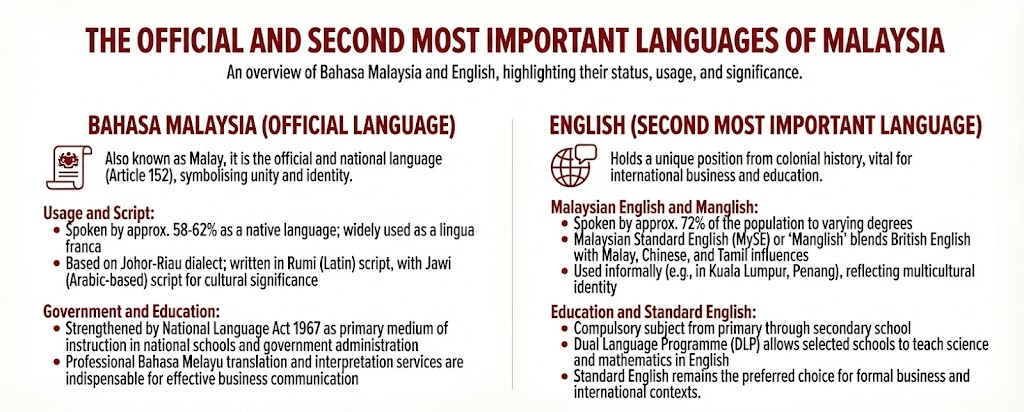
Bahasa Malaysia, also known as Malay or Bahasa Melayu, serves as the official and national language of Malaysia. This status was enshrined in Article 152 of the Federal Constitution upon Malaysia’s independence in 1957. The language represents more than just a medium of communication; it symbolises national unity and Malaysian identity across all ethnic groups.
Spoken by approximately 58-62% of the population as a native language and used more widely as a lingua franca, Bahasa Malaysia is based on the Johor-Riau dialect and has evolved significantly since independence. The language is written using the Latin alphabet (known as Rumi), which was officially adopted as the standard script, whilst the Arabic-based Jawi script continues to hold cultural and religious significance.
The Malaysian government strengthened Bahasa Malaysia’s position through the National Language Act 1967, making it the primary medium of instruction in national schools and the language of government administration. This deliberate language planning aimed to unite a diverse population under a common linguistic framework whilst preserving the rights of other communities to maintain their languages.
For businesses seeking to communicate effectively with Malaysian audiences, professional Bahasa Melayu translation and interpretation services become indispensable. Understanding the nuances of formal Bahasa Malaysia versus colloquial variations can make the difference between successful market entry and miscommunication.
English: The Second Most Important Language
English holds a unique position in Malaysia as the second most widely spoken language, with approximately 72% of the population able to communicate in English to varying degrees according to education sector analyses. The language’s prominence stems from Malaysia’s colonial history under British rule and its continued importance in international business and education.
Malaysian English and Manglish
Malaysian Standard English (MySE), colloquially known as Manglish, represents a distinctive variety of English that blends British English with influences from Malay, Chinese dialects, and Tamil. This linguistic phenomenon reflects Malaysia’s multicultural identity, with speakers naturally code-switching between languages depending on context and audience.
Manglish serves as an informal communication tool among Malaysians, particularly in urban areas such as Kuala Lumpur and Penang. However, in formal business settings, professional contexts, and international communications, Standard English remains the preferred choice.
The education system mandates English as a compulsory subject from primary through secondary school. Additionally, the Dual Language Programme (DLP), launched in 2016, allows selected schools to teach science and mathematics in English, demonstrating the government’s commitment to maintaining English proficiency amongst Malaysian students.
For companies requiring professional document translation services, understanding the difference between formal English and Manglish is crucial for crafting messages that resonate with the intended audience while maintaining professionalism.
Chinese Languages: Mandarin and Regional Dialects
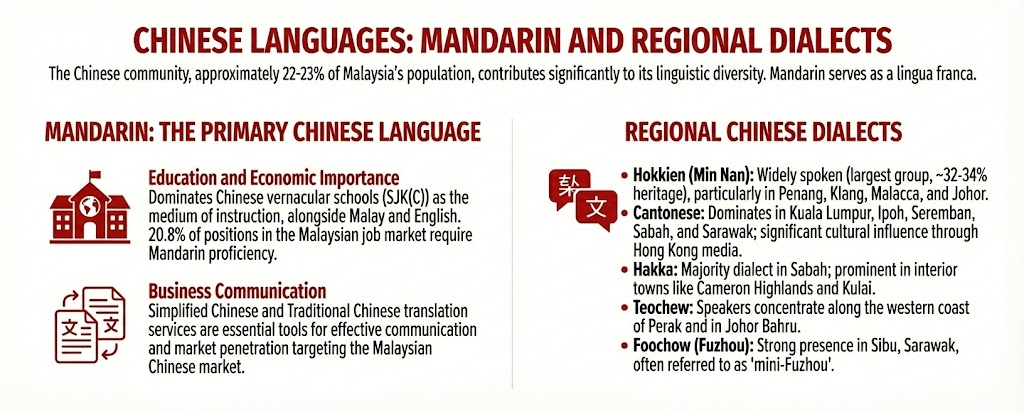
The Chinese community in Malaysia, comprising approximately 22-23% of the population as of 2024-2025, contributes significantly to the country’s linguistic diversity. Mandarin serves as the common language amongst Malaysian Chinese, functioning as a lingua franca that bridges various Chinese dialect groups.
Mandarin: The Primary Chinese Language
Mandarin Chinese dominates Chinese-language education in Malaysia through the extensive network of Chinese vernacular schools (SJK(C)). These institutions use Mandarin as the medium of instruction, whilst also teaching Malay and English as compulsory subjects. The language has gained increasing economic importance, with job market data showing that 20.8% of positions in Malaysia require Mandarin proficiency.
For businesses targeting the Malaysian Chinese market, Simplified Chinese and Traditional Chinese translation services are essential tools for effective communication and market penetration.
Regional Chinese Dialects
Beyond Mandarin, Malaysian Chinese communities speak numerous dialects that reflect their ancestral origins in Southern China. The major dialects include:
- Hokkien (also known as Min Nan) ranks among the most widely spoken Chinese dialects, particularly in Penang, Klang, Malacca, and southern regions such as Johor. Approximately one-third (32-34%) of Chinese Malaysians trace their heritage to Hokkien-speaking ancestors, making it the largest Chinese dialect group in Malaysia.
- Cantonese dominates in Kuala Lumpur, Ipoh, Seremban, and parts of Sabah and Sarawak. The dialect holds significant cultural influence through Hong Kong media and entertainment.
- Hakka is the majority dialect in Sabah and is prominent in interior towns like Cameron Highlands and Kulai.
- Teochew speakers concentrate along the western coast of Perak and in Johor Bahru.
- Foochow (Fuzhou) has established a strong presence in Sibu, Sarawak, often referred to as “mini-Fuzhou”.
Understanding these dialect variations is crucial for businesses developing localised marketing campaigns targeting specific Chinese communities in Malaysia.
Tamil and Indian Languages
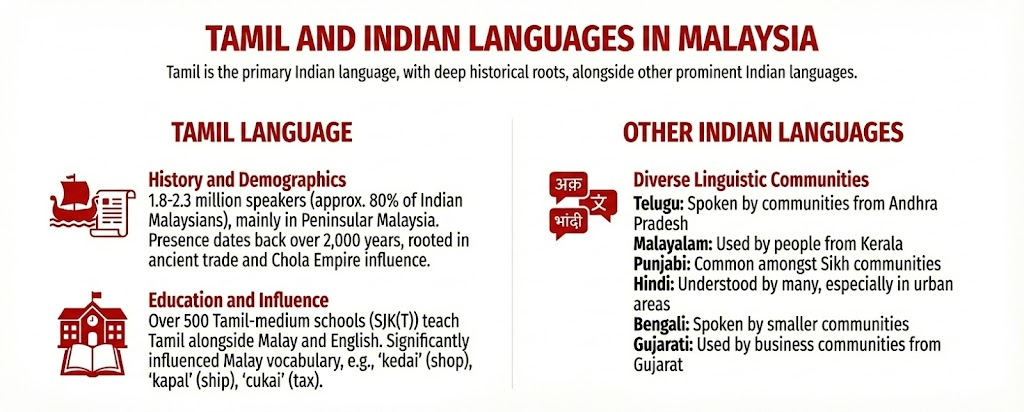
Tamil stands as the primary Indian language spoken in Malaysia, with 1.8-2.3 million speakers (representing approximately 80% of the Indian Malaysian population) concentrated mainly in Peninsular Malaysia. The language’s presence in Malaysia dates back over 2,000 years, rooted in ancient trade connections from the first centuries BCE, and the 11th-century influence of the Chola Empire, particularly through Rajendra Chola I’s naval expeditions to Kedah (known as Kadaram).
Tamil Language and Education
The Malaysian education system supports the preservation of the Tamil language through more than 500 Tamil-medium schools (SJK(T)) across the country. These institutions teach the Tamil language whilst also providing instruction in Malay and English, ensuring students become multilingual.
Tamil has significantly influenced Malay vocabulary, with many everyday words in Bahasa Malaysia originating from Tamil, such as “kedai” (shop), “kapal” (ship), and “cukai” (tax). This linguistic crossover demonstrates the deep historical and cultural connections between Tamil and Malay communities.
Other Indian Languages
Beyond Tamil, other Indian languages spoken in Malaysia include:
- Telugu: Spoken by communities from Andhra Pradesh
- Malayalam: Used by people from Kerala
- Punjabi: Common amongst Sikh communities
- Hindi: Understood by many Indians, particularly in urban areas
- Bengali: Spoken by smaller communities
- Gujarati: Used by business communities from Gujarat
For organisations serving Malaysia’s diverse Indian population, multilingual content creation that respects linguistic preferences can significantly enhance engagement and trust.
Indigenous Languages: The Heart of East Malaysia
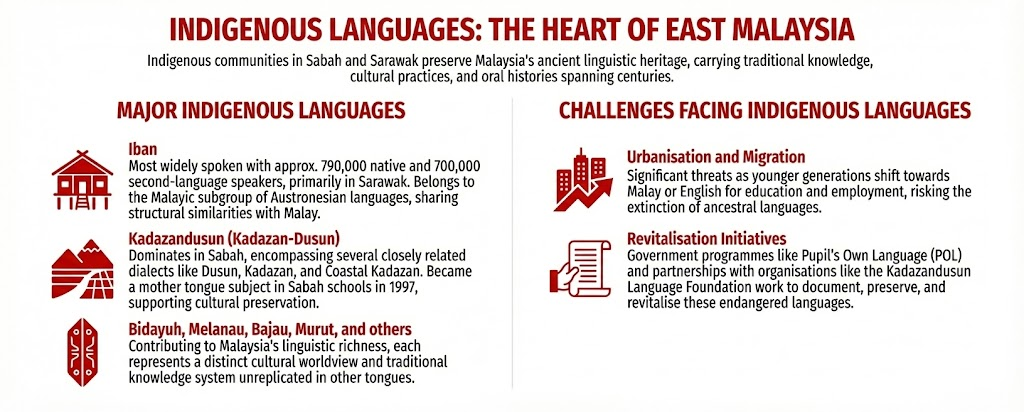
Indigenous communities in Sabah and Sarawak preserve some of Malaysia’s most ancient linguistic heritage. These languages carry traditional knowledge, cultural practices, and oral histories spanning centuries.
Major Indigenous Languages
- Iban represents the most widely spoken indigenous language, with approximately 790,000 native speakers and an additional 700,000 second-language speakers, primarily in Sarawak. The Iban language belongs to the Malayic subgroup of Austronesian languages and shares structural similarities with Malay.
- Kadazandusun (also spelt Kadazan-Dusun) dominates in Sabah, encompassing several closely related dialects, including Dusun, Kadazan, and Coastal Kadazan. The language became a mother tongue subject in Sabah schools in 1997, supporting cultural preservation efforts.
- Bidayuh, Melanau, Bajau, Murut, and dozens of other indigenous languages contribute to Malaysia’s linguistic richness. Each language represents a distinct cultural worldview and traditional knowledge system that cannot be replicated in other tongues.
Challenges Facing Indigenous Languages
Urbanisation and migration pose significant threats to indigenous language survival. Younger generations are increasingly shifting towards Malay or English for education and employment, risking the extinction of ancestral languages. Government initiatives, including the Pupil’s Own Language (POL) programme and partnerships with organisations like the Kadazandusun Language Foundation, work to document, preserve, and revitalise these endangered languages.
Malaysia’s Multilingual Education System

Malaysia’s education system reflects the country’s commitment to linguistic diversity whilst maintaining national unity through a common language.
Types of Schools
- National Schools (Sekolah Kebangsaan) use Bahasa Malaysia as the primary medium of instruction, with English taught as a compulsory second language. These schools are open to students of all ethnicities and are fully government-funded.
- National-Type Schools include Chinese vernacular schools (SJK(C)) using Mandarin and Tamil schools (SJK(T)) using Tamil as the medium of instruction. Both school types must teach Bahasa Malaysia and English as compulsory subjects. Whilst national schools receive full government funding, national-type schools receive partial government support, with communities often fundraising for infrastructure improvements.
- Private and International Schools offer alternative curricula, often using English as the primary medium of instruction.
This multilingual education model ensures that children develop proficiency in multiple languages from an early age, preparing them for Malaysia’s diverse social and economic landscape. For companies developing e-learning materials for Malaysian audiences, understanding these educational backgrounds is essential.
Language in Malaysian Business and Commerce
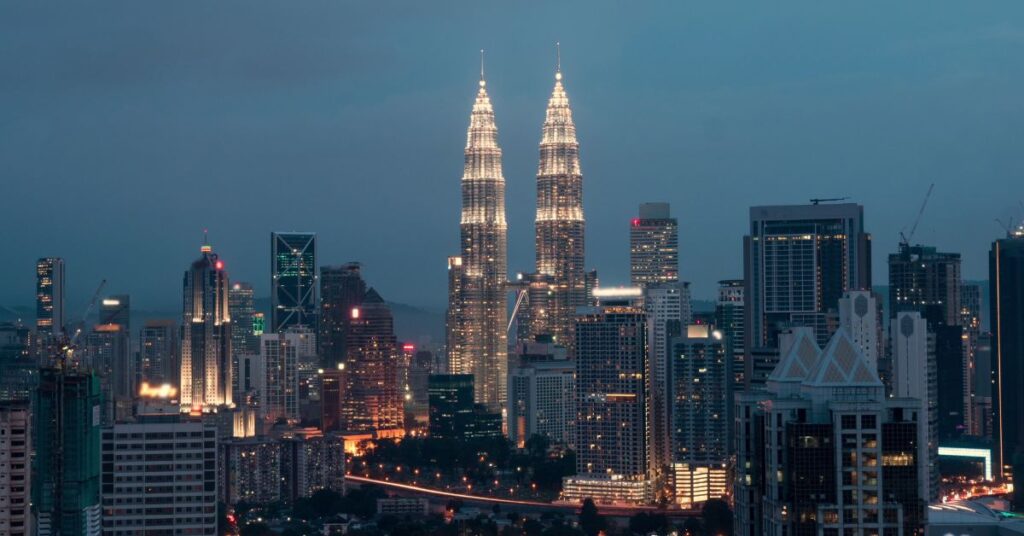
Language choices significantly impact business success in Malaysia’s multicultural market. Understanding when to use Bahasa Malaysia, English, Mandarin, or other languages can determine whether marketing campaigns succeed or fail.
Multilingual Business Communication
In professional settings, Malaysians typically demonstrate high linguistic flexibility, code-switching between languages based on the audience and context. Urban business environments commonly use a mixture of English and Bahasa Malaysia, with Chinese or Tamil incorporated when communicating with specific communities.
English maintains dominance in international business transactions, professional services, and corporate communications. However, local businesses and government dealings typically require proficiency in Bahasa Malaysia.
The job market increasingly values multilingual capabilities. Recent data indicate that Mandarin proficiency has become a significant competitive advantage, with employers actively seeking candidates who can navigate Malay, English, and Chinese.
Translation and Localisation Services
Effective market entry strategies require more than direct translation; they demand cultural localisation that resonates with local audiences, including:
- Website localisation adapted to linguistic preferences and cultural contexts
- Marketing content that uses appropriate idioms, cultural references, and persuasive techniques
- Legal document translation, maintaining accuracy and compliance with Malaysian regulations
- Technical documentation conveying complex information clearly across languages
Professional transcreation services go beyond literal translation to recreate marketing messages that maintain emotional impact and cultural relevance across languages.
Language and Cultural Identity in Malaysia

Language serves as a powerful marker of cultural identity in Malaysia, with each linguistic community maintaining distinct traditions, celebrations, and worldviews.
Unity Through Diversity
Bahasa Malaysia functions as the neutral ground that unites Malaysia’s diverse ethnic communities. The language enables cross-cultural communication in schools, government offices, and public spaces whilst allowing communities to preserve their mother tongues at home and within their ethnic networks.
This linguistic pluralism reflects Malaysia’s broader approach to multiculturalism, celebrating diversity rather than enforcing uniformity. Chinese and Tamil schools, multilingual media, and government support for language preservation demonstrate Malaysia’s commitment to maintaining its multicultural heritage.
Religious and Cultural Practices
Languages play sacred roles in religious observances across Malaysia’s communities:
- Islamic practices use Arabic for Quranic recitation and prayers
- Hindu temples conduct ceremonies in Tamil or Sanskrit
- Chinese temples maintain traditional Hokkien or Cantonese for Buddhist and Taoist rituals
These linguistic connections to spiritual practices ensure that languages remain vital beyond purely communicative functions.
The Role of Technology in Malaysian Languages

Digital platforms and social media have transformed how Malaysians use and preserve their languages. Online content creators increasingly produce multilingual materials, mixing Malay, English, Chinese, and other languages to reach diverse audiences.
Machine Translation and AI
Whilst AI translation tools have advanced significantly, they still struggle with Malaysia’s unique linguistic landscape, particularly Manglish and the nuanced code-switching that characterises Malaysian communication. Professional human translation remains essential for maintaining accuracy, cultural sensitivity, and brand integrity.
Automatic translation solutions combined with human post-editing offer cost-effective approaches for large-scale content projects whilst ensuring quality.
Language Challenges and Opportunities for Business
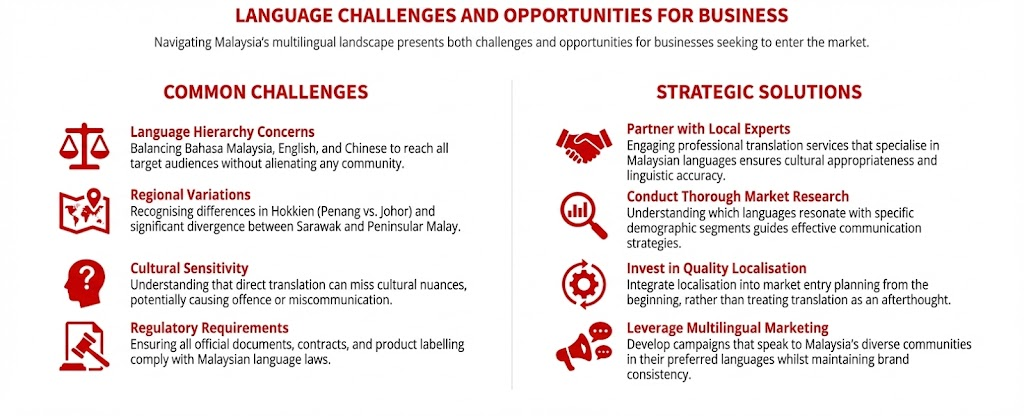
Navigating Malaysia’s multilingual landscape presents both challenges and opportunities for businesses seeking to enter the market.
Common Challenges
- Language hierarchy concerns: Balancing the use of Bahasa Malaysia, English, and Chinese languages to reach all target audiences without alienating any community.
- Regional variations: Recognising that Hokkien in Penang differs from Hokkien in Johor, and that Sarawak Malay diverges significantly from Peninsular Malay.
- Cultural sensitivity: Understanding that direct translation can miss cultural nuances, potentially causing offence or miscommunication.
- Regulatory requirements: Ensuring that all official documents, contracts, and product labelling comply with Malaysian language laws.
Strategic Solutions
- Partner with local experts: Engaging professional translation services that specialise in Malaysian languages ensures cultural appropriateness and linguistic accuracy.
- Conduct thorough market research: Understanding which languages resonate with specific demographic segments guides effective communication strategies.
- Invest in quality localisation: Rather than treating translation as an afterthought, integrate localisation into market entry planning from the beginning.
- Leverage multilingual marketing: Develop campaigns that speak to Malaysia’s diverse communities in their preferred languages whilst maintaining brand consistency.
The Future of Languages in Malaysia
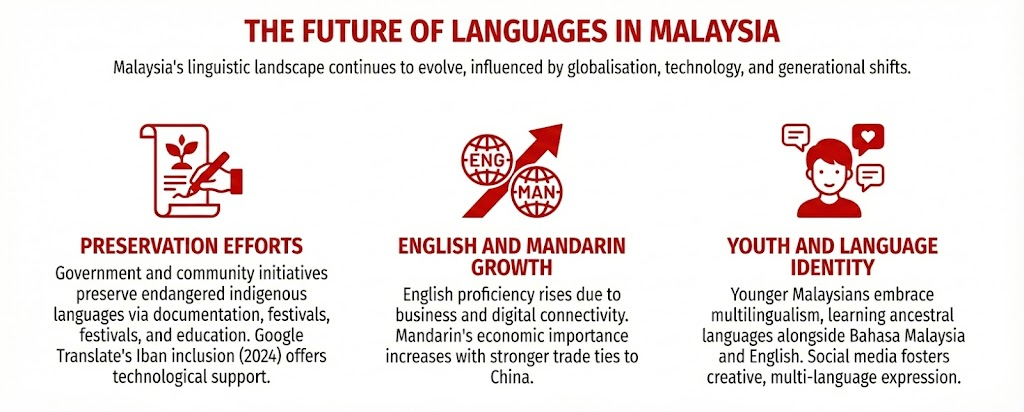
Malaysia’s linguistic landscape continues to evolve, influenced by globalisation, technology, and generational shifts.
Preservation Efforts
Government initiatives and community organisations work diligently to preserve endangered indigenous languages through documentation projects, cultural festivals, and educational programmes. The inclusion of languages like Iban in Google Translate (as of 2024) represents technological support for preservation efforts.
English and Mandarin Growth
English proficiency continues to grow, driven by international business demands and digital connectivity. Similarly, Mandarin’s economic importance increases as Malaysia strengthens trade relationships with China and Chinese-speaking markets.
Youth and Language Identity
Younger Malaysians increasingly embrace multilingualism as a source of pride, learning ancestral languages whilst maintaining fluency in Bahasa Malaysia and English. Social media platforms enable creative expression across multiple languages, fostering linguistic innovation and preservation simultaneously.
Practical Tips for Businesses Entering Malaysia
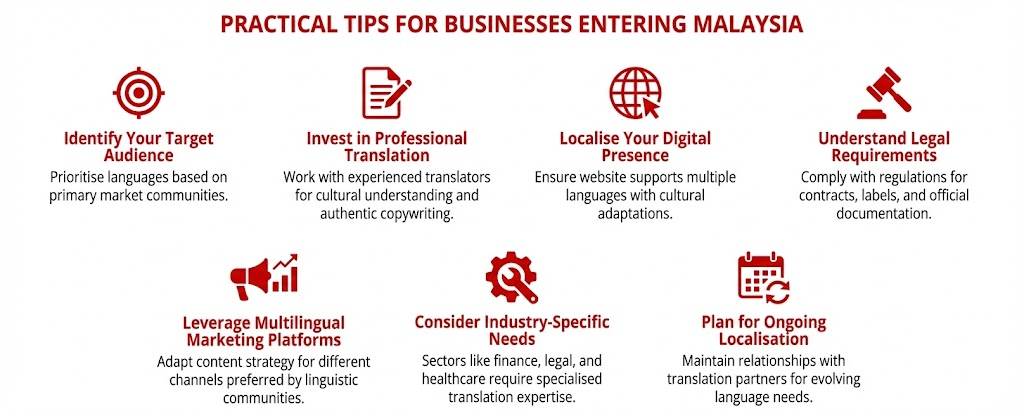
Successfully navigating Malaysia’s multilingual market requires strategic planning and cultural awareness:
- Identify your target audience: Determine which linguistic communities represent your primary market and prioritise languages accordingly.
- Invest in professional translation: Work with experienced translators who understand Malaysian culture, not just language mechanics. Professional copywriting services ensure your message resonates authentically.
- Localise your digital presence: Ensure your website supports multiple languages with appropriate cultural adaptations.
- Understand legal requirements: Comply with Malaysian regulations regarding language use in contracts, product labels, and official documentation.
- Leverage multilingual marketing platforms: Adapt your content strategy for different Asian marketing platforms, recognising that each linguistic community may prefer different channels.
- Consider industry-specific needs: Sectors like finance, legal services, and healthcare require specialised translation expertise that understands technical terminology.
- Plan for ongoing localisation: Language is dynamic; maintain relationships with translation partners who can update content as language use evolves.
Conclusion: Embracing Malaysia’s Linguistic Diversity
Malaysia’s 137 languages represent far more than communication tools; they embody centuries of cultural heritage, identity, and human connection. Understanding what language is spoken in Malaysia requires recognising that the answer is beautifully complex: Bahasa Malaysia serves as the official unifying language, English facilitates international business, Mandarin connects economic opportunities, Tamil preserves ancient cultural ties, and indigenous languages carry irreplaceable traditional knowledge.
For businesses seeking to succeed in Malaysia, linguistic and cultural competence isn’t optional; it’s essential. The most successful market entry strategies recognise that Malaysians navigate multiple linguistic worlds daily, code-switching effortlessly between languages based on context, audience, and purpose.
Whether you’re translating corporate documents, localising marketing campaigns, or simply trying to communicate more effectively with Malaysian partners, professional language services provide the cultural bridge needed for success. Malaysia’s multilingual landscape offers tremendous opportunities for those willing to invest in understanding and respecting its linguistic diversity.
By embracing this complexity and working with experienced language professionals, businesses can unlock Malaysia’s full market potential whilst building authentic connections with its diverse communities.
Ready to Connect with Malaysian Audiences?
Navigating Malaysia’s multilingual landscape requires expertise, cultural sensitivity, and strategic communication planning. Whether you need document translation, website localisation, marketing content creation, or interpreter services, professional language solutions ensure your message resonates authentically across Malaysia’s diverse communities.
Request your free quotation today and discover how expert translation services can help your business succeed in Malaysia’s dynamic multilingual market.