AI Translation Agency Asia: Your Complete Guide to Choosing the Right Partner
Quick Answer
An AI translation agency in Asia is a language service provider that pairs machine translation engines with human linguists to deliver accurate, culturally appropriate content across the region’s diverse languages. This hybrid model, often called machine translation plus post-editing, addresses gaps that generic AI tools leave in scripts, honorifics, and dialects unique to markets like Japan, China, and Thailand. Businesses rely on this approach for speed without sacrificing nuance. Industry data shows combined AI-human workflows now average over 94% accuracy across major Asian language pairs.
Key Takeaways:
- An AI translation agency in Asia blends machine translation speed with human linguistic accuracy through a hybrid MTPE workflow.
- Asia’s linguistic diversity, spanning scripts, dialects, and cultural norms, makes region-specific expertise essential for quality results.
- Hybrid translation offers faster turnaround and lower costs than fully manual translation while keeping cultural nuance intact.
- AI translation still has limits with idioms, humour, and legal or technical nuance, so human review remains important.
- Choosing an agency means checking for data security, industry expertise, and a transparent, staged translation process.
In This Article:
- What Is an AI Translation Agency?
- Why Asia Needs a Specialised Approach
- How AI Translation Actually Works
- AI Translation vs Human Translation: What’s the Difference?
- Benefits of Working With an AI Translation Agency in Asia
- Common Myths About AI Translation
- How to Choose the Right AI Translation Agency in Asia
- How to Order a Hybrid Solution from Elite Asia Singapore
- Where AI Translation Fits Across Industries
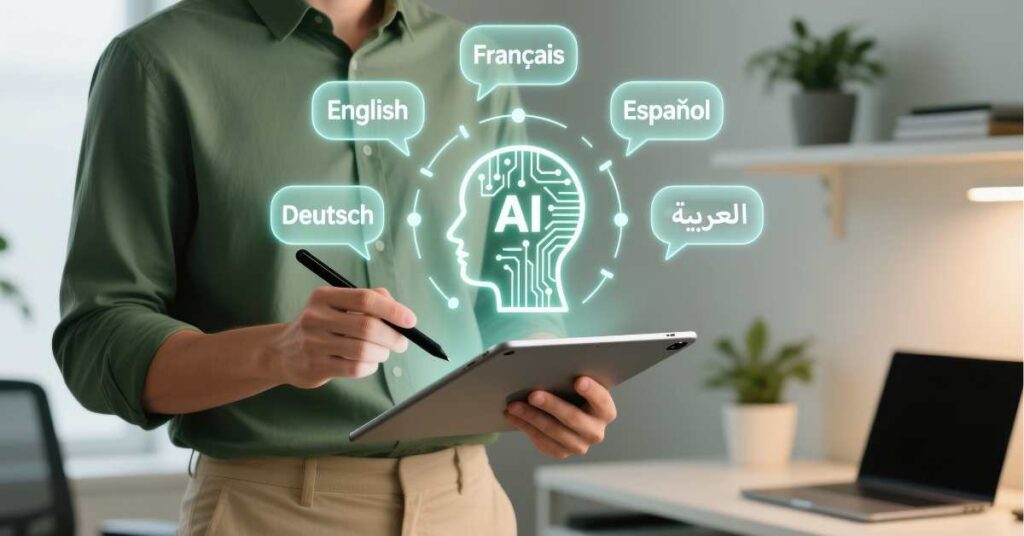
An AI translation agency in Asia combines machine translation technology with human linguists to convert content between languages quickly and accurately, while keeping cultural context intact. This hybrid approach has become the standard for businesses expanding across the region’s diverse markets, from Tokyo to Jakarta.
What Is an AI Translation Agency?
An AI translation agency is a language service provider that uses artificial intelligence tools, such as neural machine translation engines, alongside professional human translators to produce content in multiple languages. Rather than relying on AI alone, these agencies pair machine speed with human judgement to catch cultural nuances, tone, and industry-specific terms that software often misses.
This blended method is sometimes called machine translation plus post-editing, or MTPE. You can read more about how this process works step by step to understand why it has become the preferred workflow for high-volume projects.
THE BEST OF AI. THE TRUST OF HUMAN EXPERTISE.
Why choose one when you can have both? Our hybrid solutions combine the speed of AI with the cultural precision of native linguists.
- Hybrid Translation — AI-driven translation, refined by industry-specialist linguists
- Hybrid Transcription — automated voiceovers and captions that stay on-brand
- Hybrid Interpretation — host global events in any language, from any location
- AI Captioning — instant multilingual captions for meetings, webinars & beyond
Why Asia Needs a Specialised Approach
Asia is home to thousands of languages and dialects, each with its own writing systems, grammar rules, and cultural expectations. A single AI engine trained mostly on European languages often struggles with the structure of Japanese honorifics, the tonal nature of Thai, or the script differences between Simplified and Traditional Chinese.
This is why generic global tools frequently fall short in the region. Agencies based in Asia understand these local details firsthand, which helps them fine-tune AI outputs before human editors review the final text. The growing use of AI across the sector reflects this shift, as covered in a detailed look at how AI is transforming the translation industry in 2026.
Other Related Articles:
How AI Translation Actually Works
Modern AI translation relies on neural machine translation, a technology that uses layered algorithms to predict the most natural word choices based on context, not just direct word-for-word swaps. This differs from older rule-based systems that often produced stiff, robotic sentences.
The typical workflow inside a professional agency follows three stages:
- Preparation: files are analysed, glossaries are built, and the AI engine runs an initial draft using private translation memory.
- Post-editing: native linguists review, correct, and refine the machine output for tone, accuracy, and cultural fit.
- Finalisation: the content goes through proofreading, formatting, and a revision period before delivery.
For a deeper technical explanation, see how neural machine translation supports business content at scale. This structured process, sometimes run through a Translation Management System, is also outlined in the machine translation plus post-editing service overview.
AI Translation vs Human Translation: What’s the Difference?
Choosing between pure AI translation, human translation, or a hybrid mix depends on the project’s purpose, deadline, and budget. The table below breaks down the main differences.
| Factor | AI Translation Only | Human Translation Only | Hybrid (AI + Human) |
|---|---|---|---|
| Speed | Very fast | Slower | Fast |
| Cultural accuracy | Limited | High | High |
| Cost | Low | High | Moderate |
| Best for | Internal drafts, large data sets | Legal, marketing, creative content | Most business content |
| Consistency | High (with same engine) | Depends on translator | High, with quality checks |
A fuller breakdown of these trade-offs is available in the machine translation vs human translation comparison guide, which explains when each option makes the most sense for different content types.
Benefits of Working With an AI Translation Agency in Asia
Businesses that use a hybrid AI-human agency in Asia typically see several practical advantages over using either method alone.
- Faster turnaround on large volumes of content, since AI handles the first draft in seconds.
- Lower cost per word compared to fully manual translation, especially for repetitive or technical text.
- Consistent terminology across projects through shared glossaries and translation memory.
- Cultural accuracy maintained through native linguist review, avoiding awkward or offensive phrasing.
- Scalability for companies entering multiple Asian markets at once without hiring separate local teams.
Industry data shows AI translation systems now average over 94% accuracy across major language pairs when combined with human review, though results still vary by language complexity. This is one reason why more companies across the region are shifting towards artificial intelligence as part of their standard translation workflow, a trend explored in the rise of artificial intelligence in the translation industry.
Common Myths About AI Translation
Many people assume AI translation is either perfect or completely unreliable, but the reality sits somewhere in between. AI tools are excellent at handling volume and speed, yet they still make mistakes with idioms, humour, and highly technical or legal language.
This gap between expectation and reality is a common source of confusion for businesses new to the technology. A closer look at AI translation expectations versus reality explains where the technology genuinely helps and where human oversight remains essential.
How to Choose the Right AI Translation Agency in Asia
Not every provider offering “AI translation” delivers the same quality or service depth. Businesses should look for a few key markers before signing on with a partner.
- Hybrid workflow: the agency should combine machine translation with trained human post-editors, not rely on AI output alone.
- Regional language coverage: check that the agency genuinely supports the specific Asian languages and dialects your business needs.
- Industry expertise: look for linguists familiar with your sector, whether that’s legal, medical, financial, or marketing content.
- Data security: confirm the agency uses a private, secured translation engine rather than public tools that may store your data.
- Transparent process: a clear, staged workflow with defined revision periods signals a mature, reliable operation.
Understanding the wider landscape of translation methods also helps when evaluating vendors. The guide to 55 common types of translation is a useful reference for matching the right service type to your specific content needs.
How to Order a Hybrid Solution from Elite Asia Singapore
Elite Asia’s Hybrid Solution combines the speed and scale of AI technology with the accuracy of human linguists. Here is a step-by-step guide to getting started.
Step 1: Identify Your Hybrid Service Type
Visit the Elite Asia Hybrid Solution page and choose the service that best fits your business need:
| Service | What It Does |
|---|---|
| Hybrid Translation | Machine translation + post-editing by native linguists — ideal for large volumes of legal, financial, or technical content |
| Hybrid Transcription | Automated transcriptions, captions, and voiceovers created in minutes |
| Hybrid Interpretation | Remote conference interpreting via RSI (Remote Simultaneous Interpreting) and OPI (Over-the-Phone Interpreting) |
| AI Captioning | AI-powered real-time captioning, translation, and transcription for meetings and events |
Step 2: Prepare Your Files
Before submitting your project, ensure your source files are in a supported format. Elite Asia’s cloud-based Translation Management System (TMS) accepts a wide range of file types:
- Documents: DOC/DOCX, XLS/XLSX, PPT/PPTX, TXT, RTF, ODT
- Subtitles: SRT
- Images (via OCR): JPG, PNG, TIFF, BMP, GIF
- Web/Code: HTML, XHTML, PHP
- Localisation files: XML, Android XML, RESX, STRINGS
- Desktop publishing: IDML, MIF
- Bilingual interchange: XLIFF, SDLXLIFF, PO
Step 3: Request a Free Quote
Submit your project details through either of these two channels:
✅ Option A — Online Quotation Form
Go to eliteasia.co/request-free-quotation/ and select “Corporate” as your request type. Include the following details for the most accurate quote:
- Service type needed (Hybrid Translation, Transcription, Interpretation, or AI Captioning)
- Language pair(s) required
- File format and approximate word/page count
- Desired turnaround time
✅ Option B — Direct Contact / Client Portal
Log in or register at the Elite Asia Client Portal to upload documents directly and communicate with the team via Live Chat. Alternatively, reach the team at:
- 📞 Singapore: +65 6681 6717
- 📞 Hong Kong: +852 3904 1138
- 📞 Malaysia: +60 3 9212 8558
Step 4: Project Setup & Glossary Preparation
Once your order is confirmed, Elite Asia’s team begins the PREPARE stage:
- File analysis — the TMS analyses your document structure, word count, and format
- Glossary preparation — industry-specific terminology lists are built or updated to ensure consistency
- Machine Translation (MT) & Translation Memory (TM) — your files are run through Elite Asia’s private AI engine, which covers 17 language pairs including Simplified/Traditional Chinese, Japanese, Korean, major Southeast Asian languages, and European languages
Step 5: Post-Editing & Quality Review
The AI-generated output enters the POST-EDITING stage, handled by native linguists with domain expertise:
- Post-editing — a human linguist with industry knowledge reviews and refines the AI output
- Proofreading/Review — a second pass ensures accuracy, fluency, and cultural alignment
- Export from TMS — the finalised translation is exported in the original document format and layout
This hybrid workflow is 40–50% faster than traditional translation and reduces cost by 20–60%, without compromising quality.
Step 6: Client Review & Finalisation
The completed translation is submitted to you for review. Elite Asia provides a 4-week revision period to accommodate any feedback or changes needed. Once approved:
- Translation Memory (TM) is updated for future projects, ensuring cost savings on repeated content
- Final files are delivered in your original document format
Step 7: Optional — Platform Integration
For businesses with high-volume or ongoing translation needs, Elite Asia can establish a plug-in connection directly with your operating portal or CMS. This allows documents to flow automatically into the TMS without manual uploads, streamlining your entire localisation pipeline.
Where AI Translation Fits Across Industries
AI-assisted translation now supports a wide range of sectors across Asia, including e-commerce, legal services, finance, healthcare, and manufacturing. Companies use it for everything from product listings and user manuals to marketing materials and internal training documents.
As AI tools like large language models continue to mature, agencies are expanding their offerings beyond text translation into areas such as AI subtitling and multilingual content generation. This broader shift is discussed in a review of how AI translation technology is revolutionising language translation, which outlines how newer tools are reshaping client expectations.
Ready to see how a hybrid translation approach could work for your business? Explore Elite Asia’s Hybrid Translation Solution to learn how private AI translation combined with expert human linguists can support your regional growth.
Elite Asia’s team covers 30+ languages across Singapore, Malaysia, Hong Kong, Japan, South Korea, China, Taiwan, and Thailand — with full technical support, ISO 9001:2015 certification, and a dedicated MICE division ready to support your next event.
Frequently Asked Questions (FAQs)
1. Is AI translation reliable for business use in Asia?
AI translation is reliable for many business needs, especially when paired with human post-editing, though accuracy still depends on the language pair and content type.
2. What is the difference between machine translation and AI translation?
Machine translation is a type of AI translation. Modern systems use neural networks, a form of AI, to predict natural phrasing rather than translating word for word.
3. Which industries benefit most from AI translation in Asia?
E-commerce, legal, finance, healthcare, and manufacturing sectors benefit strongly, as they often need large volumes of accurate multilingual content quickly.
4. Can AI translation handle Asian languages accurately?
AI translation can handle many Asian languages well for general content, but complex scripts, honorifics, and dialects usually still require human review for full accuracy.
5. How much does hybrid AI translation cost compared to human translation?
Hybrid AI translation generally costs less than fully manual human translation because AI handles the first draft, reducing the time linguists spend on each project.

Last Modified:
Contact Us
Working across languages? Our team can support your company’s translation and interpretation needs. For business enquiries, get in touch to explore what fits your requirements.
Request a Quote