What Are the Most Spoken Languages in Vietnam? A 2026 Guide
Quick Answer
The most spoken languages in Vietnam are led by Vietnamese (Tiếng Việt), the official language and first language of roughly 85–88% of the population. Beyond the national tongue, the country hosts more than 110 languages across 54 officially recognised ethnic groups, with major minority languages including Tày, Thái, Mường, Hmong, and Khmer. English is the leading foreign language in business and education. Native Vietnamese speakers in the country number approximately 82 to 86 million.
Key Takeaways:
- Vietnamese is an Austroasiatic (Vietic) tonal language with six tones and a Latin-based script (Quốc Ngữ); roughly 50–70% of its vocabulary comes from Chinese loanwords.
- The Kinh majority is about 85.32% of the population; the other 53 ethnic groups make up roughly 14.6% (about 13.4 million people), and 96% of ethnic minorities still speak their mother tongue.
- Minority languages cluster by region—northern mountains (Tày, Hmong, Nùng), Central Highlands, and the Mekong Delta (Khmer)—while Vietnamese remains the national lingua franca.
- Foreign-language roles have shifted: French is largely a colonial legacy, Russian a Soviet-era skill among older elites, Chinese is rising with trade, and English now dominates business and education.
- Market success depends on more than word-for-word translation—regional dialect choice, cultural tone, platforms such as Zalo, and professional Vietnamese localisation all shape trust and conversion.
Vietnam’s rich linguistic landscape reflects centuries of cultural exchange and ethnic diversity. Whilst Vietnamese is the dominant language spoken by over 85% of the population, the country is home to more than 110 languages spoken by 54 officially recognised ethnic groups. This comprehensive guide explores the linguistic diversity that shapes modern Vietnam and its implications for businesses looking to enter this dynamic Southeast Asian market.
The Official Language of Vietnam
Vietnamese, known locally as Tiếng Việt, is the official language of the Socialist Republic of Vietnam. Approximately 85–88% of Vietnam’s population of over 100 million people speaks Vietnamese as their first language. As a result, the number of native Vietnamese speakers in the country is roughly 82 to 86 million, which makes Vietnamese the most widely spoken Austroasiatic language in the world, with three times as many speakers as Khmer, the second-largest language in this family.
The Vietnamese language belongs to the Austroasiatic language family, specifically within the Vietic branch. Its history is fascinating. Written initially using modified Chinese characters due to centuries of Chinese influence, the Vietnamese eventually developed their own script called Chữ Nôm. However, in the 17th century, Jesuit missionary Alexandre de Rhodes introduced the Latin-based alphabet system known as Quốc Ngữ, which remains in use today.
One of the most distinctive features of Vietnamese is its tonal nature. The language employs six tones, each capable of changing a word’s meaning entirely. These tones are represented by five tone marks placed above or below vowels. For English speakers and other non-tonal language speakers, mastering these tones presents one of the most significant challenges in learning Vietnamese. The six tones include the mid-level tone (thanh ngang), low falling tone (thanh huyền), high rising tone (thanh sắc), low rising tone (thanh hỏi), high broken tone (thanh ngã), and heavy tone (thanh nặng).
Understanding the importance of Vietnamese translation and interpretation services becomes crucial when you consider that between 50% and 70% of Vietnamese vocabulary derives from Chinese loanwords. This linguistic heritage reflects Vietnam’s complex history of cultural exchange whilst maintaining its distinct Austroasiatic roots.
Need Translation Done Professionally? Elite Asia Can Help!
Your trusted language partner across Asia since 2006 — ISO 9001:2015 certified.
- Certified & legal translation — accepted by official authorities
- 30+ languages — by experienced native linguists
- Dedicated project manager — every project, on time
- One-stop service — translation, interpreting, marketing, localisation
What Are the Top 3 Languages Spoken in Vietnam? Three Main Dialects
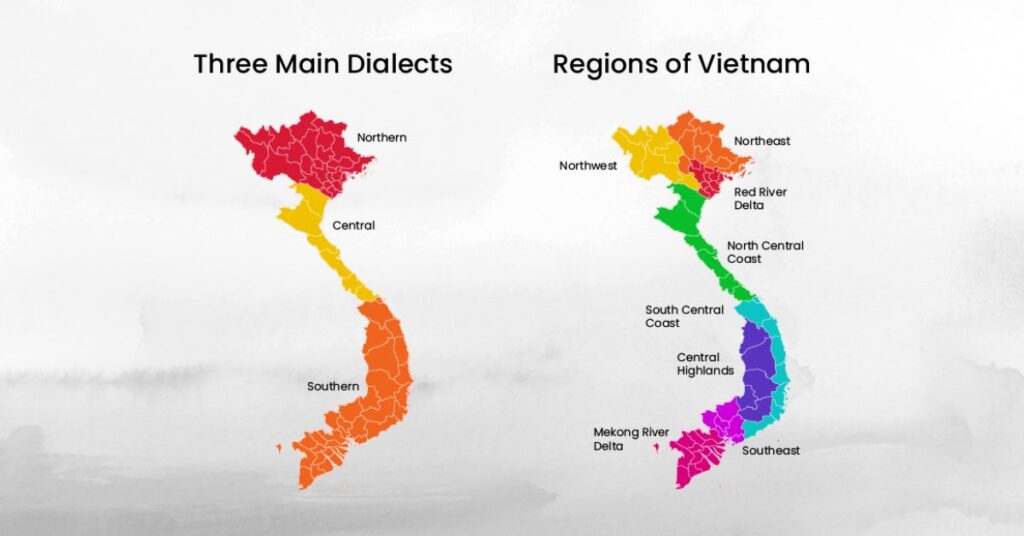
Vietnamese is not a monolithic language. Instead, it varies significantly across Vietnam’s three central geographical regions, each with its own distinct dialect.
Northern Dialect (Hanoi and Red River Delta)
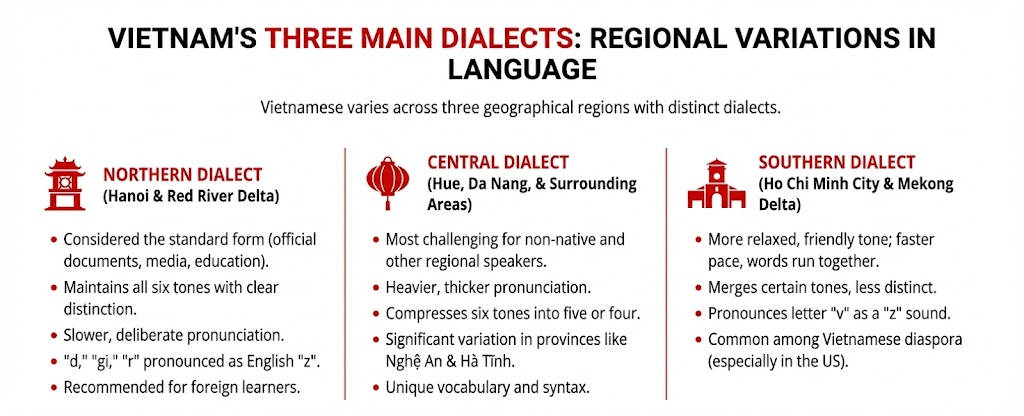
The Northern dialect, centred in Hanoi, Vietnam’s capital, is considered the standard form of Vietnamese. This dialect is used in official government documents, national television broadcasts, and educational materials throughout the country. The Northern dialect maintains all six tones with clear distinction and is characterised by slower, more deliberate pronunciation. Speakers pronounce certain consonants similarly, for instance, “d,” “gi,” and “r” all sound like the English “z”. This dialect is often recommended for foreign learners as it provides a strong foundation for understanding other regional variations.
Central Dialect (Hue, Da Nang, and Surrounding Areas)
The Central dialect is widely regarded as the most challenging for non-native speakers and even poses difficulties for Vietnamese people from other regions. This dialect features a heavier, thicker pronunciation and compresses the standard six tones into five or even four distinct tones. The Central region, particularly provinces like Nghệ An and Hà Tĩnh, displays significant pronunciation variations. Moving south towards Huế and Đà Nẵng, the accent becomes somewhat lighter but retains its distinctive character. The Central dialect also employs unique vocabulary and syntax that differ from those of both Northern and Southern dialects.
Southern Dialect (Ho Chi Minh City and Mekong Delta)
The Southern dialect, associated with Ho Chi Minh City and the expansive Mekong Delta region, has a more relaxed and friendly tone. Speakers tend to merge certain tones, making them less distinct than in the Northern dialect. The pace of Southern Vietnamese is notably faster, with words often running together in casual conversation. A distinctive feature is the pronunciation of the letter “v” as a “z” sound. Interestingly, the Southern dialect is more common among Vietnamese diaspora communities, particularly in the United States, as most Vietnamese refugees came from South Vietnam following the war in 1975.
For businesses expanding into Vietnam, understanding these regional differences is essential. Marketing localisation strategies must account for dialect variations to ensure messages resonate authentically with target audiences across different regions.
Other Related Articles:
Regions of Vietnam
Vietnam’s geography profoundly influences its linguistic landscape. The country stretches approximately 1,650 kilometres from north to south, with a distinctive S-shape along the eastern edge of the Indochinese Peninsula. At its widest point, Vietnam spans about 500 kilometres, whilst its narrowest section measures just 50 kilometres.
Northern Vietnam

Northern Vietnam encompasses the Red River Delta, the capital city of Hanoi, and mountainous areas, including the scenic region of Sapa. This region is home to the Northern dialect and features cooler weather with green terraced rice fields. The Red River Delta, covering approximately 16,700 square kilometres, provides fertile agricultural land that has supported dense populations for centuries. The mountainous Northwest region borders both China and Laos and is home to numerous ethnic minority groups who maintain distinct languages and cultures.
Central Vietnam

Central Vietnam is defined by the Annam Highlands (also known as the Trường Sơn Range), ancient cities such as Huế and Hội An, and beautiful coastal areas, including Đà Nẵng. This region stretches from Thanh Hóa province in the north to beyond the Hải Vân Pass in the south. The Central region’s challenging terrain historically limited contact between communities, thereby preserving unique dialects and minority languages. A chain of small, narrow deltas dots the central coast, totalling about 15,000 square kilometres.
Southern Vietnam
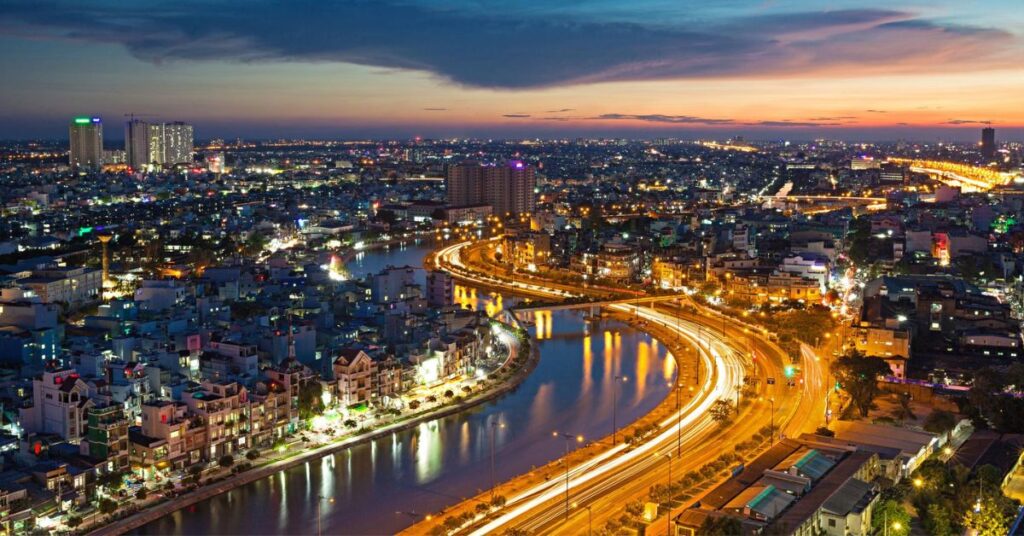
Southern Vietnam features the massive Mekong Delta, a complex system of rivers, canals, and waterways covering approximately 40,000 square kilometres. This region includes Ho Chi Minh City, Vietnam’s economic powerhouse and most populous urban centre. The Mekong Delta’s fertile land and intricate waterway network have made it Vietnam’s rice bowl and a centre of agricultural production. The region’s relative accessibility and economic opportunities have attracted diverse populations, creating a dynamic linguistic environment where the Southern dialect predominates.
Understanding Vietnam’s regional divisions helps explain patterns of language distribution. The localisation of business content must consider not only dialect differences but also regional cultural preferences and consumption patterns.
Minority Languages in Vietnam
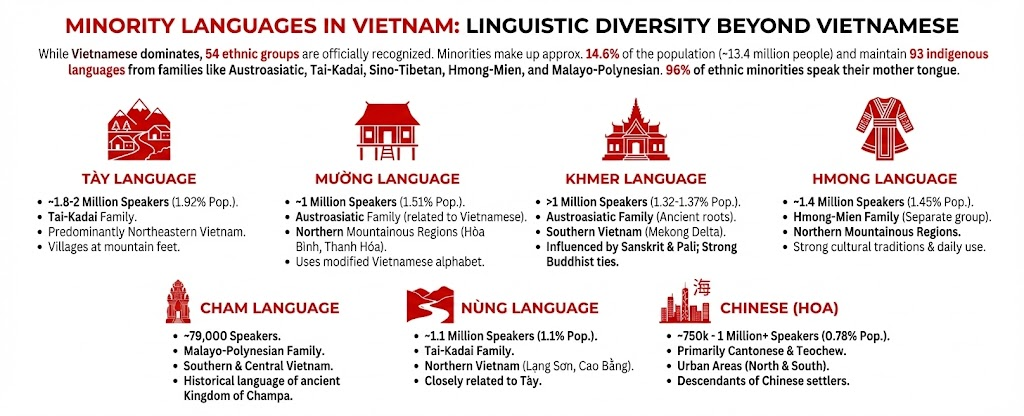
Whilst Vietnamese dominates as the lingua franca, Vietnam’s linguistic diversity extends far beyond its official language. The Vietnamese government officially recognises 54 ethnic groups, with the Kinh (ethnic Vietnamese) accounting for 85.32% of the population, according to the 2019 census. The remaining 53 ethnic minority groups, totalling approximately 14.6% of the population or about 13.4 million people, maintain their own distinct languages and cultural traditions.
These minority languages belong to several primary language families, including Austroasiatic, Tai-Kadai, Sino-Tibetan, Hmong-Mien, and Malayo-Polynesian. Remarkably, 96% of ethnic minorities continue to speak their mother tongue, demonstrating the resilience of Vietnam’s linguistic heritage. The country is home to 93 living indigenous languages, with a total of 110 languages when non-indigenous languages are included.
Tày Language
Tày represents one of the largest minority languages in Vietnam, with around 1.8 to 2 million speakers. The Tày people constitute 1.92% of Vietnam’s population. Their language belongs to the Tai-Kadai language family and is predominantly spoken in the northeastern regions of Vietnam, particularly in provinces near the China-Vietnam border. Tày communities typically establish villages at the feet of mountains, with settlements of about 15 to 20 households each.
Mường Language
The Mường language, spoken by approximately 1 million people (1.51% of the population), belongs to the Austroasiatic language family, like Vietnamese. In fact, Mường is closely related to Vietnamese, sharing many grammatical structures and vocabulary items. The Mường people primarily inhabit the mountainous regions of northern Vietnam, particularly in Hòa Bình and Thanh Hóa provinces. The language is written using a modified Vietnamese alphabet, facilitating some degree of literacy among speakers with formal Vietnamese education.
Khmer Language
More than 1 million people in Vietnam speak Khmer, representing 1.32% to 1.37% of the population. The Khmer community, often called Khmer Krom, primarily resides in southern Vietnam, particularly in the Mekong Delta region. Khmer is an Austroasiatic language with ancient roots dating back to the Khmer Empire of the 9th century AD. It is the second most widely spoken Austroasiatic language after Vietnamese. The Khmer language has been significantly influenced by Sanskrit and Pali, introduced through Buddhism and Hinduism. Most Vietnamese Khmer speakers practise Buddhism, maintaining strong cultural and linguistic ties with Cambodia.
Hmong Language
The Hmong people, representing 1.45% of Vietnam’s population with approximately 1,393,547 million speakers, primarily inhabit northern Vietnam’s mountainous regions. The Hmong language belongs to the Hmong-Mien language family, an entirely separate linguistic group from the Austroasiatic, Tai-Kadai, or Sino-Tibetan families. The Hmong community maintains strong cultural traditions and continues to use their language in daily life, despite increasing Vietnamese literacy rates.
Cham Language
Cham, a Malayo-Polynesian language, is spoken by approximately 79,000 people in southern and central Vietnam. The Cham language holds significant historical importance as it was the language of the ancient Kingdom of Champa, which flourished in central Vietnam from the 2nd century until the late 15th century. Whilst the Cham population is relatively small, their linguistic and cultural heritage represents an essential connection to Vietnam’s pre-Vietnamese history. The Cham language is classified within the Austronesian language family, linking it to languages spoken throughout maritime Southeast Asia and the Pacific.
Nùng Language
The Nùng people, representing 1.1% of the population with approximately 1,083,298 speakers, primarily live in northern Vietnam’s Lạng Sơn and Cao Bằng provinces. The Nùng language belongs to the Tai-Kadai language family and shares similarities with other Tai languages spoken in the region. The Nùng are closely related to the Tày, and their languages are mutually intelligible to varying degrees.
Chinese (Hoa)
The ethnic Chinese minority in Vietnam, known as Hoa, officially numbers around 749,466 people (0.78% of the population), though outside estimates suggest the actual number may exceed 1 million. Most Hoa descend from Chinese settlers who arrived from Guangdong province beginning in the 18th century. Consequently, most Hoa speak Cantonese, though there is also a significant Teochew-speaking population. The Chinese community primarily resides in urban areas in both northern and southern Vietnam, with substantial concentrations in major cities.
For companies looking to communicate effectively with Vietnam’s diverse population, professional content and document translation services must account for minority-language communities, especially when targeting specific regions or industries.
Language Usage Statistics
Understanding the statistical breakdown of language usage in Vietnam provides valuable insights for businesses, researchers, and policymakers.
Vietnamese Language Dominance
Vietnamese is spoken by 85% to 88% of Vietnam’s population as a first language. With Vietnam’s total population estimated at 100.3 to 105 million as of 2024-2026, this translates to approximately 82 to 86 million native Vietnamese speakers within the country. When including the Vietnamese diaspora, estimated at 4.5 million people living abroad, the total number of Vietnamese speakers worldwide reaches 90–95 million. Vietnamese is ranked 21st among the world’s most spoken languages by Ethnologue.
Ethnic Minority Language Distribution
Based on the 2019 census, Vietnam’s ethnic minority groups are distributed as follows:
- Kinh (ethnic Vietnamese): 85.32% (82,085,826 people)
- Tày: 1.92% (approximately 1.63 million)
- Thái: 1.89% (approximately 1.55 million)
- Mường: 1.51% (1,452,095 people)
- Hmong: 1.45% (approximately 1.07 million)
- Khmer: 1.32-1.37% (over 1.26 million)
- Nùng: 1.13% (approximately 969,000)
- Hoa (Chinese): 0.78% (approximately 820,000)
- Other ethnic groups: 3.7% (various smaller communities)
Geographic Distribution of Languages
Language distribution closely follows geographic patterns. Whilst Vietnamese is spoken throughout the country, ethnic minority languages concentrate in specific regions:
- Northern Midlands and Mountainous Areas: Home to approximately 7 million ethnic minority people (49.8% of all minorities)
- Central Highlands: Approximately 2.2 million ethnic minority people (15.6%)
- North and South-Central Coasts: Approximately 2.1 million ethnic minority people (14.7%)
- Mekong Delta: Significant Khmer-speaking population
About 86.2% of ethnic minority groups reside in rural areas, whilst only 13.8% live in urban areas. This rural concentration helps explain the preservation of minority languages, as rural communities often have less exposure to Vietnamese-medium education and media.
Multilingualism and Language Retention
Remarkably, 96% of ethnic minorities speak their mother tongue, demonstrating strong language retention across generations. However, most ethnic minority individuals are bilingual to some degree, using Vietnamese for official purposes, education, and inter-ethnic communication whilst maintaining their native language for home and community use.
Foreign Languages in Vietnam
Vietnam’s history of foreign influence and its increasing integration into the global economy have created a multilingual environment where several foreign languages play essential roles.
French: A Colonial Legacy
French colonisation of Vietnam, lasting from the mid-19th century until 1954, left an indelible mark on the country’s linguistic landscape. French was once the principal language of administration, education, and the elite class in Vietnam. Today, French is primarily spoken by the older generation who received their education during the colonial period or shortly thereafter.
Following independence and particularly after the 1975 reunification, French influence waned significantly. Not speaking French even became an act of cultural resistance for some Vietnamese. However, in recent years, a modest French revival has occurred. More than 5,000 Vietnamese enrol annually at the French Institute in Hanoi to learn French. This renewed interest stems from several factors: the arrival of French expatriates and entrepreneurs in Vietnam, foreign trade policies aimed at regaining French market share, and Vietnam’s membership in the Francophonie, the international organisation of French-speaking countries.
English: The Language of Business and Tourism
English has emerged as the most important foreign language in contemporary Vietnam, particularly in business, tourism, and education sectors. As Vietnam continues integrating into the global economy, English proficiency has become increasingly crucial for individuals and organisations.
According to the EF English Proficiency Index (EF EPI) 2023, Vietnam ranks in the moderate proficiency category with an EF EPI score of 505, placing 58th out of 113 countries and regions. However, this percentage varies significantly based on several factors:
- Urban vs Rural Divide: Major cities like Hanoi, Ho Chi Minh City, and Đà Nẵng have English-speaking populations ranging from 50% to 60%, whilst rural and remote regions show proficiency rates of only 20% to 30%.
- Age Differences: Younger Vietnamese, especially those aged 18 to 35, demonstrate higher English proficiency (55% to 65%) due to improved schooling and exposure to online learning platforms.
- Fluency Levels: Only about 5% to 10% of the population can communicate fluently in English, whilst around 30% to 45% possess basic to moderate skills.
English has been a compulsory subject in Vietnamese schools from primary through high school since the introduction of education reforms. However, traditional teaching methods that emphasise grammar and reading over speaking and listening, combined with limited access to native-speaking teachers, have constrained proficiency development.
English in the Workplace
The importance of English for employment cannot be overstated. Approximately 80% of job postings for mid-level positions require English proficiency. Candidates with strong English skills can earn 30% to 50% higher salaries than their non-English-speaking counterparts. This correlation between English proficiency and economic opportunity highlights the language’s significance in Vietnam’s rapidly growing economy.
Different industries show varying levels of English proficiency:
- IT and software development – 80%: typically the highest English proficiency; English is often required for documentation, coding resources, and working with overseas clients.
- Hospitality and tourism – 70%: high proficiency overall; frontline staff frequently use English with international visitors.
- Education (teachers and translators) – 65%: generally strong English skills, especially among language teachers and professional translators/interpreters.
- Manufacturing (export‑oriented) – 40%: moderate proficiency; English is more common among managers and staff dealing with foreign partners than among factory-floor workers.
- Construction and other skilled labour – 20-30% : usually the lowest English proficiency, with limited need for English in day-to-day tasks.
The Vietnamese government has launched several initiatives to boost English education, including the National Foreign Languages Project 2025, which aims to enhance English fluency amongst students and workers. Additionally, digital learning platforms such as Duolingo, Elsa Speak, and BBC Learning English have become increasingly popular for self-directed English study.
For businesses operating in Vietnam, providing multilingual website development and English-Vietnamese content ensures accessibility to both local and international audiences.
Russian: A Soviet-Era Connection
From 1975 to 1986, Russian dominated the foreign-language landscape in Vietnam, relegating other languages, such as Chinese, French, and, above all, English, to inferior status. This period coincided with Vietnam’s close ties to the Soviet Union and other socialist countries. Many young Vietnamese travelled to the Soviet Union for education and training during this era.
Russian is now primarily spoken by Vietnam’s military elite and older professionals who studied in Soviet institutions. Many higher-ranking officers in the Vietnamese military are fluent in Russian, having been sent to Russia for training and education. Those who learned Russian professionally often demonstrate higher proficiency than current Chinese learners because they studied it for extended periods in immersive environments. However, with the collapse of the Soviet Union and Vietnam’s subsequent economic reforms (Đổi Mới), Russia’s prominence has declined significantly.
Chinese: A Resurgent Influence
The Chinese maintained a limited presence in Vietnam’s foreign language landscape for approximately 30 years following the 1979 Sino-Vietnamese border war. However, since the late 2000s, Chinese has experienced renewed interest, particularly in the business sector. Vietnam’s growing economic ties with China, its largest trading partner, have driven this resurgence. Young Vietnamese increasingly study Chinese (primarily Mandarin) to access business opportunities, though the language has yet to achieve the widespread adoption seen with English.
Other Foreign Languages
Several other foreign languages maintain niche presences in Vietnam:
- Japanese and Korean: Increasingly popular due to investment from Japanese and Korean companies and cultural influence through entertainment media
- German and Spanish: Spoken by smaller populations, often linked to specific industries or educational programmes
Businesses seeking to establish a presence in Vietnam should consider how to localise their brand for the Asian market, taking into account these foreign-language influences and their varying regional impacts.
Importance of Vietnamese for Businesses
For companies seeking to expand into Vietnam, understanding the critical role of the Vietnamese language cannot be overstated. With 86.8% of Vietnam’s population speaking Vietnamese, the language serves as the gateway to reaching the vast majority of the market.
Consumer Behaviour and Language Preference
Research consistently demonstrates that language profoundly influences purchasing decisions. A remarkable 75% of consumers are more likely to buy products when information is available in their native language. This statistic underscores why businesses cannot rely solely on English to effectively penetrate the Vietnamese market.
Furthermore, localised advertising campaigns significantly outperform English-language alternatives. Studies show that 86% of localised advertising campaigns in Vietnam exceeded English campaigns in both click-through rates and conversions. This dramatic difference highlights the tangible return on investment that proper localisation delivers.
Market Growth and Economic Opportunity
Vietnam presents compelling economic opportunities for businesses. The country’s GDP is projected to surpass $600 billion by 2030, with economic growth rates hovering around 6.5% in 2025. Vietnam has emerged as one of Southeast Asia’s most attractive markets for international expansion, characterised by a young, tech-savvy population and a thriving digital economy.
The tourism sector alone demonstrates Vietnam’s growth trajectory. The country aims to attract 25 million international visitors in 2026, up from approximately 21.5 million in 2025, a 16% increase. This growth reflects stronger inflows from Northeast Asia, Southeast Asia, and selected long-haul markets. Tourism revenue is expected to reach approximately $43 billion (VND 1.12 quadrillion) in 2026.
Localisation: Beyond Basic Translation
Successful market entry requires far more than simple translation. Accurate business localisation involves adapting products, services, and content to resonate with Vietnamese cultural preferences, regional variations, and consumer behaviour patterns.
Key localisation considerations include:
- Regional Dialect Adaptation: Content must be adjusted to account for differences across Northern, Central, and Southern dialects. For instance, terms of address vary by region. Using “bạn” (you/friend) may work well in Ho Chi Minh City for casual contexts, whilst the more formal “quý khách” (valued customer) or “anh/chị” (Mr./Ms.) might be more appropriate in Hanoi, depending on the situation.
- Cultural Sensitivity: Vietnamese culture places a high value on respect for elders, family bonds, and hierarchical relationships. Marketing messages must align with these values to avoid cultural missteps.
- Platform Preferences: Vietnamese consumers heavily use both local and global social media platforms. Facebook, Zalo (a Vietnamese messaging app), and TikTok dominate the social media landscape.
Multilingual Customer Service
Providing customer service in Vietnamese is essential for building trust and ensuring effective communication. When customers can interact with businesses in their native language, inquiries, feedback, and concerns are addressed more promptly and effectively. This responsiveness directly translates to customer satisfaction and loyalty.
Many successful foreign companies in Vietnam have invested heavily in Vietnamese-language customer service teams and localised support materials. This investment demonstrates respect for Vietnamese culture and commitment to local partners, suppliers, and stakeholders.
B2B Communications
For business-to-business (B2B) operations, Vietnamese language proficiency is equally critical. Whilst many Vietnamese business professionals possess functional English skills, conducting negotiations and building relationships in Vietnamese shows respect and cultural awareness. Important legal documents, contracts, and compliance materials must be accurately translated into Vietnamese to ensure all parties understand their obligations and rights.
Companies should invest in professional website localisation services to ensure their digital presence effectively communicates with Vietnamese business partners and consumers.
The Importance of Linguistic Diversity
Vietnam’s linguistic diversity represents far more than mere statistics; it embodies the country’s rich cultural heritage and social complexity. Understanding and respecting this diversity yields significant benefits for society, government policy, and business operations.
Cultural Preservation and Identity
Each of Vietnam’s 110+ languages carries unique worldviews, traditional knowledge, and cultural practices that have developed over centuries. For ethnic minority communities, language serves as the primary vessel for transmitting cultural identity across generations. The fact that 96% of ethnic minorities continue speaking their mother tongue demonstrates the resilience of these linguistic traditions.
Language preservation efforts help maintain Vietnam’s cultural diversity amid rapid globalisation. The Vietnamese government officially recognises 54 ethnic groups, each with distinct languages, traditions, and customs. This recognition provides a framework for protecting minority language rights, though implementation varies across regions.
Economic Development and Inclusion
Linguistic diversity has important implications for economic development. Ethnic minority communities often inhabit remote mountainous regions with limited access to services, education, and economic opportunities. Language barriers can exacerbate these inequalities when government services, education, and business activities are conducted exclusively in Vietnamese.
Conversely, multilingual approaches to development can improve outcomes. Educational materials in minority languages, combined with Vietnamese language instruction, help students develop strong literacy skills in both languages. Bilingual government services ensure that minority communities can access healthcare, legal services, and social programmes effectively.
Businesses operating in regions with significant minority populations can benefit from employing multilingual staff who speak both Vietnamese and relevant minority languages. This approach builds trust with local communities and facilitates better business relationships.
Tourism and Cultural Exchange
Vietnam’s linguistic diversity presents opportunities for cultural tourism. Ethnic minority communities in regions such as Sapa, the Central Highlands, and the northern mountainous provinces attract tourists seeking to experience traditional lifestyles, crafts, and customs. Language plays a central role in these authentic cultural exchanges.
For tourism operators, understanding regional languages and cultural practices enhances the visitor experience whilst ensuring respectful interaction with minority communities. This cultural sensitivity contributes to sustainable tourism that benefits local populations rather than exploiting them.
National Unity and Cohesion
Whilst linguistic diversity enriches Vietnam, it also presents challenges for national unity. Vietnamese serves as the lingua franca, enabling communication across ethnic groups and regions. The education system, conducted primarily in Vietnamese, plays a crucial role in developing a shared national identity alongside ethnic identities.
Finding the balance between promoting national unity through a common language and preserving linguistic diversity represents an ongoing challenge for policymakers. Successful approaches typically involve recognising Vietnamese as the primary language for official purposes while supporting the maintenance of minority languages through education, media, and cultural programmes.
Businesses expanding throughout Southeast Asia should understand these dynamics. The localisation of marketing for Southeast Asian festive days demonstrates how cultural and linguistic awareness can drive successful campaigns.
Tapping into the Vietnamese Market?
Vietnam’s dynamic economy, growing middle class, and strategic location make it an increasingly attractive destination for international businesses. However, success in this market requires more than quality products and competitive pricing; it demands cultural intelligence, linguistic adaptation, and strategic localisation.
Market Entry Considerations
Companies entering the Vietnamese market must conduct thorough research to understand local consumer preferences, competitive dynamics, and regulatory requirements. Vietnam’s market exhibits significant regional variation, with different consumption patterns, price sensitivities, and brand preferences across Northern, Central, and Southern regions.
- Consumer Demographics: Vietnam’s population is remarkably young, with a median age in the mid-30s. This tech-savvy, digitally connected demographic consumes content across multiple platforms and expects seamless online experiences. They increasingly demand personalised, relevant content in their native language.
- E-commerce Growth: Vietnam’s e-commerce sector is experiencing explosive growth, creating opportunities for both domestic and international retailers. However, success requires localised websites, payment systems compatible with local preferences (including cash on delivery), and customer service in Vietnamese.
- Regulatory Compliance: Foreign businesses must navigate Vietnam’s evolving regulatory environment, including requirements for business licensing, product certification, and, in some cases, local partnerships. Legal and compliance documents must be accurately translated into Vietnamese to ensure complete understanding and compliance.
Strategic Localisation Approaches
Effective market entry requires comprehensive localisation strategies that extend beyond basic translation:
- Website and Digital Presence: Localising digital assets involves adapting not just language but also design elements, colour schemes, imagery, and user interface to Vietnamese preferences. Professional multilingual retail and e-commerce solutions ensure that online platforms deliver optimal user experiences.
- Marketing Communications: Marketing messages must be transcreated rather than translated. Transcreation involves recreating marketing content to evoke the same emotional response in the target audience whilst maintaining brand consistency. Successful campaigns in Vietnam often reference local cultural touchpoints, festivals, and values.
A compelling example is P&G’s Head & Shoulders campaign in 2021, which embraced common mispronunciations of the brand name across different Vietnamese regions. By partnering with local influencers and celebrating regional differences through humorous, relatable content, the campaign resonated nationwide. It earned P&G the Digital Marketing Strategy of the Year award in Vietnam.
- Product Adaptation: Sometimes localisation requires modifying products themselves to suit Vietnamese tastes, sizes, or preferences. Food products, cosmetics, and clothing often need adaptation to align with local preferences.
Building Local Partnerships
Successful companies in Vietnam typically establish strong local partnerships. Local partners provide invaluable insights into market dynamics, consumer behaviour, and business practices. They can help navigate regulatory complexities and develop distribution networks more efficiently than independent foreign companies.
Vietnamese business culture emphasises relationship-building and the development of trust over time. Business negotiations may progress more slowly than in Western markets, requiring patience and commitment to long-term partnerships. Understanding Vietnamese business etiquette and communication styles significantly improves negotiation outcomes.
For companies expanding across Asia, learning from examples such as Indonesia’s market expansion solutions can provide valuable insights into regional market-entry strategies.
Investment in Language Services
Companies serious about Vietnamese market success should invest in professional language services that go beyond basic translation:
- Professional Translation: Legal documents, technical manuals, marketing materials, and websites require translation by native Vietnamese speakers with relevant industry expertise.
- Interpretation Services: Business meetings, conferences, and negotiations benefit from professional interpretation. Face-to-face interpretation services enable smooth communication whilst helping businesses understand cultural nuances and non-verbal cues.
- Localisation Review: Native Vietnamese reviewers should assess all localised content to ensure cultural appropriateness, natural language usage, and alignment with regional preferences.
- Ongoing Language Support: As businesses grow in Vietnam, it ensures that new products, marketing campaigns, and customer communications maintain quality and consistency.
Technology and Innovation
Modern multilingual technologies can support market expansion efforts. Machine translation combined with post-editing by native linguists (MTPE) provides cost-effective solutions for high-volume content whilst maintaining quality. Translation management systems enable efficient coordination of multilingual content across platforms and markets.
However, technology should complement rather than replace human expertise. Understanding the difference between interpreters and translators helps companies select appropriate language services for different needs.
Measuring Success
Businesses should establish clear metrics to evaluate localisation success:
- Website analytics: Track engagement rates, bounce rates, and conversion rates for Vietnamese-language content compared to English content
- Customer feedback: Monitor customer satisfaction scores and feedback specifically related to language and communication
- Market penetration: Assess market share growth in target regions
- Brand awareness: Measure brand recognition and perception amongst Vietnamese consumers
How to Order a Language & Localisation Service from Elite Asia
Whether you need document translation, website localisation, subtitling, or certified translation, ordering from Elite Asia is straightforward. You have two main paths to get started — via the Client Portal or by requesting a free quotation directly.
Step 1: Explore the Languages & Services Available
Visit the Elite Asia Languages page to browse the full range of languages and localisation services offered. Elite Asia supports over 70 languages, covering major Asian and European languages, through a network of more than 10,000 professional linguists.
Step 2: Choose Your Service Type
Select the service that matches your project needs:
- Content & Document Translation – for business documents, legal papers, and marketing materials
- Website Localisation – adapt your site for a new market
- Subtitling Localisation – for corporate videos, presentations, and training content
- Software/App Localisation – for digital products entering new markets
- Certified Translation – for immigration, legal, and official authority use
- Interpretation – for business meetings and conferences
- Copywriting & Transcreation – for culturally adapted marketing content
Step 3: Choose Your Ordering Path
You can place your order through either of these two options:
✅ Option A — Request a Free Quotation (Recommended for First-Timers)
Go to eliteasia.co/request-free-quotation/ and fill out the online form. Elite Asia is transparent about pricing — there are no hidden surcharges. Your rate will be determined by:
- Language pair required (e.g. English to Bahasa Indonesia)
- Complexity of the source content
- Number of source words or pages
- Required turnaround time
Choose between a Corporate or Personal request type on the form, and provide as much detail about your project as possible for the most accurate quote. If you need a quote urgently, call +65 6681 6717 during office hours (GMT+8, Mon–Fri, 9 AM–6 PM).
✅ Option B — Order via the Client Portal
Sign up for a free account at the Elite Asia Client Portal. Once logged in, you can upload documents, access AI-powered translation and subtitling tools, and communicate directly with the team — all in one place.
Step 4: Upload Your Files
Whether you go through the quotation form or the Client Portal, upload your source files so the Elite Asia team can review the scope and begin processing your project. Supported file formats include .DOCX, .TXT, and .SRT (for subtitles).
Step 5: Connect with the Team
Use the portal’s Live Chat or reach the team directly via:
- 📧 Singapore: enquiry-sg@eliteasia.co | +65 6681 6717
- 📧 Hong Kong: enquiry-hk@eliteasia.co | +852 3904 1138
- 📧 Malaysia: enquiry-my@eliteasia.co | +60 3 9212 8558
Step 6: Confirm & Pay
Once the scope and pricing are agreed upon, proceed with payment. Elite Asia accepts PayPal and major credit cards online, with bank transfer available upon request. Payment via PayPal is secured with PCI Level 1 certification, the highest standard in the payment industry.
Step 7: Track Your Project & Receive Delivery
Use the Client Portal’s real-time project tracking to monitor progress, download completed files, and view your full order history at any time. You will be notified of updates throughout the process until final delivery.
Taking the Next Step
Companies ready to enter the Vietnamese market or expand their existing presence should partner with experienced language service providers who understand both linguistic and cultural nuances. Elite Asia’s Vietnamese translation and interpretation services provide comprehensive support for businesses navigating Vietnam’s complex linguistic landscape, ensuring that your message resonates authentically with Vietnamese audiences across all regions.
Whether you require website localisation, marketing transcreation, legal document translation, or on-site interpretation services, professional language partners can help you communicate effectively, build trust with Vietnamese stakeholders, and position your business for long-term success in one of Southeast Asia’s most dynamic markets.
Elite Asia’s team covers 30+ languages across Singapore, Malaysia, Hong Kong, Japan, South Korea, China, Taiwan, and Thailand — with full technical support, ISO 9001:2015 certification, and a dedicated MICE division ready to support your next event.



Frequently Asked Questions (FAQs)
1. What are the top languages spoken in Vietnam after Vietnamese?
The largest minority languages by speaker base include Tày, with about 1.8–2 million speakers; Thái; Mường, with more than 1 million speakers; Hmong; Khmer, with more than 1 million speakers; and Nùng. Chinese Hoa communities mainly use Cantonese or Teochew.
2. How many languages and ethnic groups does Vietnam have?
Vietnam officially recognises 54 ethnic groups and is home to more than 110 languages in total, including about 93 living indigenous languages.
3. Is English widely spoken in Vietnam?
English is the most important foreign language for business, tourism, and schools, but only about 5–10% of people communicate fluently. Urban rates are higher, at roughly 50–60% in major cities, than in rural areas, where rates are around 20–30%.
4. Do Northern, Central, and Southern Vietnamese differ a lot?
Yes. Hanoi’s Northern dialect is the standard used in government and education, while the Central dialect is often the hardest for outsiders to understand. Southern speech, used in Ho Chi Minh City and the Mekong Delta, is faster and merges some tones.
5. Why does Vietnamese matter for business localisation?
About 75% of consumers prefer buying when information is in their native language, and localised ads in Vietnam have been shown to outperform English campaigns on click-through and conversion metrics.

Last Modified:
Contact Us
Working across languages? Our team can support your company’s translation and interpretation needs. For business enquiries, get in touch to explore what fits your requirements.
Request a Quote