Is AI Translation Accurate Enough for Business in 2026?
Quick Answer
AI translation in 2026 delivers genuine advantages in speed, scale, and cost — but it still carries real limitations in accuracy, cultural nuance, and tone. Modern neural machine translation tools typically achieve 70–85% accuracy on standard content, compared to the 95–100% consistently delivered by professional human translators. For high-stakes business content, those gaps carry measurable risk. The most effective approach for most organisations today is a hybrid model that pairs AI efficiency with expert human post-editing.
Key Takeaways:
- AI translation accuracy in 2026 ranges from 82% to 96% depending on the engine, language pair, and content type
- Human translators still reach 98–99% accuracy and remain essential for legal, medical, and financial documents
- Consensus-based AI systems using 22+ engines reduce critical translation errors by up to 90% compared to single-engine tools
- 46% of companies with global customers are already integrating machine translation into their workflows
- A hybrid AI + human model delivers the best balance of speed, cost, and quality for B2B teams
In This Article:
- What Is AI Translation and How Does It Work in 2026?
- How Accurate Is AI Translation in 2026?
- AI Translation Accuracy by Content Type
- The Role of Language Pairs in AI Accuracy
- Common AI Translation Errors That Cost Businesses Money
- The Rise of Hybrid AI + Human Translation
- Key AI Translation Trends in 2026
- When Should B2B Companies Use AI Translation?
- AI Translation vs Human Translation: A Practical Comparison
- Why Elite Asia Is the Right Partner for AI-Powered Translation
- Frequently Asked Questions (FAQs)
What Is AI Translation and How Does It Work in 2026?
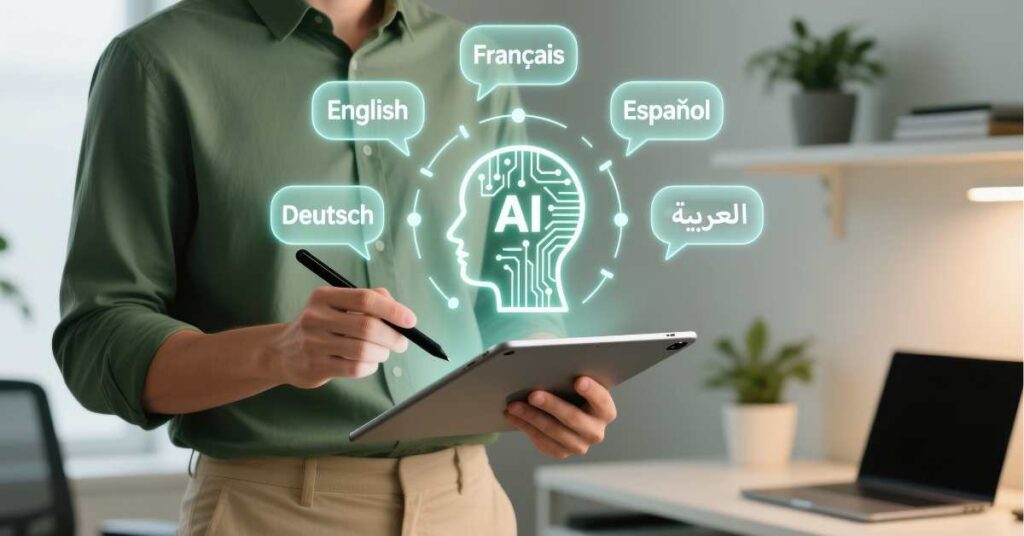
AI translation uses machine learning algorithms to convert text or speech from one language to another — automatically and at scale. Unlike the old dictionary-based systems, today’s tools use Neural Machine Translation (NMT) and Large Language Models (LLMs) to process whole sentences, understand context, and even handle cultural nuances.
The technology has evolved through four key stages: Rule-Based Machine Translation (RBMT) in the 1950s, Statistical Machine Translation (SMT) in the 2000s, Neural Machine Translation from 2016, and the current era of Large Language Models like GPT-4 and Gemini. To understand these mechanics in detail, read how AI translation works and whether it is truly helpful in 2026.
In 2026, AI translation systems average 94.2% accuracy across major language pairs, with user satisfaction scores of 4.3 out of 5. However, this headline figure can be misleading — and for businesses, the details matter far more than the average.
How Accurate Is AI Translation in 2026?
AI translation accuracy is not a single number. It shifts significantly based on three factors: the engine used, the language pair, and the type of content being translated.
Here is a breakdown of where AI stands today:
| Factor | AI Accuracy Range | Human Accuracy |
|---|---|---|
| Major language pairs (e.g. EN-ES, EN-FR) | 90–96% | 98–99% |
| Distant pairs (e.g. EN-JA, EN-ZH) | 70–80% of human quality | 98–99% |
| Low-resource languages (e.g. Burmese, Lao) | 50–65% of human quality | 98–99% |
| Legal and compliance documents | 78–85% (single engine) | 98–99% |
| Technical manuals | Up to 94% | 98–99% |
| Marketing and brand content | Varies widely | 98–99% |
Benchmark scores can also overstate real-world performance. Research from Google and Boston University warns that AI translation benchmarks may overstate performance due to data contamination in training sets. This is why relying purely on a tool’s headline accuracy number — without testing it on your specific content type — is a risk businesses should avoid.
For a full breakdown of accuracy rates across content categories, see the AI Translation Accuracy Rate guide for 2026.
THE BEST OF AI. THE TRUST OF HUMAN EXPERTISE.
Why choose one when you can have both? Our hybrid solutions combine the speed of AI with the cultural precision of native linguists.
- Hybrid Translation — AI-driven translation, refined by industry-specialist linguists
- Hybrid Transcription — automated voiceovers and captions that stay on-brand
- Hybrid Interpretation — host global events in any language, from any location
- AI Captioning — instant multilingual captions for meetings, webinars & beyond
AI Translation Accuracy by Content Type
Not all business content carries the same level of risk. The right approach depends on what you are translating.
Legal and Compliance Documents
AI still struggles with nested conditional clauses, liability language, and regulatory terms. Even consensus-based models — which use multiple AI engines and compare outputs — show 18–22% fewer critical errors than single-engine tools. Despite this improvement, human review remains essential for contracts, regulatory filings, and compliance submissions.
Technical Manuals and Product Documentation
AI performs well here, particularly for content with controlled vocabulary and repetitive sentence structures. DeepL and similar tools excel with precise terminology. Studies show 30–100% productivity gains when translators post-edit AI-generated first drafts compared to translating from scratch.
Marketing and Brand Content
This is where Large Language Models like ChatGPT perform most competitively — handling tone adaptation, cultural flavour, and creative phrasing. However, output quality can vary from one attempt to the next, making human review important for anything brand-critical.
Customer Support and E-Commerce
AI handles high-volume, time-sensitive content well in this category. Standard product descriptions, return policies, and FAQ content generally produce good results — as long as someone reviews anything with conditional phrasing or brand voice requirements.
Other Related Articles:
The Role of Language Pairs in AI Accuracy
Language pair selection is one of the biggest factors affecting AI translation quality. English-to-Spanish, English-to-French, and English-to-German pairs benefit from enormous training data and consistently achieve the highest accuracy scores.
For distant language pairs — such as English to Japanese, Chinese, or Arabic — significant quality gaps remain. AI achieves roughly 70–80% of human translation quality in these pairs due to structural and typological differences between the source and target languages.
Low-resource languages face the greatest challenges. Languages such as Swahili, Bengali, Burmese, Khmer, and Lao see AI achieving only 50–65% of human quality scores — mainly because of limited parallel training data. For businesses expanding into Southeast Asia, this is a critical consideration. Explore the language and localisation roadmap for expanding into Southeast Asia to navigate these challenges effectively.
Common AI Translation Errors That Cost Businesses Money
Understanding where AI fails helps businesses protect themselves. The most dangerous and costly error types in 2026 include:
- Negation errors — Mishandling of “not,” “never,” or “except” clauses; single engines range from 72–81% accuracy on negations
- Number and measurement errors — Dates, decimals, currency, and dosages; consensus models achieve 94% accuracy vs. 78–85% for single engines
- Omissions — Dropped clauses, missing conditions, or lost safety warnings; consensus approaches reduce omissions by 40%
- Terminology inconsistency — Specialised vocabulary used differently across the same document
- False fluency — Output that reads naturally but carries the wrong meaning
The financial impact is real. Detecting and correcting a single critical error takes 25–75 minutes of professional time. For organisations processing over 100 documents a month, annual rework costs can reach $5,000–$20,000. Compliance failures in regulated industries can trigger fines starting at $10,000, and contract liability misinterpretations can cost $50,000 or more in legal fees.
To understand how quality assurance processes can prevent these errors at scale, learn how professional translation teams ensure quality from briefing to delivery.
The Rise of Hybrid AI + Human Translation
The most effective B2B translation workflows in 2026 do not choose between AI and humans — they combine both. This approach, known as Machine Translation Post-Editing (MTPE), uses AI to generate a first draft and trained human linguists to review, refine, and verify the output.
A 2024 Forrester study found that implementing quality AI translation reduced translation time by 90% and cut workloads by 50%, resulting in a 345% ROI for early adopters. These results are only achievable when the AI foundation is reliable enough to produce usable first drafts — which is why engine selection and quality configuration matter so much.
The hybrid model is not a compromise. AI handles speed and volume; humans handle nuance, legal precision, and cultural adaptation. Together, they deliver results that neither can achieve alone.
Maintaining consistency across these workflows is made far easier with structured linguistic assets. Discover how Translation Memory and Glossaries help enterprises cut costs and stay consistent.
Key AI Translation Trends in 2026
Several developments are actively shaping AI translation accuracy this year:
Consensus-Based Translation Systems
Rather than relying on a single engine, consensus systems compare outputs from 22 or more AI models and select the version most agreed upon. This approach reduces critical errors by up to 90% and is rapidly becoming the industry standard for business-critical content.
Custom Domain Models
Businesses can now train AI models on their own terminology, past translations, and brand glossaries. Custom models consistently achieve over 90% acceptance rates — on par with human translation — within their specific domain.
Real-Time Speech Translation
End-to-end speech-to-speech (S2ST) translation with sub-2–3 second latency is now viable for live meetings, customer support calls, and webinars. Google’s S2ST demonstrations have accelerated demand for audio-first localisation.
Automatic Post-Editing and Quality Estimation
AI now routes content intelligently — sending high-confidence segments straight to publication whilst flagging uncertain segments for human review. This reduces unnecessary editing time and focuses human effort where it matters most.
Regulatory Scrutiny on AI Translation
Governments and regulators are beginning to scrutinise AI translation outputs, especially in healthcare, finance, and legal sectors. Hallucination risks, accuracy transparency, and liability for AI errors are all emerging compliance considerations in 2026.
When Should B2B Companies Use AI Translation?
Not every business document needs the same level of scrutiny. A practical tiering approach helps teams allocate resources effectively:
High-Stakes Content — Human Review Required
Legal contracts, regulatory submissions, medical documentation, financial disclosures, certified translations, and public-facing content with brand implications. AI can generate the first draft, but human sign-off is essential.
Medium-Stakes Content — AI + Light Human Review
Help articles, onboarding documents, UI strings, internal knowledge base content, and product documentation. AI performs well here with a light editorial pass.
Low-Stakes Content — AI Only
Internal communications, user-generated content, quick summaries of inbound emails, and informal content where meaning transfer is the primary goal.
For businesses managing multilingual content at scale, pairing this decision framework with a solid SEO translation strategy ensures your content performs in every market you enter. Read the complete guide to SEO translation for 2026.
AI Translation vs Human Translation: A Practical Comparison
| Factor | AI Translation | Human Translation |
|---|---|---|
| Speed | Seconds to minutes | Hours to days |
| Cost | Low per word | Higher per word |
| Accuracy (general content) | 82–96% | 98–99% |
| Legal/medical accuracy | Requires human review | Gold standard |
| Cultural nuance | Limited | Strong |
| Consistency at scale | Good (with TM) | Depends on team |
| Real-time capability | Yes | No |
| Best for | Volume, first drafts, low-stakes | High-stakes, creative, certified |
Why Elite Asia Is the Right Partner for AI-Powered Translation
Elite Asia combines proprietary AI translation technology with a network of professional human linguists to deliver the accuracy, speed, and cultural precision that B2B clients require.
Here is what sets Elite Asia apart:
- Hybrid AI + Human Workflow — AI handles volume and speed; expert linguists handle nuance, legal precision, and brand voice
- Dynamic Translation Memory and Glossaries — Your linguistic assets are continuously updated to ensure consistency across every project
- Multi-Language Coverage Across Asia — Specialised in Southeast Asian, East Asian, and South Asian language pairs, where AI accuracy gaps are most significant
- Industry-Specific Expertise — Dedicated linguists covering legal, medical, technical, and financial verticals
- Secure, Scalable Delivery — Enterprise-grade project management with real-time collaboration tools and confidentiality protocols
- End-to-End Quality Assurance — Multi-stage review processes that catch errors before they become costly problems
- ISO 9001:2015 Certified — Covering 30+ languages across Singapore, Malaysia, Hong Kong, Japan, South Korea, China, Taiwan, and Thailand
Whether you need fast, high-volume AI-assisted translation or carefully reviewed human-led localisation, Elite Asia’s hybrid solution is built to scale with your business.
🔗 Ready to Improve Your Translation Accuracy?
Discover how Elite Asia’s hybrid translation solution can help your business communicate with confidence across every language and market.
Explore Elite Asia’s Hybrid Translation Solutions →
Elite Asia’s team covers 30+ languages across Singapore, Malaysia, Hong Kong, Japan, South Korea, China, Taiwan, and Thailand — with full technical support, ISO 9001:2015 certification, and a dedicated MICE division ready to support your next event.
Frequently Asked Questions (FAQs)
For general and internal business content, AI translation is accurate enough — especially when combined with human post-editing. For legal, medical, financial, or certified documents, AI alone is not sufficient and human review remains essential.
Leading AI translation engines achieve 82–96% accuracy across major language pairs. Consensus-based systems that aggregate outputs from 22 or more engines currently lead all benchmarks, reducing critical errors by up to 90% compared to single-engine tools.
Low-resource languages — including many Southeast and South Asian languages such as Burmese, Khmer, and Lao — present the greatest challenges. AI achieves only 50–65% of human quality scores for these languages due to limited training data. Distant language pairs like English-Japanese or English-Arabic also show significant accuracy gaps.
AI translation is faster and cheaper but less reliable for complex, specialised, or culturally sensitive content. Human translation delivers 98–99% accuracy, essential for legal contracts, regulatory filings, and brand-critical materials. The hybrid model — AI for speed, human for precision — is the preferred approach for most B2B teams in 2026.
MTPE is a workflow where AI generates a translation first draft, and a trained human linguist then reviews, corrects, and refines the output. Studies show MTPE reduces translation time by up to 90% and cuts costs by up to 50% compared to fully human translation, whilst maintaining near-human quality standards.

Last Modified:
Contact Us
Working across languages? Our team can support your company’s translation and interpretation needs. For business enquiries, get in touch to explore what fits your requirements.
Request a Quote