Mandarin Colors Explained: Your Guide to Colors in Chinese
Quick Answer
Chinese colours are culturally coded meanings tied to Mandarin colour words, the Five Elements (Wǔxíng), and Yin–Yang philosophy—not mere visual labels. Red signals luck and celebration, yellow and gold mark imperial prestige and wealth, while white and black can mean purity or mourning depending on context. Cyan/blue-green (青, qīng), red, yellow, white, and black form the five cardinal colours. Each pairs with one of the five elements: Wood, Fire, Earth, Metal, and Water.
Key Takeaways:
- Mandarin’s word for colour is 颜色 (yán sè); 色 (sè) is often dropped in casual speech, so 红 can stand alone for “red.”
- Red and gold are the most auspicious pairing for celebrations, product launches, and Chinese New Year marketing.
- Yellow was once reserved for the emperor and still evokes authority and prestige; gold stresses material wealth more than cosmic status.
- White means purity in some philosophical frames but mourning in social practice—opposite traditional Western wedding white—so context is critical.
- Colour choices in logos, packaging, and gifts act as strategic signals in Chinese-speaking markets and can build trust or cause lasting offence.
In This Article:
- 颜色 Yán Sè: How to Say Colours in Chinese
- 金属 Jīnshǔ: How to Say Metals in Chinese
- The Special Meaning of Colours in Traditional Chinese Culture
- Degrees of Colours
- More 10 Obscure Colours in Chinese
- Chinese Lucky Colours and What They Mean
- Why Colour Symbolism Matters for Businesses
- Dos and Don’ts of Using Colour in China
- How to Use Chinese Colours in Sentences
- Useful Dialogues With Chinese Colours
- FAQs
- How to Order a Language & Localisation Service from Elite Asia
- Conclusion
Colour is never just decoration in Chinese culture. Every shade carries centuries of meaning — rooted in ancient philosophy, imperial history, and deeply held beliefs about luck, health, and the natural world. Whether you are learning Mandarin, planning a trip to China, or expanding your business into Chinese-speaking markets, understanding colours in Chinese is far more valuable than it might first appear. This guide covers everything: how to say colours in Mandarin, what they symbolise, and how to use them in real conversation.
颜色 Yán Sè: How to Say Colours in Chinese
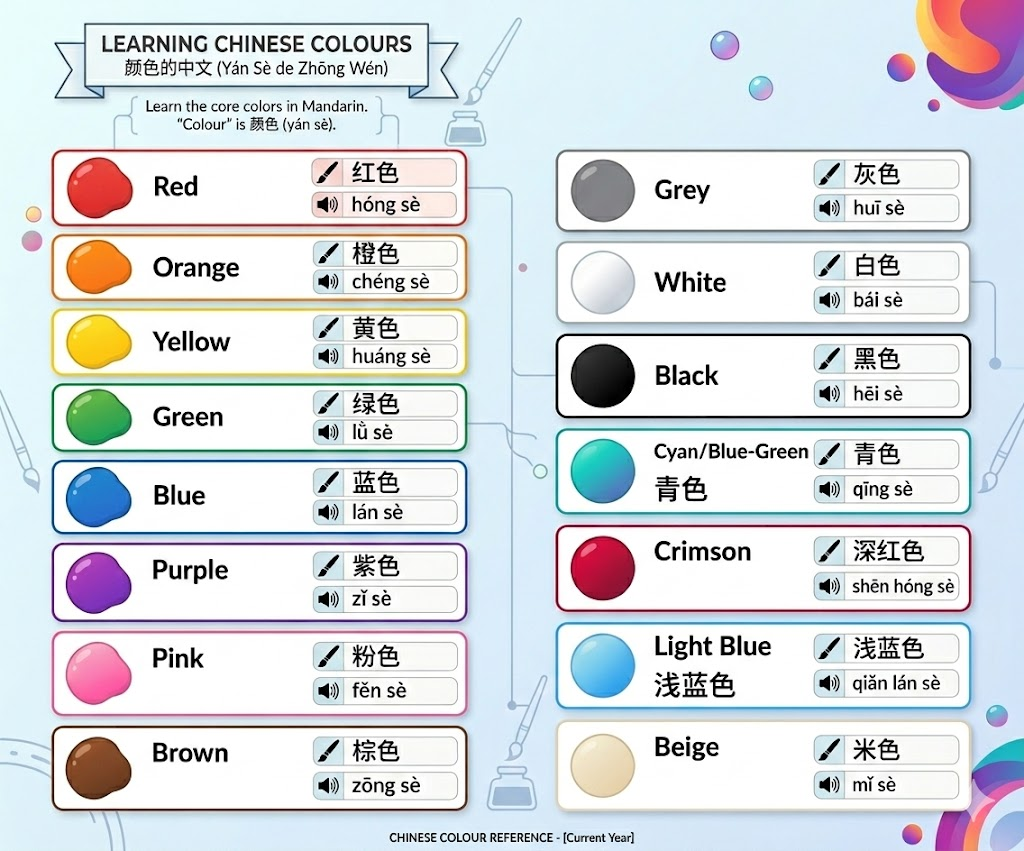
The Mandarin word for “colour” is 颜色 (yán sè). Below is a comprehensive table of the most common colours in Chinese, including their characters and Pinyin transliterations.
Note that the word 色 (sè) means “colour” and is often dropped in casual speech. So instead of saying 红色 (hóng sè), a native speaker might just say 红 (hóng). Both are correct.
Understanding the Chinese vs Japanese vs Korean differences can also help you appreciate why the same character can carry different cultural weight across East Asian languages.
Need Translation Done Professionally? Elite Asia Can Help!
Your trusted language partner across Asia since 2006 — ISO 9001:2015 certified.
- Certified & legal translation — accepted by official authorities
- 30+ languages — by experienced native linguists
- Dedicated project manager — every project, on time
- One-stop service — translation, interpreting, marketing, localisation
金属 Jīnshǔ: How to Say Metals in Chinese
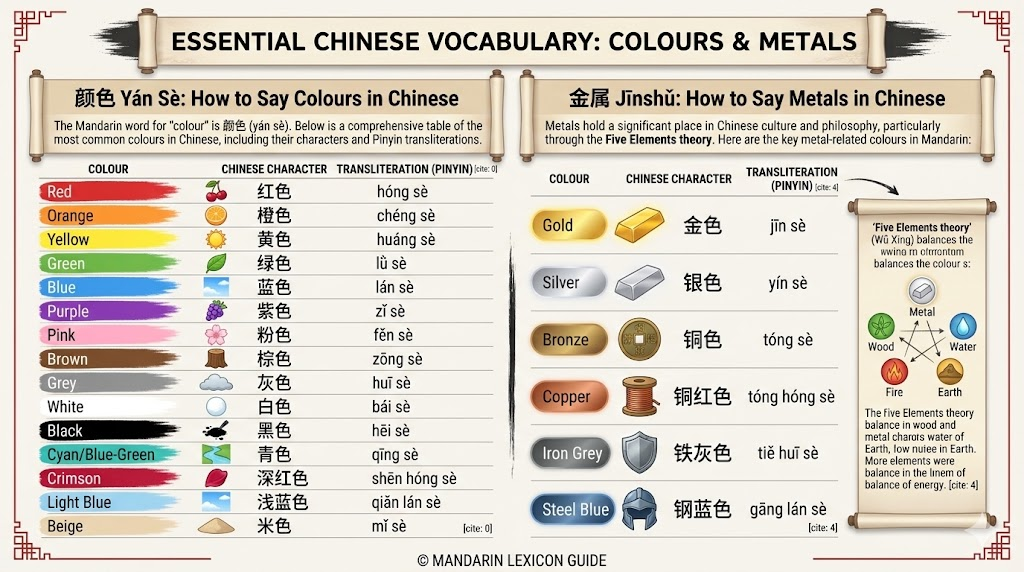
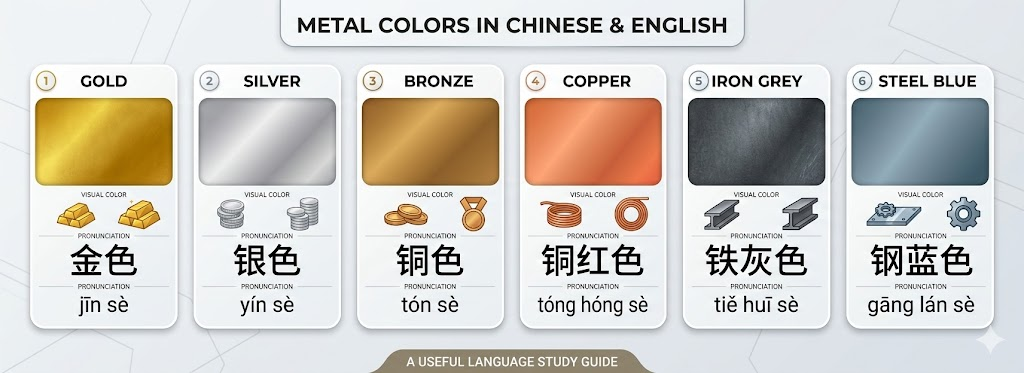
Metals hold a significant place in Chinese culture and philosophy, particularly through the Five Elements theory. Here are the key metal-related colours in Mandarin:
Gold (金色, jīn sè) is particularly important — it is associated with wealth, prosperity, and imperial power. It differs slightly from yellow (黄色, huáng sè) in that gold carries a more material and celebratory connotation, while yellow is tied to cosmic and political authority. You will see gold used extensively during Chinese New Year decorations, on temple doors, and in formal calligraphy.
Other Related Articles:
The Special Meaning of Colours in Traditional Chinese Culture
Colours in Chinese culture are not arbitrary. They are embedded within two major philosophical systems that have shaped Chinese thought for thousands of years: the Theory of the Five Elements and the principle of Yin and Yang. Understanding these frameworks unlocks the deeper logic behind colour symbolism in China.
As Elite Asia’s guide on the most difficult languages in the world notes, language and cultural context are inseparable — and nowhere is this truer than in Chinese colour meaning.
1. 五行 Wǔxíng: The Theory of the Five Elements
The Five Elements (五行, wǔxíng) — Wood, Fire, Earth, Metal, and Water — form the backbone of traditional Chinese cosmology. Each element is paired with a “cardinal colour,” a direction, a season, a planet, and a set of virtues. These are not merely symbolic; historically, Chinese emperors used this theory to select the colours of their robes, palace walls, flags, and ceremonial objects.
| Element | Chinese Character | Corresponding Colour |
|---|---|---|
| Wood (木) | 木 mù | Cyan/Blue-Green (青 qīng) |
| Fire (火) | 火 huǒ | Red (红 hóng) |
| Earth (土) | 土 tǔ | Yellow (黄 huáng) |
| Metal (金) | 金 jīn | White (白 bái) |
| Water (水) | 水 shuǐ | Black (黑 hēi) |
These five colours — cyan, red, yellow, white, and black — are considered the cardinal colours of Chinese culture. All other colours were historically regarded as secondary or “inferior” by Confucian writers. This framework continues to influence Chinese art, architecture, medicine, fashion, and even digital branding today.
Elite Asia’s article on the oldest languages in the world provides further context on how deeply ancient philosophical frameworks shaped East Asian civilisation.
2. Yin (阴) and Yang (阳)
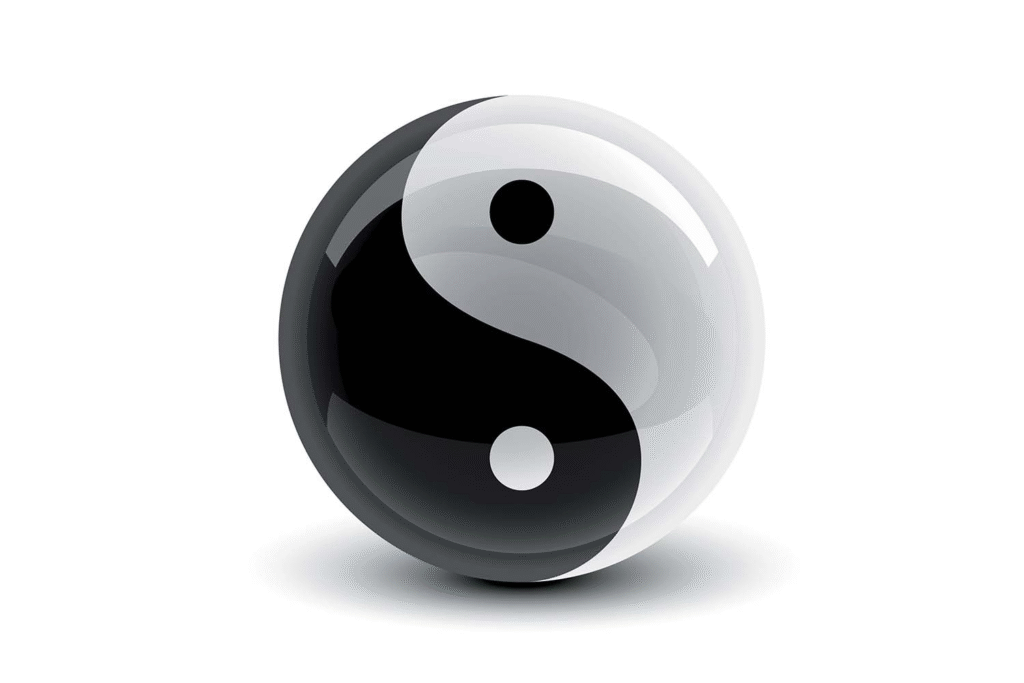
The principle of Yin and Yang represents the dual nature of all things — dark and light, passive and active, feminine and masculine. In terms of colour, black is associated with Yin (阴), representing depth, receptivity, and the unknown, while white is associated with Yang (阳), representing brightness, clarity, and action.
The iconic taijitu (太极图) — the circular black-and-white symbol — visually encapsulates this principle. Each half contains a dot of the opposite colour, showing that Yin and Yang are not opposites in conflict but complementary forces in constant balance. This is why both black and white carry complex, context-dependent meanings in Chinese culture — neither is simply “good” or “bad.”
Degrees of Colours
Like English, Mandarin uses modifiers to express lighter and darker shades. The two most common are:
- 浅 (qiǎn) — light/pale. Example: 浅蓝色 (qiǎn lán sè) = light blue
- 深 (shēn) — dark/deep. Example: 深红色 (shēn hóng sè) = dark red / crimson
You can also add intensity with:
- 鲜艳 (xiānyàn) — bright/vivid. Example: 鲜艳的红色 = vivid red
- 暗 (àn) — dim/muted. Example: 暗绿色 (àn lǜ sè) = muted green
These modifiers work with virtually any colour and are essential for natural, descriptive Mandarin speech.
More 10 Obscure Colours in Chinese
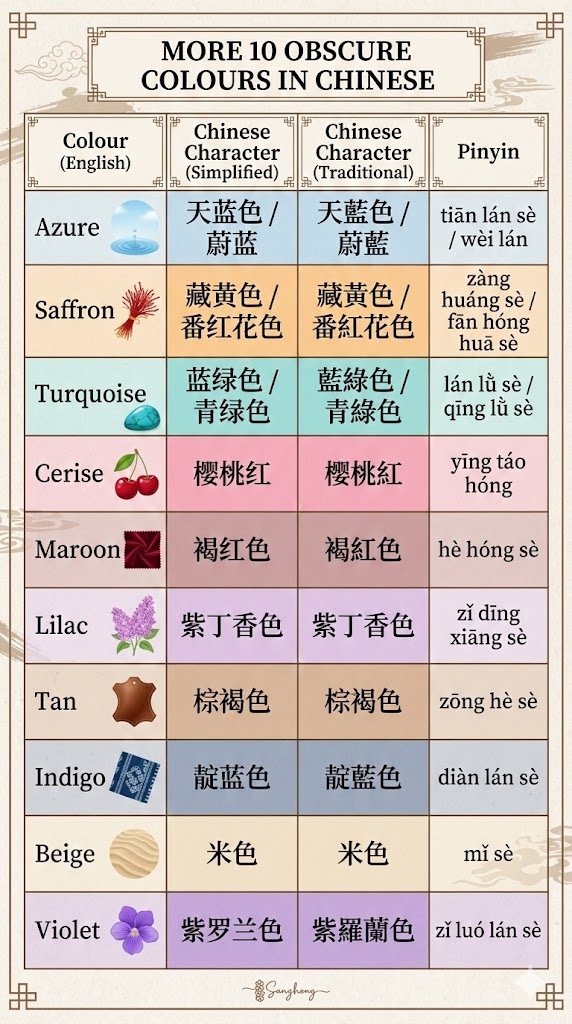
Beyond the everyday colours most Mandarin learners encounter first, there is a fascinating set of more specific, nuanced colour terms that rarely appear in standard textbooks. These ten shades — borrowed from nature, gemstones, and poetic imagery — expand your colour vocabulary significantly and are genuinely useful for descriptive, literary, or design contexts.
Understanding Chinese vs Japanese vs Korean differences helps illustrate why these specific colour words carry cultural weight unique to the Mandarin-speaking world.
| Colour (English) | Chinese Character (Simplified) | Chinese Character (Traditional) | Pinyin | Description |
|---|---|---|---|---|
| Azure | 天蓝色 / 蔚蓝 | 天藍色 / 蔚藍 | tiān lán sè / wèi lán | A clear, vivid sky-blue. 蔚蓝 (wèi lán) carries a poetic, open-sky quality — used in literature to describe a flawless blue sky or open sea. |
| Saffron | 藏黄色 / 番红花色 | 藏黃色 / 番紅花色 | zàng huáng sè / fān hóng huā sè | A deep golden-yellow borrowed from the saffron spice and crocus flower. Strongly associated with Buddhist monastic robes and spiritual ceremony across East and South-East Asia. |
| Turquoise | 蓝绿色 / 青绿色 | 藍綠色 / 青綠色 | lán lǜ sè / qīng lǜ sè | A vivid blue-green, the colour of prized turquoise gemstones (绿松石, lǜ sōng shí). Turquoise has been used in Chinese jewellery and imperial decorative arts for thousands of years. |
| Cerise | 樱桃红 | 櫻桃紅 | yīng táo hóng | Literally “cherry red” — a bright, vivid pinkish-red resembling the colour of a ripe cherry. Lively and youthful in tone, it is widely used in fashion and cosmetics branding. |
| Maroon | 褐红色 | 褐紅色 | hè hóng sè | A dark brownish-red, like dried blood or aged lacquer. The character 褐 (hè) means coarse or brown cloth — giving this colour an earthy, grounded connotation. |
| Lilac | 紫丁香色 | 紫丁香色 | zǐ dīng xiāng sè | Literally “purple lilac flower colour” — a pale, delicate purple. Named after the lilac blossom (丁香, dīng xiāng), it evokes spring, gentleness, and feminine elegance. |
| Tan | 棕褐色 | 棕褐色 | zōng hè sè | A warm, light brown — the colour of natural wood, leather, and sand. Neutral and grounding, it appears frequently in traditional Chinese furniture and craft descriptions. |
| Indigo | 靛蓝色 | 靛藍色 | diàn lán sè | A deep blue-violet derived from the indigo plant (靛青, diàn qīng), historically used in traditional Chinese textile dyeing. One of the oldest natural dye colours in Chinese material culture. |
| Beige | 米色 | 米色 | mǐ sè | Literally “rice colour” — a pale, warm off-white resembling uncooked rice grains. Simple, clean, and neutral, it is one of the most naturally descriptive colour names in Mandarin. |
| Violet | 紫罗兰色 | 紫羅蘭色 | zǐ luó lán sè | Literally “violet flower colour” — a rich blue-purple resembling the violet blossom (罗兰, luó lán). Slightly cooler and deeper than lilac, it carries associations of mystery and nobility. |
A few things worth noting for learners and professionals:
- Beige (米色, mǐ sè) is a beautiful example of how Mandarin uses everyday objects — rice — as colour references, making vocabulary both visual and memorable.
- Indigo (靛蓝色, diàn lán sè) has a genuinely ancient history in Chinese textile craft, predating synthetic dyes by millennia. Understanding the oldest languages in the world puts the deep age of many of these colour words in perspective.
- Saffron and turquoise both reflect the Silk Road’s cultural exchange — colours that entered Chinese aesthetics through trade and religious contact with Central and South Asia.
Understanding the oldest languages in the world helps put into perspective just how ancient many of these colour words truly are — some, like 丹 (dān) and 赤 (chì), predate most written languages still in use today.
Chinese Lucky Colours and What They Mean
Colour symbolism in China is rich, layered, and often context-dependent. The same colour can mean something positive in one setting and something deeply negative in another. Here is a full breakdown of each major colour and its cultural significance.
Red in China
Red (红色, hóng sè) is without question the most important colour in Chinese culture. It symbolises joy, celebration, luck, and prosperity. Red is the colour of Chinese New Year, weddings, festivals, and the national flag. The iconic red envelopes (红包, hóngbāo) given during Lunar New Year are filled with money and represent the transfer of good fortune. Red is linked to the Fire element — energy, vitality, and summer — in the Five Elements framework.
However, red must be used carefully. It is strictly forbidden at funerals, where it is seen as inappropriately celebratory. Writing someone’s name in red ink is also considered very bad luck, as it was historically associated with death sentences.
Understanding what languages are spoken in China can help you navigate the regional nuances of these customs across different Chinese-speaking communities.
Chinese Green
Green (绿色, lǜ sè) — and its related shade, cyan-green (青色, qīng sè) — represents health, growth, prosperity, and harmony in Chinese culture. Qīng in particular was historically used for the roof tiles of the Temple of Heaven, representing life and the natural world. Green is associated with the Wood element, the east direction, and the spring season — all symbols of new beginnings and vitality.
However, green carries a significant cautionary note: a green hat (绿帽子, lǜ màozi) is an idiom for a cuckolded husband — someone whose partner is unfaithful. This association is deeply embedded in Chinese slang, and men in China will typically avoid wearing green hats. This is a context any marketer or communicator needs to know.
Gold in China’s Culture
Gold (金色, jīn sè) shares much of yellow’s imperial prestige but takes on a more material, celebratory dimension. Gold represents wealth, abundance, and good fortune. It is ubiquitous during Chinese New Year, on temple decorations, and in gift-giving contexts. Combined with red — the most auspicious colour pairing in Chinese culture — gold amplifies celebrations and signals prosperity. Luxury brands targeting Chinese consumers consistently use red-and-gold colour schemes for this reason.
Yellow and the Yellow Emperor
Yellow (黄色, huáng sè) was historically the most exclusive colour in China — reserved exclusively for the emperor. Wearing yellow without imperial authorisation during the Tang, Ming, and Qing dynasties was a serious offence. The Yellow Emperor (黄帝, Huáng Dì), the mythological founding figure of Chinese civilisation, gave yellow its divine associations. The Yellow River (黄河, Huáng Hé) — the cradle of Chinese civilisation — reinforces the colour’s central symbolic importance.
Today, yellow continues to evoke prestige, authority, warmth, and intellectual refinement. It is used in religious temples, sacred objects, and ceremonial contexts.
Elite Asia’s analysis of the most spoken languages in the world highlights how Mandarin’s global dominance is inseparable from this rich civilisational heritage.
Blue in China
Blue (蓝色, lán sè) did not carry strong symbolic weight in classical Chinese thought — cyan (青色, qīng sè) was the dominant blue-green cardinal colour. However, in the modern era, blue has come to represent healing, trust, and immortality in Chinese culture. Blue is also closely associated with Taoism and is used in traditional Chinese medicine to represent certain healing properties.
In contemporary business and branding, blue is widely trusted and is the chosen colour of many major Chinese tech companies, including Alibaba and Tencent’s WeChat — suggesting reliability and professionalism.
Understanding these modern associations is essential, as explored in Elite Asia’s article on marketing translation strategies for Greater China.
Purple in China
Purple (紫色, zǐ sè) carries associations of nobility, spirituality, and divine power in Chinese culture. The most famous example is the Forbidden City, whose poetic Chinese name is 紫禁城 (Zǐ Jìn Chéng) — literally “Purple Forbidden City” — reflecting purple’s connection to heavenly authority and imperial prestige. In Taoist philosophy, purple is associated with the ascension to immortality and the harmony of heaven and earth.
In modern China, purple has also taken on associations of romance and love, particularly among younger generations influenced by global pop culture. It sits at the intersection of the traditional and the contemporary — making it a nuanced but powerful colour choice in branding and design.
White in China
White (白色, bái sè) is one of the most culturally sensitive colours in Chinese culture. While it carries associations of purity and clarity in the Yang/Five Elements framework, in social practice it is the colour of mourning and death. White is the traditional colour worn at Chinese funerals. Giving white flowers — particularly white chrysanthemums — is associated with condolence and grief and is considered deeply inappropriate as a gift in any celebratory context.
This is one of the starkest differences between Western and Chinese colour symbolism. In Western weddings, the bride wears white; in traditional Chinese weddings, white would be considered inauspicious. Any business or marketer using white prominently in packaging or gifting should be aware of this cultural context.
Elite Asia’s post on the role of language in emotion explores how cultural meaning shapes even non-verbal communication like colour.
Black in China
Black (黑色, hēi sè) has a dual nature in Chinese culture. The I Ching regards black as Heaven’s colour, and ancient Chinese people considered it the king of colours. Taoism links black to the Tao itself — the ineffable, primal force underlying all existence. Black is associated with the Water element, depth, wisdom, and hidden power.
In modern contexts, however, black is also associated with evil, illegality, and misfortune — the term 黑市 (hēi shì, black market) and 黑名单 (hēi míngdān, blacklist) reflect this shadow side. Black is also worn at funerals, alongside white. In business contexts, black is generally safe and professional — though it is worth avoiding it as a dominant colour in gifting or festive packaging.
Why Colour Symbolism Matters for Businesses
For any business operating in Chinese-speaking markets — whether in mainland China, Taiwan, Singapore, or Hong Kong — colour is not a minor design detail. It is a strategic communication tool that can either build trust or create serious cultural offence.
The stakes are higher than many Western brands realise. Colour choices in packaging, logos, website design, marketing campaigns, and even business card design send clear cultural signals to Chinese consumers. Getting them right shows cultural intelligence and earns trust. Getting them wrong — for instance, using white prominently in a gift catalogue, or putting a green hat on a male mascot — can damage brand credibility in ways that are difficult to recover from.
Elite Asia’s expertise in multilingual website content for global audiences and multilingual SEO copywriting in Hong Kong directly addresses how colour, language, and cultural context intersect in effective market entry strategy.
Dos and Don’ts of Using Colour in China
✅ Do:
- Use red and gold for celebratory campaigns, product launches, and Chinese New Year marketing — this is the most universally positive colour combination
- Use red for gifting, packaging, and festive occasions
- Use yellow/gold in contexts evoking prestige, tradition, or premium quality
- Use green for health, wellness, and environmental brands — but avoid green hat imagery in any form
- Use blue for technology, trust, finance, and healthcare brands
- Use purple for luxury, spirituality, or youth-oriented brands
❌ Don’t:
- Use white as a dominant colour in gifts, packaging, or celebratory contexts
- Use black and white together in marketing materials — this combination strongly evokes mourning
- Write names or important text in red ink — this carries connotations of death
- Put a green hat on any male figure in illustrations, logos, or mascots
- Use red in funeral or condolence contexts — it is considered highly disrespectful
How to Use Chinese Colours in Sentences
Talking About an Object With Its Colour
In Mandarin, the colour comes before the noun it describes, just as in English. The structure is:
Subject + 是 (shì) + Colour + 的 (de) + Noun
or simply:
Noun + 是 + Colour + 的
Examples:
| English | Mandarin | Pinyin |
|---|---|---|
| The apple is red. | 苹果是红色的。 | Píngguǒ shì hóng sè de. |
| The sky is blue. | 天空是蓝色的。 | Tiānkōng shì lán sè de. |
| His shirt is white. | 他的衬衫是白色的。 | Tā de chènshān shì bái sè de. |
| I want a black bag. | 我想要一个黑色的包。 | Wǒ xiǎng yào yī gè hēi sè de bāo. |
| This flower is yellow. | 这朵花是黄色的。 | Zhè duǒ huā shì huáng sè de. |
The particle 的 (de) links the colour adjective to the noun. In casual speech, it can sometimes be dropped with common colour-noun pairings, but including it is always grammatically correct.
Useful Dialogues With Chinese Colours
Asking About Someone’s Favourite Colour
A: 你最喜欢什么颜色?
Nǐ zuì xǐhuān shénme yánsè?
(What is your favourite colour?)
B: 我最喜欢蓝色,因为它让我感到平静。
Wǒ zuì xǐhuān lán sè, yīnwèi tā ràng wǒ gǎndào píngjìng.
(My favourite colour is blue, because it makes me feel calm.)
Saying Which Colours You Like and Dislike
A: 你喜欢红色吗?
Nǐ xǐhuān hóng sè ma?
(Do you like red?)
B: 喜欢!红色代表好运。但我不太喜欢白色。
Xǐhuān! Hóng sè dàibiǎo hǎoyùn. Dàn wǒ bù tài xǐhuān bái sè.
(Yes! Red represents good luck. But I don’t really like white.)
For businesses needing nuanced, culturally accurate Mandarin content, understanding which script to use matters enormously. Elite Asia’s dedicated Simplified Chinese translation and interpretation services serve clients targeting mainland China, Singapore, and Malaysia, while their Traditional Chinese translation and interpretation services are ideal for Taiwan, Hong Kong, and Macau markets. Getting both the language and the cultural context right is what separates effective communication from costly mistakes.
Elite Asia’s expertise in sworn and certified translation also highlights how formal documents — whether legal, academic, or commercial — must navigate these cultural layers with precision.
How to Order a Language & Localisation Service from Elite Asia
Whether you need document translation, website localisation, subtitling, or certified translation, ordering from Elite Asia is straightforward. You have two main paths to get started — via the Client Portal or by requesting a free quotation directly.
Step 1: Explore the Languages & Services Available
Visit the Elite Asia Languages page to browse the full range of languages and localisation services offered. Elite Asia supports over 70 languages, covering major Asian and European languages, through a network of more than 10,000 professional linguists.
Step 2: Choose Your Service Type
Select the service that matches your project needs:
- Content & Document Translation – for business documents, legal papers, and marketing materials
- Website Localisation – adapt your site for a new market
- Subtitling Localisation – for corporate videos, presentations, and training content
- Software/App Localisation – for digital products entering new markets
- Certified Translation – for immigration, legal, and official authority use
- Interpretation – for business meetings and conferences
- Copywriting & Transcreation – for culturally adapted marketing content
Step 3: Choose Your Ordering Path
You can place your order through either of these two options:
✅ Option A — Request a Free Quotation (Recommended for First-Timers)
Go to eliteasia.co/request-free-quotation/ and fill out the online form. Elite Asia is transparent about pricing — there are no hidden surcharges. Your rate will be determined by:
- Language pair required (e.g. English to Bahasa Indonesia)
- Complexity of the source content
- Number of source words or pages
- Required turnaround time
Choose between a Corporate or Personal request type on the form, and provide as much detail about your project as possible for the most accurate quote. If you need a quote urgently, call +65 6681 6717 during office hours (GMT+8, Mon–Fri, 9 AM–6 PM).
✅ Option B — Order via the Client Portal
Sign up for a free account at the Elite Asia Client Portal. Once logged in, you can upload documents, access AI-powered translation and subtitling tools, and communicate directly with the team — all in one place.
Step 4: Upload Your Files
Whether you go through the quotation form or the Client Portal, upload your source files so the Elite Asia team can review the scope and begin processing your project. Supported file formats include .DOCX, .TXT, and .SRT (for subtitles).
Step 5: Connect with the Team
Use the portal’s Live Chat or reach the team directly via:
- 📧 Singapore: enquiry-sg@eliteasia.co | +65 6681 6717
- 📧 Hong Kong: enquiry-hk@eliteasia.co | +852 3904 1138
- 📧 Malaysia: enquiry-my@eliteasia.co | +60 3 9212 8558
Step 6: Confirm & Pay
Once the scope and pricing are agreed upon, proceed with payment. Elite Asia accepts PayPal and major credit cards online, with bank transfer available upon request. Payment via PayPal is secured with PCI Level 1 certification, the highest standard in the payment industry.
Step 7: Track Your Project & Receive Delivery
Use the Client Portal’s real-time project tracking to monitor progress, download completed files, and view your full order history at any time. You will be notified of updates throughout the process until final delivery.
Conclusion
Colours in Chinese are far more than visual choices — they are a living language of culture, history, philosophy, and social meaning. From the Five Elements that link red to fire and black to water, to the imperial yellow reserved for emperors, to the complex dual nature of white as both purity and mourning — every shade tells a story. Whether you are learning to speak Mandarin, doing business in China, or simply trying to understand Chinese culture more deeply, knowing these colour meanings gives you a genuine cultural advantage.
For businesses and communicators who need their message to land perfectly in Chinese-speaking markets, working with professional language experts makes all the difference. Explore Elite Asia’s Simplified Chinese translation and interpretation services and Traditional Chinese translation and interpretation services to ensure your content is not just translated — but truly understood.
Elite Asia’s team covers 30+ languages across Singapore, Malaysia, Hong Kong, Japan, South Korea, China, Taiwan, and Thailand — with full technical support, ISO 9001:2015 certification, and a dedicated MICE division ready to support your next event.
Latest Articles on Language:
- Multilingual SEO Pricing in Asia: What B2B Companies Should Budget for Localisation, Content and Technical SEO


- The B2B Video Localisation Brief Template Used by Teams That Don’t Get Rework

- Subtitles vs Captions vs Voice-Over vs Dubbing: Which Video Localisation Method Should Your B2B Team Use for Asia Markets

Frequently Asked Questions (FAQs)
1. What Is the Luckiest Colour in China?
Red (红色, hóng sè) is widely considered the luckiest colour in Chinese culture. It represents joy, prosperity, happiness, and protection from evil spirits. It is used at weddings, Chinese New Year celebrations, and other auspicious occasions. Gold runs a close second, particularly in commercial and festive contexts.
2. Eight Places Where the Lucky Colour Red Is Found in China
Red appears throughout Chinese daily life. Eight familiar examples include:
- Red envelopes (红包, hóngbāo), given at Chinese New Year, weddings, and birthdays.
- The national flag, featuring five yellow stars on a red background.
- Wedding dresses, as traditional Chinese brides often wear red rather than white.
- Lanterns, displayed during Chinese New Year and other festivals.
- Temple gates and doors, especially at Buddhist and Taoist temples.
- Firecrackers, whose red paper wrapping symbolises celebration.
- Good-luck charms and talismans, which are commonly red.
- Spring Festival couplets (春联, chūnlián), written on red paper and displayed on doorways for the New Year.
3. What Are the Other Lucky Colours in Chinese Culture?
Beyond red, gold and yellow are strongly auspicious, with associations with imperial power, wealth, and the Earth element. Green, particularly 青 (qīng), can suggest health, vitality, and prosperity, while purple carries spiritual prestige and can be fortunate in certain contexts.
4. What Are the Unlucky Colours in Chinese Culture?
White is primarily associated with mourning, funerals, and death. Black can carry negative associations with misfortune and illegality in social settings, although it also has philosophical significance in Taoist thought. Green hats (绿帽子) are a specific negative symbol for men because they represent infidelity. The combination of black and white is especially associated with funerary imagery and should be avoided in celebratory contexts.
5. Neutral Colours in Chinese Culture
Grey (灰色, huī sè), beige (米色, mǐ sè), and brown (棕色, zōng sè) are generally neutral colours in Chinese culture, without strongly positive or negative symbolic associations. They are common in modern minimalist interiors and fashion. In traditional Chinese ink painting (水墨画, shuǐmò huà), grey and ink tones can represent restraint, wisdom, and natural beauty.
6. What Are the Lucky and Unlucky Colours for Chinese Zodiac Animals?
Each of the 12 Chinese zodiac animals has traditionally associated lucky and unlucky colours.
| Zodiac Animal | Lucky Colours | Unlucky Colours |
|---|---|---|
| Rat (鼠) | Blue, Gold, Green | Yellow, Brown |
| Ox (牛) | White, Yellow, Green | Blue, Red |
| Tiger (虎) | Blue, Grey, Orange | Gold, Silver |
| Rabbit (兔) | Red, Pink, Purple, Blue | Dark Brown, Dark Yellow |
| Dragon (龙) | Gold, Silver, Greyish White | Red, Green |
| Snake (蛇) | Red, Light Yellow, Black | White, Gold |
| Horse (马) | Yellow, Green | Blue, White |
| Goat (羊) | Brown, Red, Purple | Blue, Black |
| Monkey (猴) | White, Blue, Gold | Red, Pink |
| Rooster (鸡) | Gold, Brown, Yellow | Red, Green |
| Dog (狗) | Red, Green, Purple | Blue, White |
| Pig (猪) | Yellow, Grey, Brown | Red, Blue |
7. What Are the Lucky Colours for Chinese New Year Celebrations?
Chinese New Year (春节, Chūnjié), also called Lunar New Year, is among the most colour-rich celebrations in the Chinese calendar. The primary lucky colours are:
- Red, representing celebration, luck, and protection from evil.
- Gold, representing prosperity, wealth, and abundance.
- Yellow, representing imperial prestige and happiness.
- Orange, representing energy and good fortune.
- Green (青), representing vitality and new beginnings.
Homes, streets, markets, and clothing often shift toward these colours during the New Year period.
8. What Are the Unlucky Colours for Chinese New Year Celebrations?
During Chinese New Year, these colours are generally best avoided:
- White, which is associated with death and mourning.
- Black, which can be associated with bad luck, misfortune, and solemn occasions.
- Black and white together, which strongly evoke funerary imagery.
9. The Importance of Colours in Traditional Chinese Medicine (TCM)
In Traditional Chinese Medicine (TCM), colours are linked with organs and vital systems through the Five Elements framework.
| Colour | Element | Corresponding Organ |
|---|---|---|
| Green/Cyan (青) | Wood | Liver and Gallbladder |
| Red (红) | Fire | Heart and Small Intestine |
| Yellow (黄) | Earth | Spleen and Stomach |
| White (白) | Metal | Lungs and Large Intestine |
| Black (黑) | Water | Kidneys and Bladder |
TCM practitioners may use these colour-organ correspondences in diagnosis, dietary advice, and treatment. For example, green foods are traditionally believed to support liver health, while black foods such as black sesame and black beans are associated with kidney vitality. These ideas can also influence colour choices in TCM clinics and health-product branding.
10. Colours to Avoid in Marketing
For brands entering Chinese markets, these colour considerations are particularly important:
- White-dominated packaging, especially for food, gifting, or luxury products, because it can evoke mourning.
- All-black or black-and-white branding, which may feel funeral-like in celebratory or consumer-facing contexts.
- Red ink for names, as writing a client’s name in red can be a serious cultural misstep; use black or blue instead.
- Green hats or green headwear on male characters, because the “green hat” (绿帽子) idiom is strongly negative.
- Pure white flowers as gifts, particularly white chrysanthemums, which are associated with funerals.


Last Modified:
Contact Us
Working across languages? Our team can support your company’s translation and interpretation needs. For business enquiries, get in touch to explore what fits your requirements.
Request a Quote