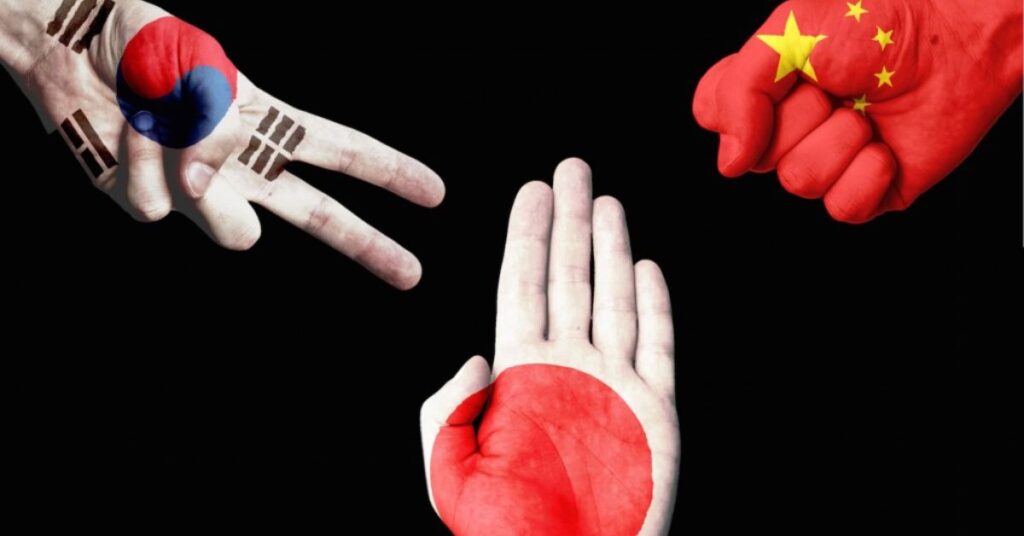
Chinese vs Japanese vs Korean: Which is Harder?
Learning an Asian language opens doors to rich cultures, exciting career opportunities, and new perspectives on the world. But if you’re standing at the crossroads wondering whether to learn Chinese, Japanese, or Korean, you’re probably asking yourself one crucial question: which one is actually the hardest?
The truth is, there’s no simple answer. Each of these East Asian languages presents unique challenges and rewards. The difference between Chinese, Japanese, and Korean extends far beyond the writing system; it encompasses grammar structures, pronunciation patterns, communication styles, and the learning resources available to you.
This comprehensive guide explores the key differences between these three fascinating languages, helping you understand what makes each one challenging in its own way. Whether you’re a complete beginner or someone looking to add another Asian language to your repertoire, understanding these distinctions will help you make an informed decision.
Key Differences Between Chinese, Japanese, and Korean
When comparing the Chinese, Japanese, and Korean language options, several fundamental differences emerge that affect the learning journey. These three languages, whilst all originating from East Asia, have evolved along remarkably different paths.
Chinese (specifically Mandarin) belongs to the Sino-Tibetan language family and uses a logographic writing system in which each character represents a meaning. Japanese, whilst incorporating Chinese characters, belongs to the Japonic language family and uses three distinct writing systems simultaneously. Korean, part of the Koreanic language family, employs a unique alphabet called Hangul, specifically designed for ease of learning.
The Foreign Service Institute (FSI) classifies all three languages as Category IV, the second-highest difficulty level for English speakers, requiring approximately 2,200 hours of study to achieve professional proficiency. However, this classification doesn’t capture the nuanced ways in which each language challenges learners.
Writing System and Vocabulary
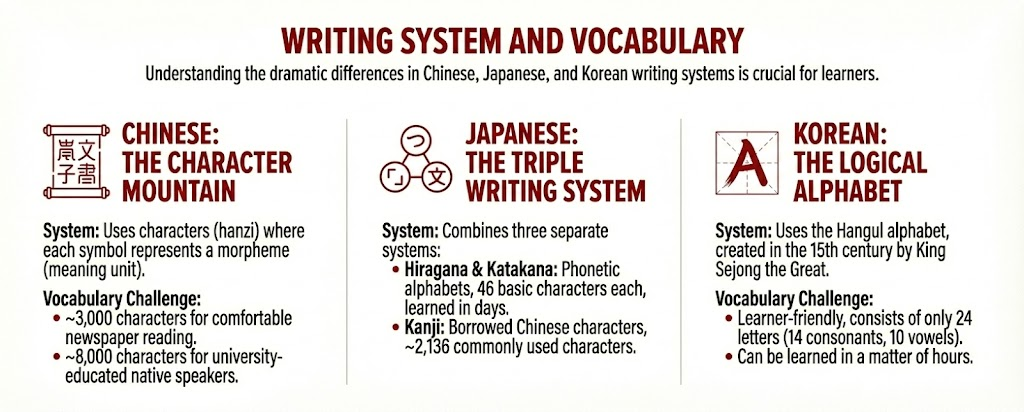
1. Chinese: The Character Mountain
Chinese, Korean, and Japanese writing systems differ dramatically, and understanding these differences is crucial for learners. Chinese writing uses characters (called hanzi) where each symbol represents a morpheme, a unit of meaning. To read a Chinese newspaper comfortably, you’ll need to recognise approximately 3,000 characters, whilst university-educated native speakers typically know around 8,000.
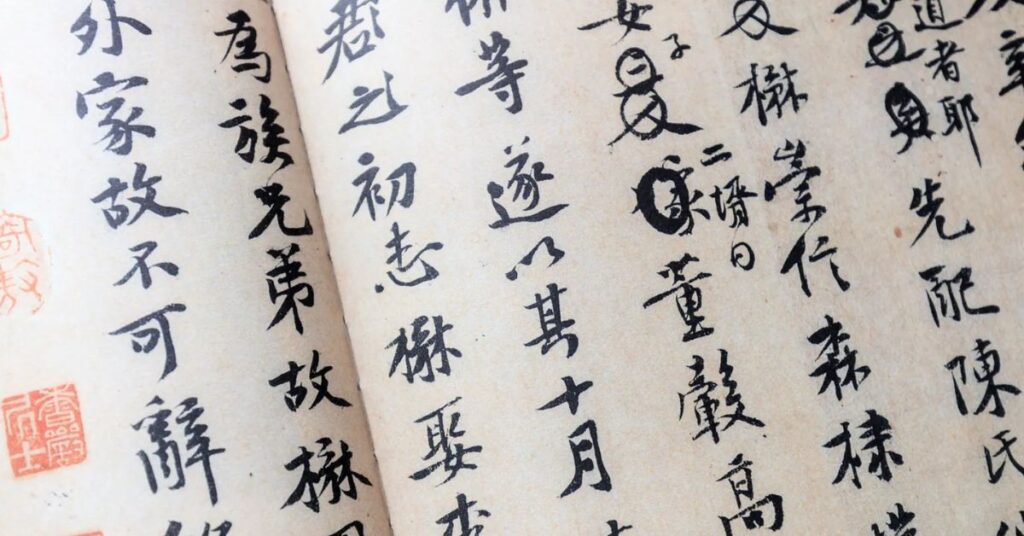
The challenge lies not just in quantity but in complexity. Each character must be memorised individually, along with its pronunciation and meaning. However, there’s a silver lining: once you’ve mastered the most common characters, you can often deduce the meaning of unfamiliar words by understanding their parts. For instance, the word for “computer” (电脑) literally translates to “electric brain”.
Chinese comes in two main variants: Simplified Chinese (used in mainland China, Malaysia, and Singapore) and Traditional Chinese (used in Taiwan and Hong Kong). At Elite Asia, we offer professional Simplified Chinese translation services and Traditional Chinese translation services to meet diverse business needs across Asia.
2. Japanese: The Triple Writing System
Japanese writing presents a unique challenge by combining three separate systems: Hiragana, Katakana, and Kanji. Hiragana and Katakana are phonetic alphabets, each containing 46 basic characters that can be learned in a few days. Kanji, borrowed from Chinese characters, comprises approximately 2,136 commonly used characters.

What makes Japanese particularly tricky is that each Kanji character often has multiple readings, both “Chinese” (on-yomi) and “Japanese” (kun-yomi) pronunciations. The character 生 (life), for example, has over ten different pronunciations depending on context. As a result, learners cannot always predict how to pronounce a word even if they recognise the characters.
The advantage of this system is that once you understand the three scripts, reading becomes more systematic. Hiragana indicates grammatical functions, Katakana signals foreign loanwords, and Kanji conveys core meanings. For businesses requiring accurate Japanese translation services, understanding these nuances is essential for maintaining meaning and cultural authenticity.
3. Korean: The Logical Alphabet
Korea’s Hangul alphabet stands out as arguably the most learner-friendly writing system among the three languages. Created in the 15th century by King Sejong the Great, Hangul consists of just 24 letters, 14 consonants and 10 vowels, which can be learned in a matter of hours.
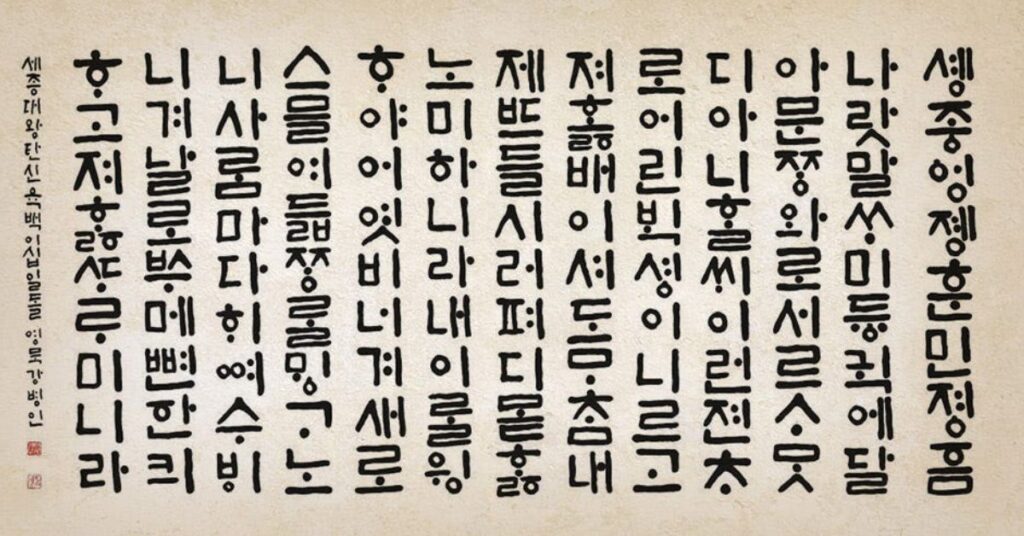
The brilliance of Hangul lies in its scientific design. The consonant shapes actually represent the position of the tongue and mouth when making those sounds. Letters combine into syllable blocks, making Korean phonetic and predictable to read once you’ve mastered the alphabet.
However, there’s a trade-off. Whilst Korean doesn’t require memorising thousands of characters, approximately 50% of Korean vocabulary has Chinese origins. These words (called Hanja) share similar meanings and pronunciations with their Chinese counterparts. Still, without the visual cues that Chinese characters provide, it can be harder to remember and distinguish between similar-sounding words.
Professional Korean translation services require a deep understanding of both Hangul and the underlying Hanja roots to capture nuanced meanings in business localisation projects.
Reading Complex Material
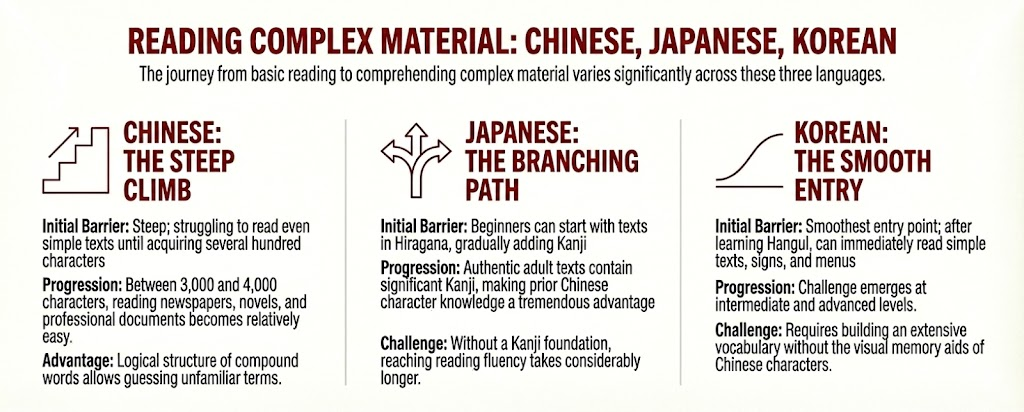
The journey from basic reading to comprehending complex material varies significantly across these three languages.
For Chinese learners, the initial barrier is steep; you’ll struggle to read even simple texts until you’ve acquired several hundred characters. However, between 3,000 and 4,000 characters, you’ll find yourself able to read newspapers, novels, and professional documents with relative ease. The logical structure of Chinese compound words means you can often guess the meaning of unfamiliar terms.
Japanese learners face a different trajectory. Beginners can start with texts written primarily in Hiragana, gradually progressing to material with higher proportions of Kanji. Authentic Japanese texts for adults typically contain significant amounts of Kanji, so your prior knowledge of Chinese characters becomes a tremendous advantage. Without this foundation, reaching fluency in reading Japanese takes considerably longer.
Korea presents the smoothest entry point. Once you’ve learned Hangul, you can immediately begin reading simple texts, street signs, and menus. The challenge emerges at intermediate and advanced levels, where understanding requires building an extensive vocabulary without the visual memory aids that Chinese characters provide.
Grammatical Structure
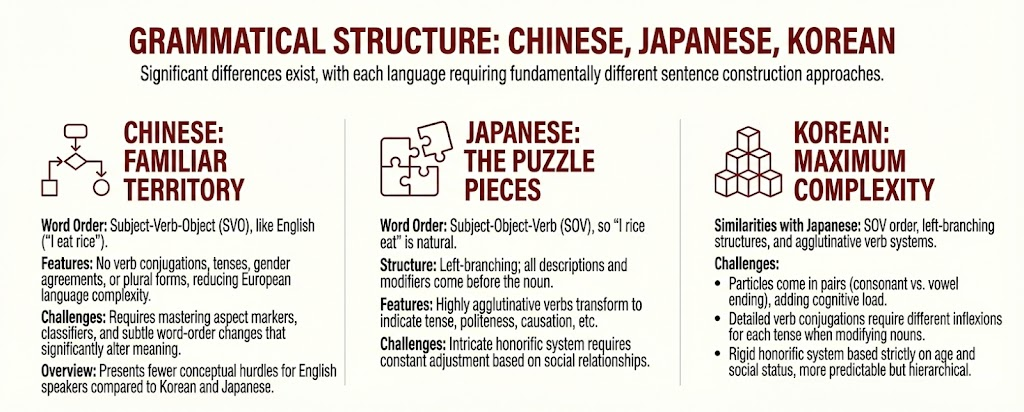
Grammar is one of the most significant differences between Chinese and. Japanese vs. Korean comparison, with each language requiring fundamentally different approaches to sentence construction.
1. Chinese: Familiar Territory
Chinese grammar will feel remarkably familiar to English speakers. Both languages use Subject-Verb-Object (SVO) word order, meaning you say “I eat rice” in the same sequence in both languages. Chinese lacks many features that make European languages complex: no verb conjugations, no tenses, no gender agreements, and no plural forms.
Chinese grammar is not necessarily simple, but it is different. Learners must master aspect markers (such as 了 for completed actions), classifiers for counting objects, and subtle word-order changes that significantly alter meaning. A misplaced character can shift a sentence from describing an experience to describing an ongoing action. However, compared to Korean and Japanese, Chinese grammar presents fewer conceptual hurdles for English speakers.
2. Japanese: The Puzzle Pieces
Japanese grammar operates on fundamentally different principles from English. The language uses Subject-Object-Verb (SOV) order, so “I rice eat” becomes the natural sequence. More challenging is that Japanese is a left-branching language; all descriptions and modifiers come before the noun they modify.
This structure allows entire clauses to function as single units, creating sentences that feel like linguistic puzzles where you must track multiple embedded elements before reaching the verb that ties everything together. Japanese is also highly agglutinative, meaning verbs transform through various endings to indicate tense, politeness level, causation, and more.
The intricate honorific system adds another layer of complexity. You must constantly adjust your language based on social relationships, using different verb forms, vocabulary, and sentence structures depending on whether you’re speaking to superiors, peers, or subordinates.
3. Korean: Maximum Complexity
Korean grammar shares many similarities with Japanese; both use SOV word order, left-branching structures, and agglutinative verb systems. However, several features make Korean grammar slightly more challenging than its Japanese counterpart.
Korean particles (grammatical markers) come in pairs, one form when a word ends in a consonant, another when it ends in a vowel. Whilst this seems like a minor distinction, it adds cognitive load when you’re already managing complex verb conjugations and sentence structures. Korean verb conjugations also go into greater detail than Japanese, requiring different inflexions for each tense when modifying nouns.
The honorific system in Korean is predominantly hierarchical, based strictly on age and social status. You’ll always use honorifics with older individuals or superiors, regardless of familiarity, making the system somewhat more rigid but also more predictable than Japanese honorifics.
Pronunciation (Phonetics)
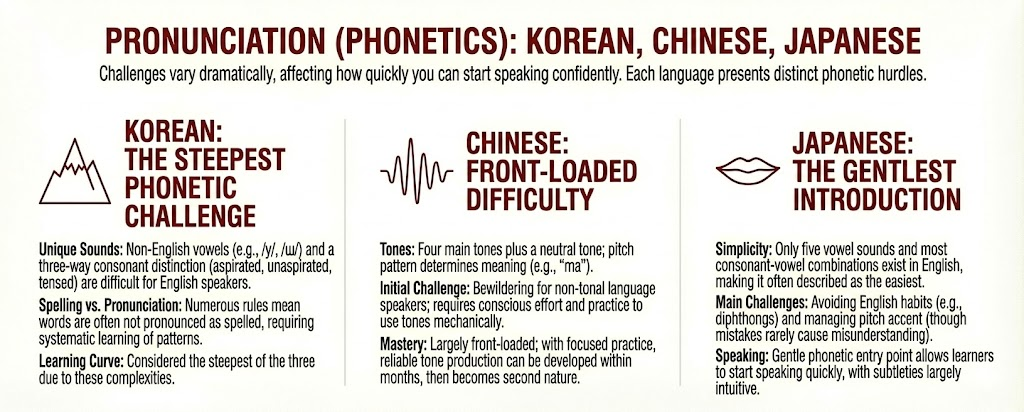
Pronunciation challenges vary dramatically across these three languages, affecting how quickly you can start speaking confidently.
1. Korean: The Steepest Phonetic Challenge
Korean pronunciation is widely considered the most difficult of the three languages. The challenge begins with sounds that don’t exist in English, such as the vowels /y/ (similar to French “u”) and /ɯ/ (produced from the back of the throat).
The real difficulty lies in the Korean three-way distinction for stop consonants like “t,” “p,” and “k.” Each comes in aspirated (with a puff of air), unaspirated (without a puff of air), and tensed (with glottal tension) varieties. English speakers can produce the first two but don’t consciously differentiate them; the “k” in “king” is aspirated, whilst the “k” in “sky” isn’t. Confusing these sounds will genuinely impede comprehension.
Adding to the complexity, Korean has numerous spelling and pronunciation rules, so words aren’t pronounced as they’re spelt. You’ll need to learn these patterns systematically to achieve accurate pronunciation, making Korean’s phonetic learning curve the steepest of the three languages.
2. Chinese: Front-Loaded Difficulty
Chinese pronunciation centres around one notorious challenge: tones. Mandarin uses four main tones plus a neutral tone, where the pitch pattern of a syllable determines its meaning. The word “ma” can mean mother (mā), hemp (má), horse (mǎ), or scold (mà) depending on the tone.
For learners from non-tonal languages, this is initially bewildering. You already use all these pitch patterns in English, but for emotional expression rather than distinguishing word meanings. The transition to using tones mechanically takes conscious effort and dedicated practice with tone pairs and tone combinations.
The encouraging news is that tone mastery is largely front-loaded. Through focused practice with native Chinese speakers and deliberate attention to tone patterns, most learners develop reliable tone production within several months. Once you’ve clicked the tones, they become second nature, and Chinese pronunciation becomes relatively straightforward.
3. Japanese: The Gentlest Introduction
Japanese pronunciation is often described as the easiest among the three languages for English speakers. The language has only five vowel sounds, and most consonant-vowel combinations exist in English in some form. Even if your pronunciation isn’t perfect, Japanese speakers will generally understand what you’re trying to say.
The main challenge is avoiding English habits, such as turning vowels into diphthongs (the word “no” in English becomes “no-oo,” whereas in Japanese “, no” stays flat). Japanese also uses pitch accent; certain syllables are pronounced at higher pitches, but mistakes here rarely cause misunderstandings.
Some subtleties exist, like devoiced vowels (the “u” in “desu” is barely pronounced) and the various sounds represented by ん. Still, these are largely intuitive, and you’ll naturally adjust with exposure. This gentler phonetic entry point makes Japanese attractive for learners who want to start speaking quickly.
Pronunciation (Prosody)
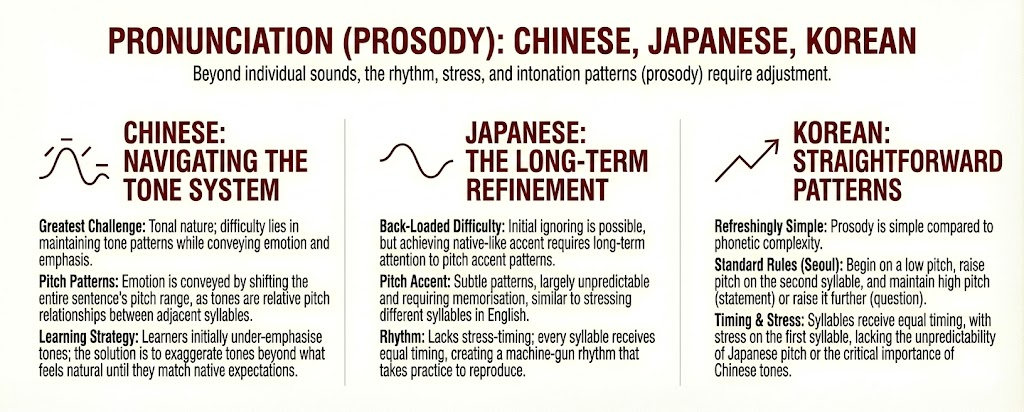
Beyond individual sounds, the rhythm, stress, and intonation patterns of these languages, collectively called prosody, require adjustment for English speakers.
1. Chinese: Navigating the Tone System
The tonal nature of Chinese presents the greatest prosodic challenge. The difficulty isn’t just producing individual tones correctly, but maintaining proper tone patterns throughout entire sentences whilst also conveying emotion and emphasis.
Interestingly, Chinese speakers adjust pitch for emotional expression just as English speakers do, but they do so by shifting the entire sentence’s pitch range rather than individual syllables. Tones are relative, not absolute; what matters is the pitch relationship between adjacent syllables.
Many learners discover that they initially under-emphasise tones, producing variations that sound identical to those of native speakers. The solution involves exaggerating tones beyond what feels natural until you receive confirmation that your tonal range matches native speaker expectations.
2. Japanese: The Long-Term Refinement
Japanese prosody is more back-loaded in difficulty. You can largely ignore it initially without severe consequences, but achieving a native-like accent requires long-term attention to pitch accent patterns.
Unlike Chinese tones that change word meanings, Japanese pitch accent is more subtle, similar to how Americans and Britons stress different syllables in words like “advertisement”. Each word has one of four pitch patterns, which are largely unpredictable and require memorisation.
Japanese also lacks the stress-timing of English, where we reduce some vowels to “uh” sounds. Every Japanese syllable (mora) receives equal timing, creating a machine-gun rhythm that takes practice to reproduce naturally.
3. Korean: Straightforward Patterns
Korean prosody is refreshingly simple compared to its phonetic complexity. Standard Seoul Korean follows three basic rules: begin on a low pitch, raise pitch on the second syllable, and either maintain high pitch for statements or raise it further on the final syllable for questions.
Korean syllables receive equal timing like Japanese, and Koreans tend to stress the first syllable of words rather than the middle syllables, as English often does. These patterns take some adjustment but lack the unpredictability of Japanese pitch accent or the critical importance of Chinese tones.
Honorifics and Communication
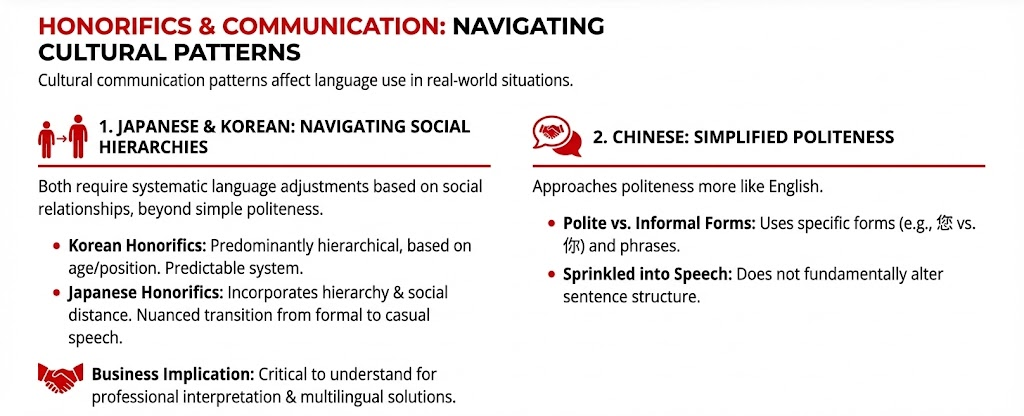
Cultural communication patterns significantly affect how quickly you can use these languages naturally in real-world situations.
1. Japanese and Korean: Navigating Social Hierarchies
Both Japanese and Korean require speakers to adjust their language systematically according to social relationships. In these languages, politeness goes far beyond simply adding words like “please” and “thank you”; speakers must use entirely different vocabulary, verb forms, and grammatical structures depending on the listener’s social status.
The systems differ in application. Korean honorifics are predominantly hierarchical and based on objective factors like age and position. You’ll use honorifics with older individuals or superiors, even if you’re close friends, making the system relatively predictable once you understand the social hierarchy.
Japanese honorifics incorporate both hierarchy and social distance. As relationships develop, you transition from formal to casual speech, and this transition point varies depending on context, personality, and regional culture. This flexibility makes the Japanese honorific system subtly more nuanced but also more context-dependent.
For businesses expanding into these markets, understanding these communication patterns is critical. Professional interpretation services and multilingual business solutions must account for these cultural dimensions to ensure messages resonate appropriately.
2. Chinese: Simplified Politeness
The Chinese approach politeness more like English. There are polite and informal forms (like the formal 您 versus informal 你 for “you”), and specific phrases are considered more respectful. Still, these are sprinkled into speech rather than fundamentally altering sentence structure.
This more straightforward approach to social registers means Chinese learners can focus on vocabulary and grammar without constantly monitoring social dynamics. The cultural nuances still matter tremendously in business contexts, but they manifest differently than in Korean and Japanese cultures.
Learning Strategies for Korean, Japanese, and Chinese
Effective language learning requires strategies tailored to each language’s unique challenges.
Immersion Through Reading and Listening
All three languages benefit tremendously from extensive reading and listening practice. The most successful learners consume vast amounts of content in their target language, from early beginner materials through authentic native content.
For Chinese, start with graded readers and podcasts with transcripts, paying special attention to tones whilst listening. As you progress, authentic materials like Chinese dramas and novels become invaluable for understanding how characters combine into natural expressions.
Japanese learners should begin with content written primarily in Hiragana, gradually progressing to materials with more Kanji as proficiency develops. Anime, manga, and Japanese dramas provide excellent listening practice, particularly slice-of-life content that reflects everyday language rather than fantasy scenarios.
Korean learners have the advantage of immediate access to written content thanks to Hangul. K-dramas and K-pop provide engaging listening practice, whilst Korean novels and news articles build vocabulary depth.
Digital marketing content and localised websites in these languages offer practical reading practice whilst providing insight into how businesses communicate across cultures.
Spaced Repetition and Active Recall
Memory systems like Anki or Memrise, which use spaced-repetition algorithms, are especially valuable for East Asian languages. These systems present information at optimised intervals to maximise retention whilst minimising study time.
For Chinese, flashcards should include characters, pinyin, tones, and example sentences. Focus on tone pairs, how tones combine in actual words, rather than just individual syllables.
Japanese learners benefit from learning Kanji through their component radicals (smaller, meaningful parts). This approach helps you understand why characters look the way they do and makes memorisation more logical.
Korean vocabulary memorisation can incorporate knowledge of Hanja to recognise patterns across similar-sounding words. Understanding that 학 (hag) appears in both 학교 (school) and 심리학 (psychology) helps build systematic vocabulary networks.
Speaking Practice and Language Exchange
Regular conversation practice accelerates proficiency in all three languages. Language exchange partners, tutors, or conversation groups provide essential feedback on pronunciation, grammar, and natural expression.
For tonal languages like Chinese, having native speakers correct your tones early and often prevents fossilised errors. Japanese and Korean learners benefit from practice navigating honorific systems in realistic social scenarios.
Remote interpretation services and multilingual business solutions demonstrate how professionals handle complex communication scenarios, offering real-world models for learners aiming for business proficiency.
Writing Practice
Regular writing practice reinforces character recognition and production. For Chinese and Japanese, this means practising proper stroke order and developing muscle memory for characters.
Korean writing practice helps internalise Hangul’s syllable block structure and the numerous spelling rules that affect pronunciation. Even though Hangul is alphabetic, the syllable-block arrangement requires systematic practice.
So Which One Is the Hardest?
After examining pronunciation, writing systems, grammar, and cultural communication patterns, the answer remains: it depends on you.
1. Chinese: Front-Loaded Challenge
Chinese presents its most significant difficulties early in the learning journey. Tones and characters form formidable initial barriers that discourage many learners. However, once you’ve mastered approximately 1,000 characters and developed reliable tone production, progress accelerates. The grammar’s relative simplicity means you can focus on vocabulary acquisition and reading comprehension.
Chinese is ideal for learners who prefer straightforward grammar, can dedicate intense effort to early-stage challenges, and have strong visual memory for character recognition. The language’s growing global importance, particularly in business contexts, makes it highly valuable. Our China digital marketing services help businesses navigate this crucial market.
2. Japanese: Back-Loaded Complexity
Japanese offers a gentler entry point with accessible pronunciation and abundant high-quality learning resources. The three writing systems seem daunting initially, but become manageable with consistent practice.
The challenges emerge at intermediate and advanced levels. Japanese grammar’s complexity, the nuances of the honorific system, and the cultural preference for indirect communication create obstacles that persist even after years of study. Reading authentic materials requires mastering approximately 2,000 Kanji plus vocabulary combinations.
Japanese suits learners who enjoy grammar puzzles, appreciate cultural subtlety, and have access to Japanese media they genuinely want. The extensive availability of learning resources, from textbooks to online courses to native content, makes sustained learning more accessible.
3. Korean: Middle Ground
Korean falls in the middle in terms of difficulty. Hangul’s brilliance makes reading immediately accessible, but the complex pronunciation and grammar create substantial challenges.
Korean grammar matches or exceeds Japanese in complexity, with intricate verb conjugation systems and paired particles. The pronunciation demands, particularly the three-way consonant distinctions and numerous pronunciation rules, require sustained attention to master.
Korean appeals to learners who appreciate a logical writing system, enjoy the challenge of complex grammar, and find motivation in Korean popular culture. The growing global influence of K-pop, K-dramas, and Korean technology creates abundant opportunities for exposure.
The Real Answer: Passion Trumps Difficulty
The most challenging language is the one you’re least motivated to learn. Three thousand hours studying a language you love feels shorter than three hundred hours studying one that bores you.
Successful learners consistently report that interest in the culture, media, or professional opportunities associated with a language matters far more than abstract difficulty rankings. If you’re passionate about Japanese anime, Korean dramas, or Chinese literature, that enthusiasm will carry you through challenges that would discourage someone learning purely for pragmatic reasons.
FAQs
Which language is the easiest to learn? Korean, Japanese, or Chinese?
None of these languages is objectively easy for English speakers; all three require approximately 2,200 hours to achieve professional proficiency according to FSI rankings. However, they’re easy in different ways. Korean has the simplest writing system to learn. Chinese has the most straightforward grammar. Japanese has the gentlest pronunciation. Choose based on which type of “easy” matters most to you at the beginning of your journey.
Which language takes the longest to learn?
Chinese and Japanese typically require more time than Korean due to their complex writing systems. Chinese demands mastery of 3,000+ characters for literacy. Japanese requires learning three writing systems with 2,000+ Kanji characters that have multiple readings. Korea’s Hangul alphabet can be discovered in hours, allowing you to focus on grammar and vocabulary more quickly. However, individual learning speed depends heavily on study methods, prior language knowledge, and consistency.
Does knowing one of these languages help with the others?
Yes, significantly. Knowledge of Chinese provides enormous advantages when learning Japanese or Korean. Approximately 60% of Japanese vocabulary and 50% of Korean vocabulary derive from Chinese. Knowing Chinese characters helps you recognise Kanji in Japanese immediately. Understanding Hanja (Chinese characters used historically in Korea) helps decode Korean vocabulary patterns. Japanese and Korean share similar grammar structures, making the second one easier if you’ve learned either one first. Learning any of these languages develops cognitive strategies that accelerate subsequent acquisition of Asian languages.
What is the most challenging aspect of each language?
For Chinese, the writing system and tones present the most significant challenges. Memorising thousands of characters whilst mastering four tones requires sustained effort. For Japanese, the complex grammar, multiple Kanji readings, and indirect communication style prove most difficult. Achieving advanced reading proficiency takes years due to the sheer number of character-vocabulary combinations. For Korean, the pronunciation system with its three-way consonant distinctions and unintuitive grammar structure (for English speakers) creates the most significant obstacles. Understanding linguistic nuances matters enormously in professional contexts, which is why expert translation services remain essential.
Which language has the easiest grammar?
Chinese has the simplest grammar for English speakers. It uses familiar Subject-Verb-Object word order and lacks verb conjugations, tenses, gender, and plural forms. Japanese and Korean both employ complex agglutinative verb systems and Subject-Object-Verb word order, which feel unnatural to English speakers. Korean grammar is slightly more complicated than Japanese due to paired particles and more detailed verb inflexions. However, all three languages feature grammatical concepts that require substantial study to master. Professional document translation services must account for these grammatical differences to maintain accuracy across languages.
Final Thoughts
The Chinese vs Japanese vs Korean debate ultimately has no winner; it’s about different paths suited to other learners. Chinese rewards those who can scale the initial walls of tones and characters with relatively approachable grammar and logical vocabulary construction. Japanese welcomes beginners with gentle pronunciation before revealing its grammatical depths and cultural complexities of communication. Korean splits the difference, offering immediate reading accessibility whilst demanding attention to pronunciation nuances and grammar intricacies.
Your success depends less on which language is “objectively” easier and more on alignment between the language’s characteristics and your learning style, interests, and goals. Someone with strong visual memory might find Chinese characters intuitive, whilst another learner with musical inclinations might master Chinese tones effortlessly. A grammar enthusiast might relish Japanese’s logical, if complex structures, whilst someone who learns through cultural immersion might thrive with Korean’s wealth of accessible media.
The most important decision isn’t which language to choose, it’s the commitment to consistent practice once you’ve selected. Fifteen minutes daily beats sporadic weekend marathons. Engaging with content you genuinely enjoy, whether Chinese historical dramas, Japanese manga, or Korean variety shows, sustains motivation when progress feels slow.
As you progress in any of these languages, you’ll discover that fluency opens doors beyond mere communication. You’ll gain insight into fundamentally different ways of organising thoughts, expressing emotions, and building relationships. The journey transforms not just your linguistic capabilities but also your cognitive flexibility and cultural awareness.
Remember that these languages exist on a continuum. Many successful learners eventually study multiple East Asian languages, with each new language becoming easier as patterns emerge and learning strategies strengthen. Your first Asian language is the hardest; after that, you’ve developed the meta-skills that make subsequent languages more accessible.
Work with an Asian Language Specialist Translation Team
Whilst personal language learning opens incredible opportunities, professional contexts demand expert-level precision. Cultural nuances, industry terminology, and communication style differences require specialised knowledge that goes beyond conversational fluency.
Elite Asia has delivered premium translation and interpretation services across Chinese, Japanese, and Korean for nearly three decades. Our team comprises certified linguists with tertiary education in translation studies and a minimum of five years of professional experience in their specialised industries.
We understand that effective cross-cultural communication extends beyond word-for-word translation. Our transcreation services adapt marketing messages to resonate with local audiences whilst maintaining your brand’s core values. Our website localisation solutions ensure your digital presence feels native to each market, not merely translated.
Whether you need certified translation for legal documents, AI-powered translation with human post-editing for large-scale content projects, or real-time interpretation services for multilingual conferences, Elite Asia delivers accuracy, cultural sensitivity, and reliability.
Our services span all major Asian languages, helping businesses establish themselves and connect meaningfully across cultures. From multilingual technology solutions to multilingual retail and e-commerce localisation, we provide comprehensive language support tailored to your industry and objectives.
Contact Elite Asia today to discuss how our language experts can help your business communicate effectively across Chinese, Japanese, Korean, and 80+ other languages. Because when precision matters, professional expertise makes all the difference.
Explore our comprehensive language services here.