Corporate Social Responsibility (CSR): What It Is, How It Works, and Types
Corporate Social Responsibility has transformed from a voluntary initiative into a strategic business imperative. Companies across industries, from banking to healthcare, insurance to manufacturing, are recognising that success today requires more than profit. It demands accountability, ethical conduct, and genuine commitment to society and the environment.
What Is CSR?
Corporate Social Responsibility (CSR) is the concept that businesses should operate in accordance with principles and policies that have a positive impact on society and the environment. Rather than focusing solely on financial gain, CSR encourages companies to consider the broader implications of their actions on communities, stakeholders, and the planet.
CSR represents a voluntary commitment by companies to integrate environmental and social concerns into their business strategy. It goes beyond legal obligations, requiring organisations to adopt ethical, sustainable, and responsible business practices that deliver benefits to consumers, shareholders, employees, and society at large.
At its core, CSR is a management concept focused on creating positive societal and environmental impact alongside financial value. This approach marks a fundamental shift in how companies view their role, moving from maximising profits for shareholders alone to considering all stakeholders, including employees, communities, and the planet.
How is Corporate Social Responsibility Defined Today?
Today’s definition of CSR extends beyond simple charitable giving. It encompasses a holistic approach to business that considers environmental sustainability, social impact, and corporate governance. Modern CSR involves conducting business in an ethical, transparent, and sustainable manner whilst remaining economically viable.
ESG and CSR have distinct but complementary roles. Whilst CSR focuses on a company’s voluntary efforts to integrate social and environmental issues into its strategy, Environmental, Social, and Governance (ESG) provides a standardised framework for evaluating and measuring sustainable practices.
The relationship between these concepts is symbiotic: CSR feeds ESG by providing the qualitative and quantitative content for investors to evaluate performance, whilst ESG offers a framework and legitimacy to CSR initiatives. Understanding the difference between sustainability and ESG is crucial for modern business leaders.
Who Is Responsible for Corporate Social Responsibility?
Responsibility for CSR begins at the board level and cascades throughout the organisation. Company directors and senior management must champion CSR initiatives, ensuring that sustainability becomes embedded in corporate culture and strategic decision-making.
According to industry best practices, companies often establish dedicated CSR committees when they meet certain thresholds. In some jurisdictions, such as India, insurance companies that earn a net profit of Rs. 5 crore or more in the preceding financial year are required to constitute a CSR committee.
Key stakeholders involved in CSR implementation include:

- Governments and Regulators: Oversee CSR implementation through policies, incentives, and sometimes mandatory requirements
- Corporations and Business Partners: Primary implementers of CSR initiatives, allocating resources and developing strategies
- Donors and Philanthropic Organisations: Partner with corporations to enhance CSR impact through matching funds or collaborative initiatives
- Private Sector Investors: Consider CSR performance in investment decisions, driving corporate adoption of responsible practices
- Educational Institutions: Benefit from and partner in CSR education initiatives through facility improvements and programme support
- Local Communities and Beneficiaries: Direct recipients of CSR programmes who provide feedback on local needs and impact
- Civil Society Organisations (CSOs): Collaborate with corporations to implement CSR programmes and provide expertise on social issues
Engaging stakeholders effectively is essential to the successful implementation of a CSR programme.
Why Should a Company Implement CSR Strategies?
The Importance and Impact of CSR in Today’s World
The business landscape has fundamentally shifted. Consumers, employees, and investors increasingly expect companies to demonstrate genuine commitment to social and environmental causes. This expectation is not merely a trend; it represents a permanent transformation in how businesses operate and succeed.
CSR matters for several compelling reasons:

- Trust and Reputation: Companies with authentic CSR programmes enjoy stronger brand reputations and deeper customer trust. In fact, 77% of consumers prefer brands that support social causes.
- Risk Management: CSR helps identify and mitigate various risks, from environmental disasters to reputational damage. Companies with strong CSR programmes recover from reputational crises up to four times faster than those without established social responsibility credentials.
- Long-term Sustainability: CSR is not a short-term initiative but a long-term strategy for building resilient and future-ready businesses. It enables companies to address pressing global challenges whilst ensuring sustainable growth.
- Regulatory Compliance: As governments worldwide implement stringent sustainability disclosure frameworks, CSR provides a foundation for meeting these requirements. Understanding ESG regulations has become essential for compliance.
What Are the Benefits of CSR?

Enhanced Brand Reputation and Customer Loyalty
CSR strengthens brand reputation by demonstrating commitment to social and environmental causes. Such visible commitment attracts consumers and investors who value these principles, fostering deeper loyalty. Research shows that 70% of customers are more loyal to socially responsible companies.
When customers connect with your social mission, price sensitivity decreases. Brands like Patagonia have demonstrated that consumers will pay premium prices for products aligned with their values, driving higher margins that fuel both business growth and expanded impact.
Improved Employee Engagement and Talent Attraction
CSR programmes significantly impact workforce dynamics. Employees, especially younger workers, want to work with companies whose values align with their goals. Companies with strong CSR programmes experience 17% higher productivity through increased employee engagement.
Furthermore, 76% of millennials consider CSR when choosing employers. Robust CSR initiatives are therefore essential for attracting and retaining top talent in competitive labour markets.
Operational Savings and Financial Performance
Sustainable practices such as energy efficiency, waste reduction, and responsible sourcing can significantly reduce costs. Many companies discover that CSR initiatives originally designed to address environmental impact also substantially reduce operational expenses.
The financial benefits extend beyond cost savings. Companies with strong social purpose enjoy 6% higher market value and generate 20% more revenue than their non-CSR counterparts. Purpose-driven companies can outperform peers by up to 400% in market value.
Competitive Advantage and Market Differentiation
ESG initiatives differentiate businesses in crowded marketplaces. In an increasingly socially conscious world, consumers and investors are more likely to support and engage with companies that prioritise CSR principles.
Innovation and Long-term Growth
CSR challenges organisations to think beyond traditional business models, sparking creative solutions that can open entirely new markets. When companies partner with diverse stakeholders, nonprofits, universities, and government agencies, they bring fresh perspectives that accelerate problem-solving.
This innovation advantage creates a continuous improvement cycle that future-proofs organisations against changing consumer preferences, resource constraints, and evolving regulatory environments.
What Companies Have the Best CSR?
Several companies have distinguished themselves through exemplary CSR programmes:
Google reached its 100% renewable energy target and is now the world’s largest corporate purchaser of renewable energy. The company provides generous grants to social impact initiatives, including Goodwill Industries International and the Equal Justice Initiative.
The LEGO Group
Founded in 1986, The LEGO Foundation has worked to entertain and inspire millions of children through play and learning. The LEGO Group is working towards 100% renewable energy by 2030.
Patagonia
Patagonia has set new standards for corporate philanthropy with its commitment to donate 1% of annual sales to environmental organisations. Launched in 1985, the “1% for the Planet” initiative embodies the company’s philosophy that business must be a force for good.
BMW
BMW ranks high on the CSR list through its sustainable practices and inspiring results. The automobile company promotes diversity in education with inclusive programmes and incentives globally, whilst ensuring gender and race equality through various hiring practices.
These successful programmes demonstrate how CSR can be integrated into core business strategy.
How CSR Works
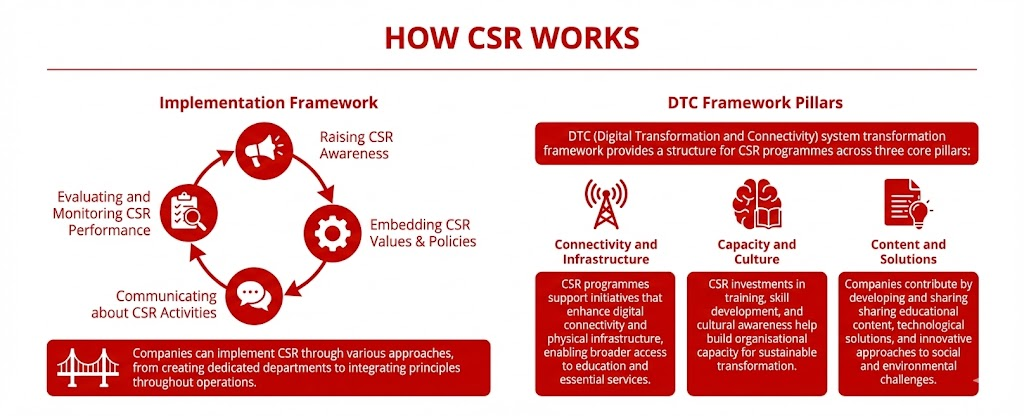
Implementation Framework
CSR implementation involves several key aspects:
- Raising CSR awareness within the organisation
- Embedding CSR values and policies throughout operations
- Communicating about CSR activities internally and externally
- Evaluating and monitoring CSR performance regularly
Companies can implement CSR through various approaches, from creating dedicated CSR departments or foundations to integrating CSR principles throughout their operations and decision-making processes.
DTC Framework Pillars
The Digital Transformation and Connectivity (DTC) system transformation framework provides a structure for CSR programmes across three core pillars:
- Connectivity and Infrastructure: CSR programmes support initiatives that enhance digital connectivity and physical infrastructure, enabling broader access to education and essential services.
- Capacity and Culture: CSR investments in training, skill development, and cultural awareness help build organisational capacity for sustainable transformation.
- Content and Solutions: Companies contribute by developing and sharing educational content, technological solutions, and innovative approaches to social and environmental challenges.
How Can CSR Programmes Help Nonprofits?

CSR programmes provide crucial support to nonprofit organisations through multiple channels. Companies donate money or in-kind resources to charitable causes, enabling nonprofits to expand their reach and impact. Employee volunteer programmes allow staff to contribute their time and expertise, whilst pro-bono services provide professional support that nonprofits might not otherwise afford.
Beyond direct contributions, corporate partnerships with nonprofits create opportunities for collaborative innovation and tailored solutions. These partnerships help provide a holistic view of CSR strategy whilst amplifying overall impact.
Key Stakeholders
Successful CSR requires engagement with diverse stakeholder groups, each playing distinct roles in programme development and implementation. Understanding how to engage stakeholders effectively ensures CSR initiatives address genuine community needs whilst building sustainable partnerships.
Where Does the Money Come From?
CSR funding originates from multiple sources:
- Corporate Funds: Allocation of a portion of company profits towards CSR activities, dedicated CSR budgets or departments for strategic and sustained investment, and large-scale corporate investments in targeted initiatives.
- Employee Contributions: Employee giving programmes, often with company matching, enable workforce participation in CSR efforts whilst amplifying individual contributions.
- Dedicated CSR Funds: Companies establish specific funds for targeted CSR initiatives, ensuring consistent resource allocation for priority programmes.
The funding structure should support sustained, long-term commitment rather than sporadic contributions. Consistent, adequate funding demonstrates genuine commitment and helps build lasting partnerships that drive real change.
Types of Corporate Social Responsibility

CSR initiatives generally fall into four main categories, each contributing to a company’s overall CSR strategy:
1. Environmental Responsibility
Environmental responsibility focuses on initiatives that minimise a company’s environmental impact whilst contributing positively through actions like planting trees or hosting clean-up events.
More companies are assessing their overall environmental impact and taking steps to protect natural resources and minimise their contribution to climate change. These efforts include:
- Waste reduction programmes: Reducing waste through recycling, composting, and limiting single-use items
- Sustainable material sourcing: Sourcing materials from businesses that prioritise ethical and sustainable practices
- Renewable energy initiatives: Reducing fossil fuel usage and transitioning to renewable sources like solar, wind, and hydropower
- Carbon footprint reduction: Adopting strategies to cut greenhouse gas emissions through renewable energy adoption, enhanced energy efficiency, and minimised waste
Environmental responsibility hinges on eliminating the negative impacts of business operations whilst offsetting them through programmes that support biodiversity and ecosystem restoration.
2. Ethical Responsibility
Ethical responsibility ensures that companies operate fairly and ethically at all levels. CSR initiatives focus on social impact and human rights, such as guaranteeing fair wages, safe working conditions, and the proper treatment of employees and suppliers.
This category includes:
- Fair labour practices: Upholding standards that protect worker rights and dignity
- Supply chain transparency: Ensuring ethical sourcing throughout the supply chain
- Ending workplace discrimination: Creating inclusive environments free from bias
- Accountability measures: Establishing mechanisms for both internal and external accountability
Ethical CSR demonstrates that money is not a company’s sole motivator, ensuring choices align with values even when alternatives might save money or boost short-term profitability.
3. Philanthropic Responsibility
Philanthropic responsibility involves businesses giving back to communities through charitable donations, corporate giving programmes, and community engagement. Philanthropy represents one of the most visible aspects of CSR.
Common philanthropic initiatives include:
- Corporate donations: Financial contributions to charitable organisations and causes
- Volunteer programmes: Employee volunteering opportunities that enable staff to contribute time and skills
- Community development projects: Supporting local initiatives that address social challenges
- Disaster relief: Assisting with emergencies and crises
Philanthropy enhances a company’s reputation, fosters a sense of purpose within the workforce, and builds stronger community ties. Effective philanthropic programmes align with company values whilst addressing genuine community needs.
4. Economic Responsibility
Economic responsibility involves demonstrating that money is not the company’s sole motivator. Companies enact policies and procedures to ensure choices align with values, even if alternatives might save money or boost short-term profitability. Such policies and procedures include:
- Supporting economic development: Fostering growth in communities where businesses operate.
- Job creation efforts: Supporting employment opportunities and economic stability
- Local partnerships: Forging relationships that strengthen regional economic ecosystems
- Sustainable business practices: Making financial decisions that promote long-term sustainability whilst balancing profitability
CSR Across Different Industries
CSR in Business
CSR in business encompasses all four types of responsibility, tailored to each company’s sector and stakeholder needs. Modern businesses integrate CSR into their core strategy, recognising it as essential for long-term competitiveness and value creation.
CSR Certificate Meaning
A CSR certificate in cybersecurity and digital contexts refers to a Certificate Signing Request, an encoded file containing information about websites, services, organisations, and domain names. In contrast, Corporate Social Responsibility certification validates a company’s commitment to sustainable and ethical practices.
CSR in Banking
CSR in banking revolves around the commitment to both the financial and non-financial well-being of society. Banks now prioritise funding sustainable and ethical projects, promoting eco-friendly ventures and emphasising long-term sustainability over short-term gains.
Key banking CSR initiatives include:
- Sustainable lending practices: Supporting green and ethical projects through preferential financing
- Philanthropic efforts: Contributing to charitable causes and community development
- Ethical investment strategies: Focusing on socially responsible investing that fosters positive societal change
- Environmental initiatives: Reducing paper waste, implementing energy-efficient facilities, and investing in green projects
Banks can demonstrate environmental CSR by going paperless, issuing eco-friendly debit cards, and investing in nonprofits fighting climate change. The role of financial institutions in CSR continues to expand as stakeholders demand greater accountability.
CSR in Healthcare and Hospitals
CSR in hospital settings and CSR healthcare initiatives focus on delivering accessible, affordable care whilst addressing social determinants of health. Healthcare organisations engage in various CSR activities, including:
- Free medical camps: Providing services in underserved communities
- Medical supply donations: Contributing equipment to disaster-stricken regions or areas in need
- Affordable housing investments: Supporting housing projects to address homelessness
- Environmental sustainability: Implementing eco-friendly practices to reduce carbon footprints
- Community health initiatives: Investing in programmes that address poverty, education, and healthcare access
The impact of CSR in hospitals extends beyond monetary contributions, fostering community trust and empathy whilst enhancing institutional reputation. Hospitals assist the health of disadvantaged populations through free medical camps and funded procedures, increasing accessibility and promoting preventative healthcare.
CSR in Insurance
CSR insurance sector initiatives promote sustainable practices, ethical governance, community support, and environmental stewardship to enhance societal well-being. The insurance industry plays a pivotal role beyond risk management, using CSR to drive positive change.
Insurance companies can implement CSR through:
- Paying valid claims efficiently: Demonstrating maturity and building client satisfaction through quick, fair claim settlement
- Risk minimisation: Reducing claim costs and frequency for clients through proactive risk management
- Strategic philanthropy: Associating with charities and providing disaster relief support
- Environmental initiatives: Making financial investments in energy conservation and environmental risk management
In India, insurance companies that meet specific criteria must contribute 2% of their minimum CSR spend, as mandated by Section 135 of the Companies Act, 2013. This legal framework ensures the insurance sector’s commitment to social responsibility.
CSR in Clinical Trials
CSR in clinical trials refers to Clinical Study Reports. These detailed scientific documents describe the methodology, conduct, and results of clinical trials. These comprehensive reports, often exceeding 1,000 pages for Phase III trials, provide regulators with transparent accounts necessary for drug approval decisions.
A CSR clinical trials document includes study design and objectives, efficacy and safety outcomes, statistical analyses, and supporting data appendices. Unlike corporate responsibility, clinical trial CSRs serve as regulatory documents that ensure transparency and accountability in medical research.
CSR in Veterinary Practice
CSR vet meaning refers to Client Service Representatives in veterinary practices, frontline staff who first interact with pet owners and their animals. Veterinary CSRs play crucial roles in recognising patient distress, triaging cases, and facilitating effective communication between pet owners and medical teams.
Effective veterinary CSRs receive training in:
- Recognising common signs of distress in various species
- Expediting access to trained veterinary personnel
- Initiating conversations about CPR directives with pet owners
- Managing emotionally distressed clients with compassion
CSR in Customer Service
CSR in customer service stands for Customer Service Representative, employees who interact with customers to handle complaints, process orders, and provide information about products and services. Customer service CSRs typically assist by phone, email, chat, or social media, requiring strong communication, problem-solving, and interpersonal skills.
CSR in Sales
CSR in sales is transforming how sales teams operate. Corporate social responsibility now extends beyond production and HR into commercial functions. Sales staff must understand customer CSR challenges, propose tailored solutions with reduced impact, and integrate sustainability criteria into their performance metrics.
Modern CSR sales approaches focus on contribution rather than mere promotion, requiring sales professionals to discuss utility, meaning, impact, and lifecycle analysis. This shift demands greater transparency, ethics, and respect for customers whilst meeting needs aligned with sustainability objectives.
CSR Marketing
CSR marketing strategically integrates marketing activities with a company’s Corporate Social Responsibility goals. By promoting the brand’s focus on social, environmental, and ethical initiatives, companies build credibility with socially conscious consumers.
Effective CSR marketing highlights efforts like sustainable practices, ethical supply chains, and community involvement through authentic messaging that stands for more than profit. This approach emphasises transparent communication, consistency across channels, and deep connections with audiences valuing sustainability.
What Are the Benefits of Corporate Social Responsibility?

Beyond the benefits already discussed, CSR delivers additional strategic advantages:
Access to Capital
Investors increasingly factor ESG and CSR performance into investment decisions. Companies with strong CSR credentials enjoy improved access to capital and enhanced shareholder confidence. Transparent CSR reporting helps publicly listed companies meet compliance requirements whilst demonstrating accountability.
Regulatory Advantages
CSR provides a buffer against regulatory challenges. Companies with strong CSR programmes often enjoy better relationships with regulators, which can provide advantages during periods of regulatory scrutiny or policy changes.
Supply Chain Resilience
CSR-focused companies develop deeper supplier relationships based on shared values. These connections provide priority access during shortages or disruptions, strengthening overall supply chain resilience.
Crisis Management
Strong CSR programmes provide stakeholder support during crises. Communities, customers, and regulators are more likely to support companies with established CSR credentials, giving them the benefit of the doubt when challenges arise.
Challenges to Be Aware of
Whilst CSR offers substantial benefits, companies must navigate several challenges:
Greenwashing Risks
The enemy of CSR is greenwashing, using misleading communications to appear more environmentally friendly than reality. Avoiding greenwashing requires authentic commitment and transparent reporting backed by verifiable data.
Companies must focus on programmes that are material to their operations rather than highlighting immaterial initiatives solely for favourable publicity. Acknowledging areas for improvement builds credibility more effectively than portraying perfection.
Resource Constraints
Implementing comprehensive CSR programmes requires dedicated resources, financial, human, and technological. Companies must balance CSR investments with other business priorities whilst ensuring adequate, consistent funding.
Sporadic or insufficient funding can leave nonprofit partners struggling and make CSR seem like token gestures rather than genuine commitments.
Measurement Difficulties
CSR is less quantifiable than ESG, making it harder for outside observers to measure objectively. Companies must develop robust measurement frameworks that track both short-term indicators and long-term impact.
Stakeholder Alignment
Different stakeholders may have conflicting expectations about CSR priorities. Companies must engage meaningfully with diverse groups to understand concerns while making strategic decisions about resource allocation.
What is the Difference Between CSR and ESG?

Understanding the distinction between CSR and ESG is crucial for effective implementation:
Purpose and Focus
CSR’s purpose centres on general social responsibility, advocating that businesses take actions because they’re the right thing to do. It’s typically values-driven and voluntary, focusing on creating larger societal impacts through initiatives rooted outside the business.
ESG’s purpose emphasises risk management. Whether addressing resource depletion or employee mistreatment, ESG aims to improve circumstances that could impact business value. It considers not only social and environmental factors but also governance issues such as executive compensation, board diversity, and internal controls.
Measurability
The ability to measure results represents the most crucial difference between ESG and CSR. CSR is an internal framework for companies that can be difficult or impossible for outside observers to measure objectively.
ESG is highly measurable and quantifiable, providing fact-based evidence crucial for investors and stakeholders. ESG leans towards quantity, whilst CSR leans towards quality.
Reporting Standards
ESG applies standardised and comparable reporting frameworks, ensuring disclosures are consistent across industries and regions. International frameworks, standards, regulations, and questionnaires provide a basis for comparable ESG disclosure and performance measures.
CSR outcomes and reporting are generally developed independently by companies, offering more flexibility but less comparability. Understanding major ESG frameworks helps companies navigate reporting requirements.
How Does CSR Relate to ESG?
CSR and ESG have a complementary relationship:
- CSR feeds ESG: Companies’ CSR initiatives serve as the basis for ESG evaluations. For example, a company that reduces CO₂ emissions or adopts ethical governance practices directly feeds into ESG indicators.
- ESG provides a framework to CSR: ESG gives structure and legitimacy to CSR efforts, enabling standardised measurement and comparison.
Companies can run CSR and ESG programmes simultaneously, using CSR’s flexibility for values-driven initiatives whilst leveraging ESG’s rigour for measurable performance tracking. The relationship between sustainability and ESG provides additional context for understanding these frameworks.
What Are Examples of Corporate Social Responsibility Programmes?
Successful CSR programmes span diverse industries and approaches:
Technology Sector
Chipotle Mexican Grill has become a CLMA-certified leader in the matching gift industry. By implementing matching gift auto-submission functionality, Chipotle simplifies the donation matching process while significantly boosting CSR funding through successful matches.
Food Industry
Danone actively engages employees in promoting sustainable practices through philanthropy, volunteerism, and other initiatives. The company’s CLMA-certified matching gift programme uses auto-submission to provide an effortless experience for employees, doubling their charitable contributions.
Local Initiatives
PETRONAS in Malaysia demonstrates comprehensive CSR through its PETRONITA mental health programme, which provides school counsellor training and student support, reaching over 60,000 students and teachers since 2019.
Nestlé Malaysia’s food aid programme has distributed meals to 26,000+ families whilst also running nutrition and healthy lifestyle campaigns. These examples illustrate how effective CSR programmes address genuine community needs.
How Can I Develop a Socially Responsible Business?

Building a socially responsible business requires systematic planning and authentic commitment:
1. Define Your Company’s Values
The foundation of social responsibility lies in understanding and articulating your company’s values. Identify what your organisation stands for and against, providing a clear framework for aligning with social causes that resonate with your corporate identity.
2. Involve Your Staff
Employees must be active contributors to the social responsibility agenda. When staff help shape CSR efforts, they feel more motivated and involved, leading to more creative ideas and greater commitment. This deep connection translates shared values into meaningful action.
3. Recognise Issues That Matter
Understanding stakeholder concerns is crucial. Conduct research and engage with customers through surveys and social media to identify causes that resonate with them. This insight enables you to tailor initiatives to align with stakeholder values.
4. Establish Realistic Goals
Setting specific, measurable, attainable, relevant, and time-bound (SMART) goals is essential. Establish a timeframe for initiatives and define particular steps that align with values whilst contributing meaningfully to chosen causes.
5. Integrate Sustainability into Operations
Evaluate and enhance business operations to minimise environmental impact. Practical steps include adopting eco-friendly practices, reducing waste, and sourcing materials responsibly. Sustainable marketing strategies can amplify these efforts.
6. Promote Ethical Business Practices
Ensure fair treatment throughout the supply chain, from employees to suppliers. Establish transparent governance structures and ethical decision-making processes.
7. Support Community Initiatives
Become active in local communities by supporting initiatives addressing social challenges. Examples of such initiatives include contributing to local charities, partnering with nonprofits, or initiating community development projects.
8. Invest in Education and Awareness
Promote education about social issues within your organisation and the broader community. Organise workshops, webinars, or awareness campaigns to inform and engage stakeholders.
9. Implement Transparent Reporting
ESG reporting frameworks, such as GRI, provide a framework for communicating CSR performance. Regular, transparent disclosure builds trust and demonstrates genuine commitment.
10. Ensure Responsible Supply Chains
Extend CSR commitment to supply chains by collaborating with suppliers who share similar values. Ensuring supply chain sustainability contributes to a more socially responsible ecosystem.
What to Avoid When Creating a CSR Business Model? (CSR Mistakes to Avoid)

Understanding common pitfalls helps companies build more effective CSR programmes:
1. Leading with PR Stunts and Photo Ops
When CSR programmes prioritise appearances over impact, stakeholders notice negatively. Authenticity matters more than publicity. Focus on meaningful initiatives that create genuine change rather than opportunities for marketing materials.
2. Weak Goals and Misaligned Priorities
Sustainability reports built around weak organisational goals are doomed to fail. Know what success looks like for your company and build CSR programmes around that vision. Recognise that triple bottom line pillars are interconnected, requiring balanced attention to sustainability alongside financial performance.
3. Mismanaged Data
Good data collection is essential for achieving meaningful results from initiatives such as auditing or footprinting. Assign data collection responsibilities to trained people and continuously check numbers for accuracy. Without reliable data, measuring impact becomes impossible.
4. Breaking Reporting Rules
Good reporting should follow trusted frameworks or guidelines. The Global Reporting Initiative provides an excellent structure for standardised disclosure. Understanding GRI reporting standards ensures compliance and comparability.
5. Discounting Stakeholder Feedback
Reporting shouldn’t be a one-way endeavour. Take advice from third parties such as auditors and stakeholder panels, who can comment on reports and help verify data accuracy. Meaningful engagement with stakeholders ensures programmes address genuine needs.
6. Hyper-Specifying Programme Funding
Overly rigid funding guidelines can stifle innovation and restrict nonprofits from doing their best work. When organisations must shoehorn projects into narrow requirements, it leads to inefficiency and missed opportunities.
7. Unreachable or Irrelevant Targets
Targets should be linked to corporate priorities whilst remaining relevant, aggressive, yet achievable. Setting unrealistic goals undermines credibility and demoralises teams.
8. Thinking Short-Term
Accept sustainable opportunities simply because they have higher price tags or longer payback periods. Whilst quarterly results matter, maintaining focus on long-term value creation pays dividends.
9. Underreporting and Inconsistent Communication
Don’t limit the communication of sustainability performance to annual CSR reports. Use various media to communicate progress and challenges whilst ensuring message consistency across channels.
10. Inadvertent Greenwashing
Whilst conveying environmental and social progress is essential, focusing solely on positives or highlighting immaterial programmes creates problems. Avoiding greenwashing requires acknowledging areas needing improvement while tying CSR goals to the company’s mission.
Conclusion
Corporate Social Responsibility has evolved from a peripheral concern to a central element of business strategy. Whether in banking, healthcare, insurance, sales, customer service, or marketing, CSR principles shape how organisations operate and compete in today’s marketplace.
The evidence is clear: companies embracing authentic CSR programmes enjoy enhanced reputations, improved financial performance, stronger stakeholder relationships, and greater resilience. Yet success requires more than good intentions. It demands systematic implementation, transparent reporting, genuine stakeholder engagement, and unwavering commitment to continuous improvement.
Understanding ESG frameworks and how they complement CSR initiatives provides structure for measuring and communicating impact. As regulatory requirements tighten and stakeholder expectations rise, companies that integrate CSR authentically into their core strategies will thrive, whilst those that treat it superficially will struggle.
For organisations ready to embark on or enhance their CSR journey, expert consultation provides invaluable guidance. From developing comprehensive strategies to implementing robust reporting frameworks, professional support ensures CSR initiatives deliver genuine impact whilst building long-term value.
The future belongs to businesses that recognise responsibility and profitability as complementary rather than competing objectives. By embracing CSR principles today, companies position themselves for sustainable success tomorrow.
Ready to transform your business through meaningful CSR initiatives?
Discover how Elite Asia’s comprehensive ESG solutions can guide your organisation towards authentic, impactful corporate social responsibility. From ESG consultation to sustainability reporting, our experts provide tailored support at every stage of your CSR journey. Contact us today to build a responsible business that creates lasting value for all stakeholders.