How to Do Keyword Research for Baidu SEO 2026 (+Tips & Tools)
If your business wants to reach Chinese consumers online, mastering Baidu search is non-negotiable. Baidu holds roughly 58% of China’s search market as of January 2026, making it the single most important search engine in the country. Yet many international businesses make the mistake of applying Google SEO tactics directly to Baidu — and wonder why their rankings never move.
This guide walks you through how to do keyword research for Baidu SEO in 2026, with the right Baidu SEO tools, practical tips, and a step-by-step approach tailored for digital marketers, SEO specialists, business stakeholders, and B2B teams.
The following is a list of the knowledge you will acquire:
- Why Baidu Matters: It’s the go-to platform for Chinese users, especially on mobile.
- The main differences: Baidu prefers .cn domains, fast-loading pages, meta keywords (yes, they still matter).
- Tools you’ll need: Baidu Keyword Planner, Baidu Index, and other tools tailored for the Chinese market.
- 4-step process: Start with basic keywords, expand your list, analyse search data, focus on long-tail phrases.
TL;DR: To optimise your keywords, review Baidu’s algorithm preferences and follow its best practices. Collect keywords using tools like the Baidu Keyword Planner and Baidu Index. Analyse demand using long-tail phrases and cultural nuances. Integrate keywords naturally and refine your strategy by monitoring performance.
What is Baidu?
Baidu is China’s dominant search engine, often described as the “Google of China.” Founded in 2000 by Robin Li and Eric Xu, the platform serves over 500 million active users and controls the majority of organic and paid search traffic across mainland China.
But Baidu is far more than a search bar. It operates a full digital ecosystem that includes Baidu Baike (a Wikipedia-style encyclopaedia), Baidu Tieba (a community forum platform), Baidu Maps, Baidu News, and Baidu’s own AI assistant. This means that Baidu SEO is not simply about ranking your website — it also means building visibility within Baidu’s wider ecosystem of owned properties.
For any business targeting the Chinese market, Baidu is the starting point. As Elite Asia’s guide on Top 10 Chinese Search Engines Every Business Needs to Know explains, understanding which platforms your audience uses — and when — is the foundation of any China SEO strategy.
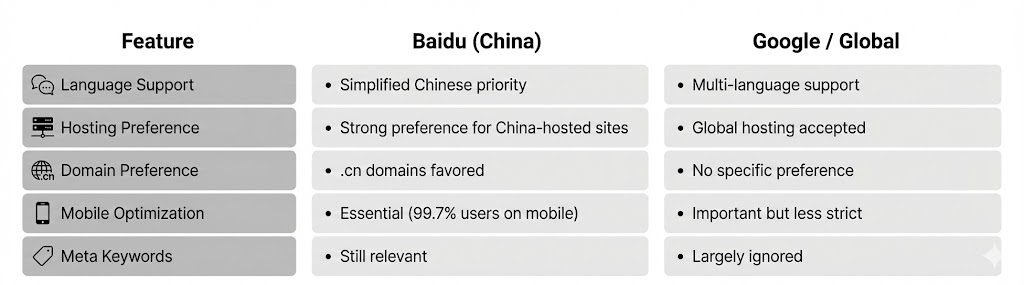
Baidu vs. Other Search Engines
Search Algorithm Differences
Baidu’s algorithm is customised for China’s distinct online landscape, distinguishing it from global search engines like Google, which holds a 90.48% global market share.
Here are some key differences in how Baidu operates:
- Indexing Speed: Baidu updates its index weekly, meaning new content takes longer to appear.
- Performance Standards: It prioritises sites with a First Contentful Paint (FCP) under 2 seconds and favors hosting within China, especially with .cn domains.
- Backlink Preferences: Backlinks from Chinese websites carry more weight.
- Meta Keywords: Unlike most search engines, Baidu still uses meta keywords as ranking factors.
These differences highlight Baidu’s focus on localised content and performance, which creates specific challenges for optimisation.
Chinese Market Requirements
With 99.7% of China’s internet users accessing the web via mobile devices, mobile optimisation is absolutely critical for success on Baidu.
Here’s a comparison of key market needs:
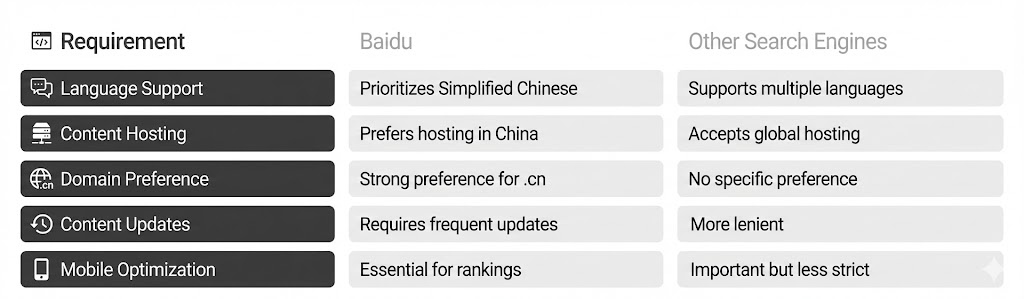
Additional considerations include:
- Content Structure: Shorter, easily readable content performs better than long-form articles.
- Technical Tags: Uses content-language HTML attributes instead of hreflang tags.
- Cultural Relevance: Content should align with Chinese holidays, traditions, and even regional dialects” for smoother phrasing.
These insights are crucial for crafting a strategy tailored to Baidu, laying the groundwork for effective keyword research and optimisation techniques discussed in later sections.
Understanding Baidu’s Search Algorithm
Baidu’s algorithm shares some similarities with Google’s, but it has distinct ranking signals that you must understand before doing any keyword research.
Key Baidu ranking factors include:
- Keyword relevance and density: Baidu places heavy weight on exact-match keywords appearing in titles, meta tags, and body content. About 49% of top-ranking pages use exact-match keywords in their content. On average, the keyword density of top-ranking pages is less than 1%.
- Content length and originality: Top-ranking pages average around 4,929 characters of Chinese-language content. Baidu penalises duplicate or plagiarised material.
- Domain age and authority: Older, well-established domains with consistent content histories tend to rank higher.
- Backlinks from Chinese domains: The number and quality of backlinks from reputable Chinese websites carry significant weight.
- Mobile-friendliness: Baidu expects responsive design rather than separate mobile pages.
- HTTPS: Now an official Baidu ranking signal, with 69.6% of top-ranking pages using HTTPS.
- Social signals: Activity and engagement from platforms like Weibo and WeChat can positively influence rankings.
- Page speed and hosting: Hosting on a Chinese server (or using a CDN optimised for China) significantly affects load times and crawl rates.
One critical difference from Google: Baidu’s own properties dominate the SERPs. A notable 34.9% of top-10 search results are Baidu-owned pages — up from 24.7% in 2020. This is why a strong Baidu SEO strategy must account for Baidu’s broader ecosystem, not just your own website.
For a deeper dive into Baidu’s technical requirements and ranking logic, see Elite Asia’s dedicated resource: Baidu SEO: How to Optimise China’s #1 Search Engine in 2026.
How to Conduct Keyword Research for Baidu SEO
Keyword research for Baidu follows a logical sequence. Here is a clear, step-by-step process to get you started:
Start with core keywords
Identify terms that directly relate to your business or products. Think like your target audience:
- What problem are they trying to solve?
- What specific features do they value in your product?
Define Your Core Topics
Start by identifying the main themes relevant to your business or products. Think from the perspective of a Chinese consumer — what would they type into Baidu search to find you?
For example, if you offer B2B software, your core topics might include: “企业软件” (enterprise software), “SaaS解决方案” (SaaS solutions), or “云计算服务” (cloud computing services).
Keep your list to 5–10 core terms at this stage. You will expand them later.
Research in Simplified Chinese
This is one of the most important rules of Baidu SEO: always research and write keywords in Simplified Chinese. Direct English-to-Chinese translation will often miss how real users search.
Also consider Pinyin variations — many Chinese users type Pinyin (romanised Chinese) that auto-converts to characters. Research both character-based and Pinyin forms of your target keywords.
If your team lacks native Chinese language skills, this is where working with a localisation partner matters enormously. Elite Asia’s resource on SEO Translation vs SEO Localisation explains why adapting content at a cultural level, rather than just translating it, leads to far stronger results.
Use Baidu Autocomplete
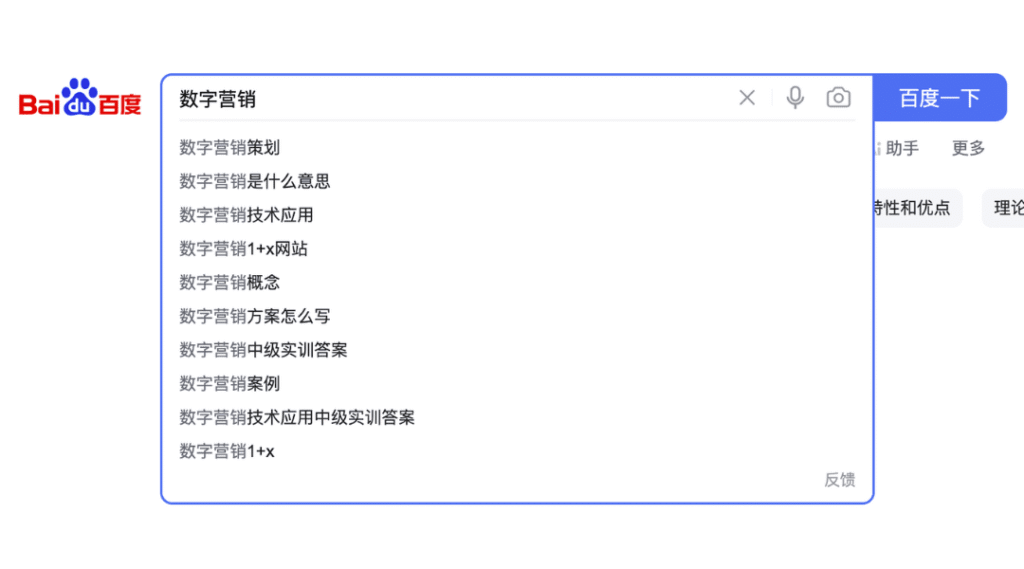
A fast and free starting point is Baidu’s own autocomplete feature. Type your core keyword into the Baidu search bar and study what the platform suggests.
For example, typing “电商” (e-commerce) may return suggestions like “跨境电商” (cross-border e-commerce) or “电商运营方案” (e-commerce operation plan). These suggestions reflect real, high-frequency user queries.
Explore Related Searches
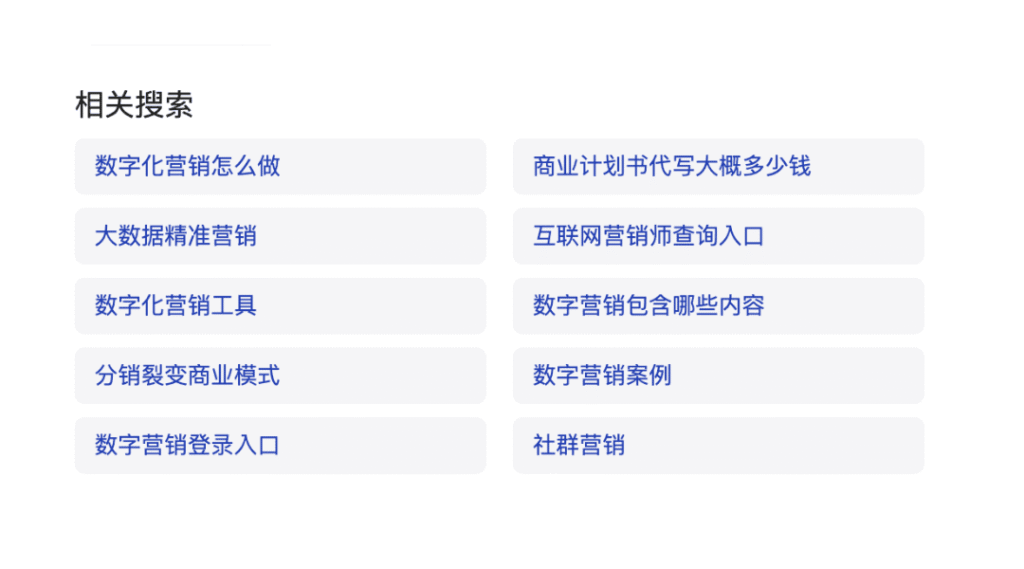
You can also explore “related searches” (相关搜索) on Baidu to discover searches that users commonly pair with your initial query.
Expand Using Baidu-Specific Tools
Once you have a seed keyword list, use dedicated Baidu keyword research tools to expand it. Baidu Keyword Planner, Baidu Index, and Baidu Webmaster Tools are the three most important platforms (covered in detail below).
Analyse Keyword Demand and Competition
Review each keyword for:
- Search volume — how often users search for this term monthly.
- Competition level — how many advertisers or pages compete for the term.
- Trend — is the term growing, stable, or declining?
Use Baidu Index and Baidu Keyword Planner together for the most complete picture.
LocaliSed keywords
In the Chinese market, localisation also involves cultural alignment, regional dialects, and search habits. For instance:
The word “cheap” can be expressed as “便宜” (piányí) in Mandarin, but in certain regions, alternative slang like “划算” (huásuàn) may resonate more with users.
Work with local partners to properly localise keywords.
Prioritise and Organise Your List
Group keywords by intent (informational, commercial, navigational) and by content category (product keywords, service keywords, long-tail keywords). Build a spreadsheet with columns for search volume, competition level, and priority score.
Map keywords to the customer journey
- Awareness stage: general queries like “what is Baidu SEO?” or “how to improve website speed in China”.
- Consideration stage: comparative phrases like “Baidu SEO tools vs Google tools” or “best e-commerce platforms in China”.
- Decisions stage: actionable terms like “buy [product]” or “sign up for [service]”.
Monitor Keyword Results
Regular monitoring is essential to refine your keyword strategy. By tracking key metrics, you can confirm whether your chosen keywords are effective and adjust as needed:
| Metric Type | What to Monitor | Why It Matters |
|---|---|---|
| Traffic Data | Page views, visitor count, bounce rates | Gauges how well your content is performing |
| Search Terms | Top keywords driving traffic | Highlights terms that resonate with your audience |
| Geographic Data | Visitor location distribution | Helps you tailor content to specific regions |
| User Behavior | Time on site, navigation paths | Shows engagement levels and usability of your site |
Baidu Tongji and Webmaster Tools can also help you identify indexing issues and track keyword rankings, offering deeper insights for refining your approach.
Update Your Strategy
Use the performance data to make informed adjustments to your keyword tactics:
- Regional Targeting: Focus on specific areas based on geographic data. For instance, if you’re in the online education space and see high search volumes in tech-driven cities, consider adding location-specific keywords like “广州在线学习课程” (online learning courses in Guangzhou).
- Performance Tweaks: Look for keywords generating traffic but few conversions, pages with high bounce rates, and differences in performance between mobile and desktop users.
Additionally, use Baidu Index to keep up with trending topics and shifts in search behavior.
Recommended Tools for Baidu Keyword Research
Here is a practical overview of the most important Baidu SEO tools available in 2026:
Baidu Webmaster Tools
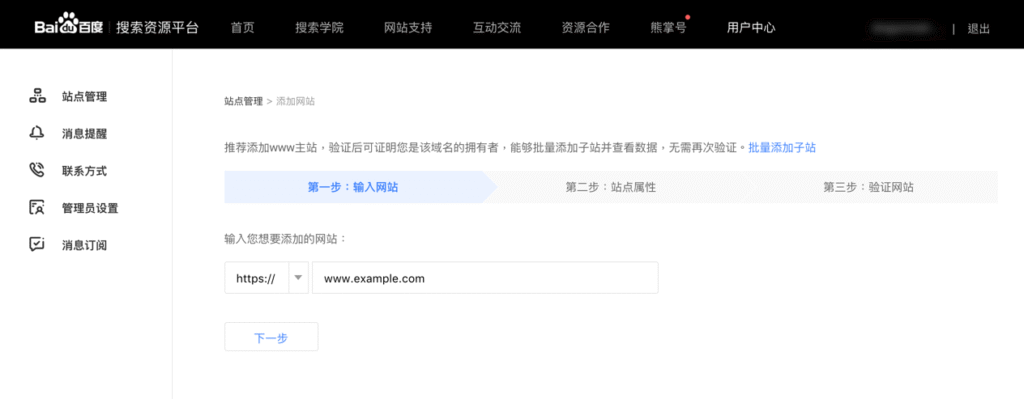
Also known as Baidu Ziyuan (百度资源平台), Baidu Webmaster Tools is the official platform for managing your site’s relationship with Baidu’s crawler.
What it does:
- Submits sitemaps and robots.txt files directly to Baidu.
- Shows which keywords your site currently ranks for and generates impressions.
- Flags crawl errors, indexation issues, and mobile usability problems.
- Provides data on page loading speed and overall site health.
Step-by-Step Access Instructions
- Create a Baidu Account: Go to the Baidu registration page to sign up using your phone number, which is required for SMS verification.
- Log in to Baidu Webmaster Tools: Visit the Baidu Ziyuan Platform and log in with your credentials.
- Add Your Website: Click on the “User Center” (用户中心) and select “Site Management” (站点管理). Click “Add Site” (添加网站), enter your URL, and select the site category.
- Verify Site Ownership: Choose one of the following methods to verify your site:
- HTML Tag: Add a
<meta>tag provided by Baidu to your site’s<head>section. - File Verification: Upload an HTML verification file to your website’s root directory.
- CNAME Record: Update your DNS settings with the CNAME record provided.
- HTML Tag: Add a
- Finalise: Click the “Verify” (完成验证) button in the dashboard.
Key Considerations:
- You need a Baidu account to log in. If your site requires an ICP (Internet Content Provider) licence to operate in China, Baidu Webmaster Tools will also help you verify your domain.
- The interface is in Chinese, so using a browser translator is recommended.
- While it can be instant, Baidu recommends waiting up to 6 hours for verification to process.
- If you do not have a Chinese phone number, you may need to work with a local partner to complete the setup.
This tool is the non-negotiable starting point for any Baidu SEO effort. Without it, you are essentially operating blind.
Baidu Tongji
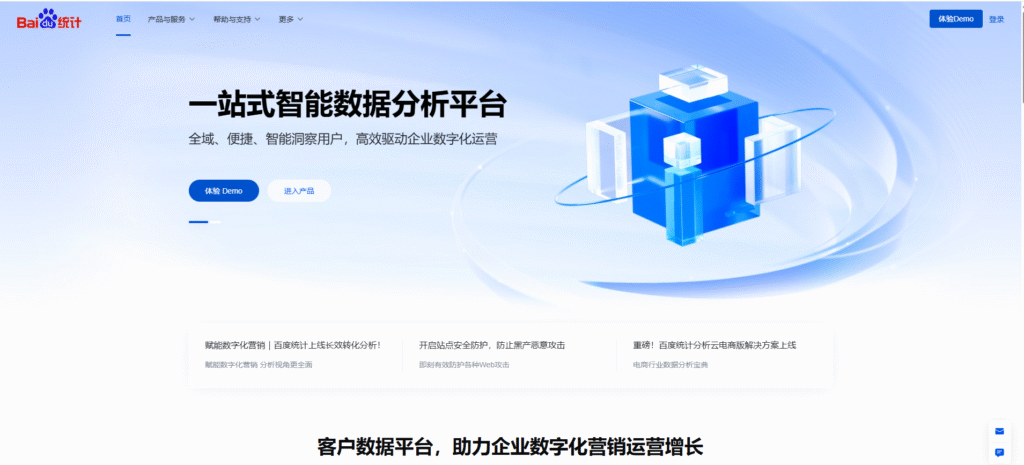
Baidu Tongji is a powerful tool for analyzing your site’s traffic and rankings. Here’s how to get started:
- Create an account through Baidu PPC or Baidu Webmaster Tools. You’ll need to complete the necessary verification process (note: the interface is in Chinese).
- Log in using your Tuiguang or Zhanzhang account, then add the provided tracking code to the
<head>section of every page on your site. This enables unlimited tracking of page views and ensures quick data processing.
Baidu Keyword Planner
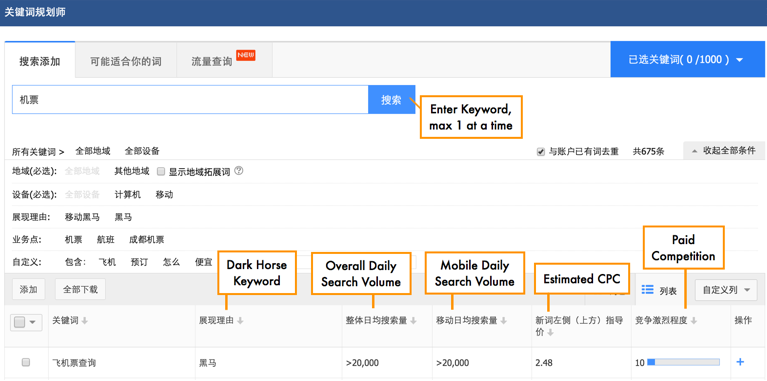
Baidu Keyword Planner (百度关键词规划师) is accessible through a Baidu PPC (Pay-Per-Click) account and functions similarly to Google’s Keyword Planner in Google Ads.
What it does:
- Provides monthly search volume data for specific Chinese keywords.
- Generates related keyword suggestions.
- Shows estimated CPC (cost-per-click) for paid campaigns.
- Helps evaluate keyword competition levels.
Here’s how to access the Baidu Keyword Planner:
- Register a Baidu PPC account: To sign up, visit the Baidu Marketing site (aifanfan.baidu.com). Note that this often requires a Chinese business license, tax ID, and a 900 USD deposit, making it challenging for foreign businesses without a local partner.
- Verify business credentials: You must submit documentation for verification, which can take several days.
- Log in to the dashboard: After that, log in to the Baidu PPC platform.
- Locate the Keyword Planner: In the Tools section, find the “Keyword Planner” (关键词规划师) tool. This will allow you to search for keyword ideas, search volumes, and competition levels.
How to use it for SEO: Even if you are not running paid ads, the Keyword Planner is invaluable as a Baidu keyword research tool for organic content planning. Input a seed keyword and study the related suggestions, filtering by search volume to build your content calendar.
Example: For a business targeting eco-friendly products in China, entering “环保产品” (eco-friendly products) might yield related terms like “可降解包装” (biodegradable packaging) or “绿色建材” (green building materials) — each with search volume data to help you prioritise.
Baidu Index

Baidu Index (百度指数 — Baidu Zhishu) is Baidu’s equivalent of Google Trends. It is a free, publicly accessible tool that tracks the popularity of search terms over time.
What it does:
- Shows search interest trends over days, weeks, months, or years.
- Provides regional breakdowns — useful for targeting specific provinces or cities.
- Displays demographic data about who is searching for a given term.
- Highlights related searches and rising topics.
Steps to Access Baidu Index:
- Create a Baidu Account: Go to the Baidu registration page.
- Verify Phone Number: Use a Chinese mobile number to receive an SMS code. International numbers can sometimes work, but registration can be unstable.
- Access the Platform: Navigate to index.baidu.com.
- Keyword Search: Enter your target keywords (preferably in Chinese for better accuracy) to view trend graphs, search volume, and demographic breakdowns.
Key Tips:
- Data Limitations: For low-volume or rare keywords, data may not appear, requiring a Baidu advertising account for deeper insights.
- VPN/Location: If accessing from outside China, a VPN might be necessary for stability.
- Alternatives: For broader SEO, use Baidu Webmaster Tools to monitor indexing and search performance.
How to use it strategically:
- Monitor seasonal trends — identify when demand for your product category peaks.
- Assess keyword longevity — determine if a keyword is a short-term trend or a long-term opportunity.
- Identify regional targets — find out which cities or provinces have the highest search interest for your keywords.
- Plan content around events — see how search volume changes around Chinese New Year, Golden Week, or major industry conferences.
Example use case: An online education platform targeting Chinese students could use Baidu Index to discover that searches for “高考辅导” (college entrance exam tutoring) spike sharply in February–May each year, allowing them to plan content releases strategically.
Third-Party Tools
- Chinaz – Chinaz is a free tool that analyses keywords based on daily searches, traffic data, CPC (cost-per-click) and related keywords.
- Aizhan Keyword Tool – Aizhan offers long-tail keyword suggestions based on user-inputted keywords and allows tracking of keyword performance.
- AccuRanker – Accuranker is a tracking tool that monitors organic search results on Baidu, helping users analyse keyword performance over time.
- 5118 – 5118 provides insights into general keywords, related long-tail keywords, CPC, daily search volume and competition levels.
Other Keyword Research Tools
If you’re looking for alternatives, several other tools can complement Baidu-specific ones:
| Tool | Key Features |
|---|---|
| SEMrush | Google keyword data, Baidu position tracking |
| Ahrefs | Supports multiple search engines, backlink analysis |
How to Use These Baidu Tools to Optimise Your Website in China
Choosing the right Baidu SEO tools is essential for any successful keyword strategy. Here is how to use the main tools available to you.
Analysing Keyword Demand and Competition
Both Baidu Keyword Planner and Baidu Index let you compare keyword demand side by side. Use them to identify keywords with high search volume and relatively low competition — especially in niche B2B sectors where established players may not have fully covered the market.
For competition analysis, look at the number of pages Baidu returns for a given query (shown as “百度为您找到相关结果约X个”). A lower number suggests less competition and easier ranking potential.
Long-tail Keywords
Long-tail keywords — phrases of three or more Chinese characters — are a powerful opportunity in Baidu SEO. They attract users with clearer, more specific intent, and they are typically easier to rank for than broad head terms.
For example, instead of targeting “在线教育” (online education), a more targeted phrase might be “广州在线学习课程” (online learning courses in Guangzhou). This kind of geo-specific, long-tail approach can deliver highly qualified traffic.
Tools like 5118 and Aizhan are particularly good for discovering long-tail keyword suggestions in Chinese.
Understanding how to serve your Chinese audience at a deeper linguistic level is part of good localisation practice. For context on the linguistic diversity across China, Elite Asia’s article on Languages Spoken in China is a useful background read.
Cultural and Linguistic Nuances
Keyword research for Baidu is as much a cultural exercise as a technical one. Chinese consumers use different terminology, phrasing, and emotional language compared to English-speaking markets.
Consider the following:
- Idiomatic search terms — Mandarin internet culture has its own slang and trending phrases. What works in a direct translation may feel foreign or awkward to native speakers.
- Regional variations — Search behaviour can differ between Tier 1 cities (Beijing, Shanghai, Shenzhen) and lower-tier cities.
- Seasonal and cultural events — Chinese New Year, Singles’ Day (光棍节), and Golden Week drive massive search spikes for relevant products. Use Baidu Index to plan content around these dates.
Elite Asia’s piece on Brand Localisation for Greater China covers why cultural adaptation goes beyond language and directly affects how your brand is perceived across the Chinese-speaking world.
For broader multilingual SEO considerations in Asia, Multilingual SEO Copywriting in Hong Kong is also highly relevant for businesses targeting Greater China.
Integrating Keywords Into Your Content
Once you have a finalised keyword list, integrate your terms naturally and strategically:
- Page titles — Keep titles under 32 characters (including Chinese characters) to meet Baidu’s recommended title length.
- Meta descriptions — Write relevant, keyword-rich meta descriptions in Simplified Chinese.
- Body content — Aim for at least 3,000 characters per page. Top-ranking pages average around 4,929 characters. Maintain a natural keyword density — do not stuff keywords.
- Headings and subheadings — Use keyword-rich H1, H2, and H3 tags to signal topical relevance to Baidu’s crawler.
- Internal linking — Build a strong internal link structure in Simplified Chinese, helping Baidu understand your site architecture.
For website-level implementation, Elite Asia’s guide to Website Localisation and Multilingual WordPress Localisation offer practical steps for adapting your site fully for the Chinese market.
Monitoring and Refining Your Keyword Strategy
Keyword research is not a one-off task — it is an ongoing cycle. Once your content is live, use the following methods to monitor and refine performance:
- Baidu Webmaster Tools — Track indexed pages, crawl errors, and which keywords are generating impressions and clicks.
- AccuRanker — A rank-tracking tool that monitors your positions in Baidu’s organic results over time.
- Monthly content audits — Review which pages are ranking and where they can be improved with updated keywords or richer content.
- Seasonal reviews — Update your keyword list before major Chinese holidays or industry events.
For a broader China SEO framework that covers content, on-site, off-site, and technical factors together, Elite Asia’s in-depth article on SEO in China 2026 is an excellent companion guide.
Tips for Successful Baidu Keyword Research
To get the most out of your Baidu search keyword strategy, keep these practical tips in mind:
- Always use Simplified Chinese — Research and write all content in Simplified Chinese, not Traditional Chinese or Pinyin alone. Baidu’s core audience in mainland China uses Simplified characters.
- Check Baidu’s autocomplete regularly — It reflects the freshest real-time search trends and can surface keyword ideas you won’t find in any paid tool.
- Prioritise intent over volume — A mid-volume keyword with clear commercial or informational intent will outperform a high-volume keyword with vague intent every time.
- Target long-tail keywords early — For new entrants to the Chinese market, long-tail keywords offer faster, more achievable ranking opportunities than head terms.
- Align keywords with China’s content ecosystem — Your keywords should guide not just your website, but also your WeChat articles, Baidu Baike entries, and social platform content. Understanding the full landscape is critical — Elite Asia’s How to Succeed in Digital Marketing in China explains how search and social platforms work together in China’s digital ecosystem.
- Consider ICP compliance early — Without an ICP licence, your website may load slowly or be blocked in China, making all your SEO work ineffective.
- Localise beyond translation — Simply translating English keywords into Chinese will not deliver the same results as genuine keyword research conducted in Chinese from the start. Elite Asia’s resource on Marketing Localisation outlines how localisation impacts digital performance at every level.
- Use a global marketing framework — Baidu SEO should sit within a broader global marketing strategy. Elite Asia’s article on Global Marketing Strategy helps you understand how China fits within your wider internationalisation plan.
- Supplement with third-party tools — In addition to the official Baidu tools, platforms like 5118, Chinaz, and Aizhan offer additional keyword data, long-tail suggestions, and competitor insights not available through Baidu’s own tools.
- Document everything — Maintain a live keyword spreadsheet with columns for search volume, competition level, content status, and target page. This keeps your strategy organised and measurable.
For businesses operating across multiple Asian markets, Elite Asia’s overview of Marketing Platforms in Asian Countries provides broader context on how Baidu keyword research fits within a multi-market SEO approach.
Also, if you are planning a Digital Marketing strategy beyond just search — including WeChat, social media, and content marketing for China — Elite Asia’s full suite of digital marketing services covers all major channels.
Tips for Better Results
For improved outcomes with your Baidu keyword strategy, focus on these areas:
- Technical Adjustments:
- Stick to a simple HTML5 layout, as Baidu’s crawlers have difficulty with JavaScript and Flash.
- Optimise for mobile devices – most users in China browse via smartphones.
- Submit detailed sitemaps to help Baidu better understand your site.
- Content Planning:
- Use specific, well-targeted keywords.
- Avoid duplicate content to steer clear of penalties.
- Place key information at the top of your content, aligning with Baidu’s prioritisation rules.
- Cultural Awareness:
- Work with native speakers to ensure linguistic precision.
- Keep all content in Simplified Chinese.
- Use Baidu Index to stay informed about trending topics.
Ready to Master Baidu SEO?
Doing keyword research for Baidu in 2026 requires more than copying your Google strategy. It demands cultural understanding, the right Baidu keyword research tools, and a sustained commitment to creating genuinely localised content for a Chinese-speaking audience.
From understanding Baidu’s algorithm and using Baidu Webmaster Tools, to finding long-tail keywords with Baidu Index and integrating them into high-quality Simplified Chinese content — every step in this guide builds towards one goal: sustainable organic visibility in China’s most important search engine.
Ready to take the next step? Whether you are entering the Chinese market for the first time or looking to strengthen your existing Baidu presence, Elite Asia’s team of native Chinese-speaking digital marketing specialists can help you build a keyword strategy that drives real results.
👉 Explore Elite Asia’s China Digital Marketing Services and start connecting with your Chinese audience today.