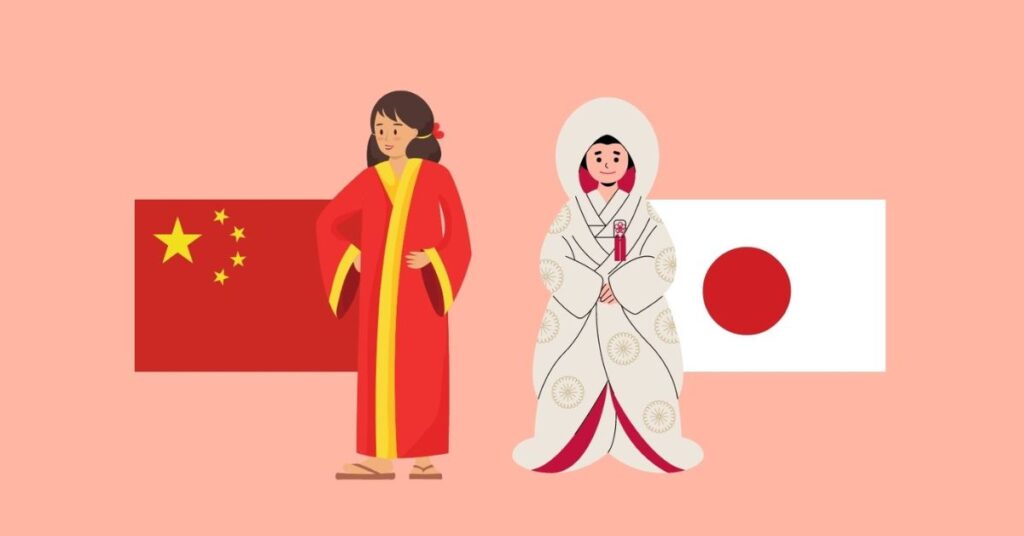
Chinese vs Japanese 2026: 10 Key Differences You Need to Know
Quick Answer
Chinese and Japanese are structurally distinct languages that share some characters but differ fundamentally in writing systems (one script vs three), grammar (SVO vs SOV), and pronunciation (tonal vs pitch-accent), making each harder at different stages of learning.
- 1 Chinese uses a single script (Hanzi, Traditional or Simplified); Japanese mixes Kanji, Hiragana, and Katakana in the same sentence.
- 2 Chinese is tonal (four tones plus neutral); Japanese uses a more forgiving pitch-accent system where context often compensates for errors.
- 3 Shared characters can be “false friends” — e.g., 手紙 means “letter” in Japanese but “toilet paper” in Chinese.
- 4 Difficulty is front-loaded for Chinese (tones/characters early, simple grammar later) and back-loaded for Japanese (easy start, complex grammar/honorifics later).
- 5 Mandarin has roughly 1.3 billion speakers globally vs Japanese’s ~128 million, giving Chinese broader business/geographic reach while Japanese offers more specialised cultural/tech-sector opportunities.
In This Article:
- 1. Writing Systems: One Script vs Three Scripts
- 2. Grammar and Sentence Structure: SVO vs SOV
- 3. Pronunciation: Tones vs Pitch Accent
- 4. Characters: Same Look, Different Meanings
- 5. Cultural Values: Homogeneous vs Heterogeneous
- 6. Religious and Philosophical Differences
- 7. Food Culture: Bold vs Subtle Flavours
- 8. Which Is Harder to Learn?
- 9. How to Identify Chinese vs Japanese People
- 10. Global Influence and Opportunities
- Understanding the Bigger Picture
- Which Language Should You Learn?
- Practical Tips for Language Learners
- Cultural Sensitivity and Respect
- Looking Forward: Chinese and Japanese in 2026
- How to Order a Language & Localisation Service from Elite Asia
- Conclusion
When you see Asian languages written on signs or in books, you might wonder whether you’re looking at Chinese or Japanese. These two languages often confuse people because they share some characters, but they’re actually quite different. Understanding Chinese vs Japanese differences can help you appreciate two of Asia’s most fascinating cultures and decide which language might be right for you to learn.
This guide breaks down the 10 most important differences between Chinese and Japanese in 2026, covering everything from how to identify Chinese vs Japanese writing to Chinese culture vs Japanese culture distinctions. Whether you’re a student, traveller, or business professional, this article will give you clear insights into both languages.
1. Writing Systems: One Script vs Three Scripts
The most visible difference between Chinese vs Japanese writing is the number of writing systems each language uses.
Chinese Writing
Chinese uses a single writing system called Hanzi (漢字). There are two versions:
- Traditional Chinese: Used in Taiwan, Hong Kong, and Macau. These characters have more strokes and are more complex
- Simplified Chinese: Used in mainland China and Singapore. These characters were created in the mid-20th century to make reading and writing easier
Chinese writing consists entirely of characters. Each character represents a word or meaningful part of a word. You need to know about 2,500-3,000 characters for daily communication, though there are over 80,000 characters in total.
Japanese Writing
Japanese uses three different writing systems at the same time:
- Kanji: Chinese characters borrowed from China. Japanese uses about 2,000 commonly
- Hiragana: A curved, flowing script with 46 basic characters. Used for native Japanese words and grammar
- Katakana: An angular script with 46 basic characters. Used mainly for foreign words, names, and emphasis
A typical Japanese sentence mixes all three scripts together. For example, you might see kanji for main words, hiragana for grammar particles, and katakana for a foreign brand name—all in one sentence.
How to Tell Them Apart
When you want to identify Chinese vs Japanese writing:
- If you see only complex characters with no simpler symbols mixed in, it’s probably Chinese
- If you see a mix of complex characters along with simpler, curved symbols (hiragana) or angular symbols (katakana), it’s Japanese
This is one of the easiest ways to distinguish the two languages at a glance.
Need Translation Done Professionally? Elite Asia Can Help!
Your trusted language partner across Asia since 2006 — ISO 9001:2015 certified.
- Certified & legal translation — accepted by official authorities
- 30+ languages — by experienced native linguists
- Dedicated project manager — every project, on time
- One-stop service — translation, interpreting, marketing, localisation
2. Grammar and Sentence Structure: SVO vs SOV
Chinese vs Japanese grammar differences are significant, and they affect how you build sentences.
Chinese Grammar (SVO)
Chinese follows a Subject-Verb-Object word order, similar to English:
- English: I eat fish
- Chinese: 我吃魚 (Wǒ chī yú) – I eat fish
Chinese grammar is relatively simple. Verbs don’t change based on tense, and you don’t need to worry about plural forms or gender. Instead, Chinese uses context and helper words to show when something happened.
Japanese Grammar (SOV)
Japanese uses Subject-Object-Verb word order:
- English: I eat fish
- Japanese: 私は魚を食べます (Watashi wa sakana o tabemasu) – I fish eat
Japanese grammar is much more complex than Chinese. Verbs change their form based on:
- Past, present, or future tense
- Politeness level (casual vs formal)
- Whether the sentence is positive or negative
Japanese also uses particles—small words like は (wa), が (ga), を (o), and で (de)—that show the relationship between words in a sentence. Chinese doesn’t have these particles.
Other Related Articles:
3. Pronunciation: Tones vs Pitch Accent
The way Chinese and Japanese sound when spoken is completely different, and this is one of the hardest aspects for learners.
Chinese Pronunciation (Tonal)
Mandarin Chinese is a tonal language with four main tones plus a neutral tone. The same syllable pronounced with different tones creates completely different words.
For example, “ma” can mean:
- mā (1st tone, high and flat): mother
- má (2nd tone, rising): hemp
- mǎ (3rd tone, falling then rising): horse
- mà (4th tone, falling): scold
If you use the wrong tone, you might say something completely different from what you intended. This makes Chinese pronunciation challenging for learners, especially those whose native languages don’t use tones.
Japanese Pronunciation (Pitch Accent)
Japanese uses pitch accent, not tones. This means words use high and low pitches, but the pitch system is much simpler than Chinese tones.
For example, “hashi” can mean:
- はし (high-low pitch): chopsticks
- はし (low-high pitch): bridge
The good news is that even if you get the pitch wrong, Japanese speakers can usually understand you from context. This makes Japanese pronunciation more forgiving for learners compared to Chinese vs Japanese which is harder to pronounce.
4. Characters: Same Look, Different Meanings
While Japanese borrowed Chinese characters (called Kanji in Japanese and Hanzi in Chinese), these characters don’t always mean the same thing in both languages.
Most Characters Are Similar
The majority of shared characters keep similar meanings in both languages. For example:
- 山 means “mountain” in both Chinese and Japanese
- 水 means “water” in both languages
- 火 means “fire” in both languages
Some Compound Words Differ
However, when characters combine into compound words, meanings can diverge significantly:
| Characters | Japanese Meaning | Chinese Meaning |
|---|---|---|
| 手紙 | Letter (correspondence) | Toilet paper |
| 大丈夫 | It’s okay, no problem | A strong man |
| 娘 | Daughter | Young woman/girl |
| 新聞 | Newspaper (physical) | News (abstract) |
These “false friends” are rare but important to know, especially if you’re learning both languages.
Different Readings
Japanese kanji often have multiple pronunciations:
- On-yomi: Chinese-style reading
- Kun-yomi: Native Japanese reading
For example, 学 (study) can be read as “gaku” (Chinese reading) in 学校 (gakkou/school) or “manabu” (Japanese reading) when it stands alone. Chinese characters typically have just one pronunciation per character.
5. Cultural Values: Homogeneous vs Heterogeneous
Chinese culture vs Japanese culture reflects different historical experiences and social structures.
Japanese Culture: Homogeneous Society
Japan remained relatively isolated from outside influence for much of its history. This created a homogeneous society with shared cultural values:
- Extreme formality: Hierarchy and politeness levels are strictly observed, even with people only one or two years older
- Group harmony (Wa): Individual needs often come second to group cohesion
- Self-discipline: Public displays of emotion are uncommon
- Introverted energy: Japanese public spaces like coffee shops tend to be quieter
In business settings, Japanese companies emphasise long-term relationships, consensus decision-making, and careful attention to detail. Meetings may progress slowly as everyone’s input is considered.
Chinese Culture: Heterogeneous Society
China’s vast size and long history of contact with various peoples created a more diverse culture:
- More egalitarian: While hierarchy exists, relationships can be more flexible
- Open expression: People are more comfortable showing emotions publicly
- Extroverted energy: Public spaces tend to be livelier and more energetic
- Guanxi (relationships): Personal connections and networks are crucial for success
Chinese business culture moves faster than Japanese, with emphasis on practical results, quick decision-making, and flexibility. Price competitiveness often matters more than in Japan.
Read More: For insights into effective communication across Asian cultures, explore How to Localise Your Brand to An Asian Market.
6. Religious and Philosophical Differences
Japanese Religious Practice
Japanese people typically follow a combination of Buddhism and Shinto. Religion plays a more visible role in Japanese daily life through:
- Shrine visits during festivals
- Religious ceremonies for life events
- Seasonal celebrations tied to religious calendar
However, many modern Japanese people describe themselves as non-religious while still participating in religious customs.
Chinese Religious Practice
Modern China has a more secular approach to religion. While Buddhism, Taoism, and Confucianism have influenced Chinese thought, religious practice is less prominent in daily life than in Japan.
Chinese philosophical traditions emphasise:
- Practical wisdom
- Family relationships
- Social harmony
- Respect for education and scholarship
Learn More: Understanding emotions across cultures matters for effective communication. Read Expression of Emotions in Language for deeper insights.
7. Food Culture: Bold vs Subtle Flavours
The cuisines reflect broader cultural differences between Chinese culture vs Japanese culture.
Chinese Food
Chinese cuisine is known for:
- Bold, spicy flavours
- Heavy use of oil and frying
- Complex cooking techniques
- Communal dining style with shared dishes
Regional variations are significant, from Cantonese dim sum to Sichuan’s fiery hotpots to Beijing’s hearty noodles.
Japanese Food
Japanese cuisine emphasises:
- Subtle, delicate flavours
- Minimal cooking or raw preparation (sushi, sashimi)
- Fresh, seasonal ingredients
- Careful presentation and aesthetics
Japanese meals often feature multiple small dishes rather than large shared plates.
8. Which Is Harder to Learn?
People often ask: Chinese vs Japanese which is harder? The answer depends on what aspect of the language you’re considering.
Chinese: Front-Loaded Difficulty
Chinese is harder at the beginning because of:
- Tones: Mastering the four tones requires significant practice and a good ear
- Characters: Learning thousands of characters without an alphabet system can feel overwhelming
- No phonetic help: You can’t sound out words like you can with alphabetic writing
However, Chinese becomes easier as you advance because:
- Grammar is simple with no verb conjugations or plurals
- Sentence structure is straightforward
- Once you know the characters, reading is relatively easy
Japanese: Back-Loaded Difficulty
Japanese is easier at the beginning:
- Pronunciation: Simple and forgiving, with context helping understanding
- Hiragana and Katakana: You can learn these 46-character alphabets in days
- Early reading: You can read basic Japanese quickly using kana
But Japanese becomes harder as you progress:
- Three writing systems: Juggling kanji, hiragana, and katakana is complex
- Multiple readings: Each kanji can have several pronunciations
- Complex grammar: Particles, honorifics, and verb forms create intricate sentence structures
- Indirect communication: Cultural preference for implied meaning makes advanced comprehension challenging
Difficulty Summary Table
| Aspect | Chinese Difficulty | Japanese Difficulty |
|---|---|---|
| Writing System | Hard (thousands of characters) | Very Hard (3 systems + multiple readings) |
| Pronunciation | Very Hard (4 tones required) | Easy (no tones, forgiving) |
| Grammar | Easy (minimal rules) | Hard (particles, conjugations, honorifics) |
| Beginning Level | Harder | Easier |
| Advanced Level | Easier | Harder |
For Professional Translation: If you need expert language services, Korean Translation Services and Traditional Chinese Translation can help bridge communication gaps.
9. How to Identify Chinese vs Japanese People
While it’s important to remember that appearances vary greatly and stereotypes shouldn’t be relied upon, some general observations have been made about physical features and fashion choices.
Facial Features (Very General)
- Chinese: Typically rounder faces, eyes that angle slightly downwards
- Japanese: Generally longer and wider faces, eyes that angle slightly upwards, often fuller features
These differences are subtle and not reliable for identification, as there’s enormous diversity within each population.
Fashion and Style Differences
Style choices can sometimes be more telling than physical features:
Japanese Fashion:
- Plain, simple, subtle colours
- Emphasis on harmony and blending in
- Suits are very common even for university presentations
- Women often wear bangs
- Men more likely to have facial hair
Chinese Fashion:
- More varied and experimental
- Bolder makeup with emphasis on large eyes
- More jewellery and accessories
- Greater style diversity
Read More: For multicultural communication strategies, check out Marketing Platforms in Asian Countries to understand regional preferences.
10. Global Influence and Opportunities
In 2026, both languages offer valuable opportunities, but in different ways.
Chinese: Global Economic Power
Mandarin Chinese is spoken by approximately 1.3 billion people worldwide. Learning Chinese offers:
- Business opportunities: China’s massive economy and growing global influence create demand for Chinese speakers
- Wide geographic reach: Mandarin speakers are found across Asia and in Chinese communities worldwide
- Career advancement: Increasingly important in international business, diplomacy, and trade
- Academic access: Direct access to Chinese research, literature, and historical texts
Japanese: Specialised Opportunities
Japanese is spoken by approximately 128 million people, primarily in Japan. Learning Japanese offers:
- Business with Japan: Japan remains a major economic power with advanced technology sectors
- Cultural access: Direct engagement with Japanese literature, film, anime, manga, and pop culture
- Tourism: Japan’s tourism industry is booming in 2026, making Japanese increasingly valuable
- Specialised careers: Translation, interpretation, and cultural liaison roles
Geographic Concentration
You’re more likely to encounter Mandarin speakers around the world, while Japanese speakers are more geographically concentrated. This affects how easy it is to find practice opportunities outside of Asia.
Professional Support: For expanding your business internationally, Website Localisation and Multilingual Technology Solutions can help you reach global audiences.
Understanding the Bigger Picture
The differences between Chinese vs Japanese reflect more than just linguistic features—they show how language shapes and reflects culture, history, and ways of thinking.
Shared History, Different Paths
Japan borrowed Chinese characters and cultural elements in the 3rd century AD. However, both languages have evolved independently for over a thousand years, creating distinct linguistic and cultural identities.
Business Implications
Understanding Chinese culture vs Japanese culture differences is crucial for business success:
- Japanese business: Requires patience, relationship-building, formal etiquette, and respect for hierarchy
- Chinese business: Emphasises guanxi (connections), pragmatic flexibility, quick decisions, and price sensitivity
Companies expanding into Asia must adapt their approach for each market.
For Business Expansion: Learn how to navigate Asian markets through Digital Marketing in China and Transcreation Services for culturally appropriate messaging.
Which Language Should You Learn?
The question “Chinese vs Japanese which is harder” doesn’t have a single answer because difficulty depends on your goals, learning style, and interests.
Choose Chinese If:
- You want simpler grammar and straightforward sentence structure
- You’re interested in business opportunities across multiple countries
- You enjoy the challenge of tones and want to develop your ear for language
- You want access to the world’s most spoken language
- You’re interested in Chinese history, philosophy, or modern culture
Choose Japanese If:
- You prefer easier pronunciation and a more forgiving sound system
- You’re fascinated by Japanese culture, anime, manga, or media
- You want to travel extensively in Japan
- You don’t mind complex grammar but struggle with tones
- You’re interested in Japanese business opportunities or technology sectors
Can You Learn Both?
Some people choose to learn both languages. Having Chinese knowledge can help with Japanese kanji recognition, though pronunciation and grammar remain completely different. Learning one doesn’t automatically make the other easy, but it can provide some advantages.
Additional Resources: Enhance your language learning journey with AI Translation Technology and Real-Time AI Transcription tools.
Practical Tips for Language Learners
For Chinese Learners:
- Practice tones daily from the beginning—don’t skip this step
- Learn character radicals to help memorise new characters more efficiently
- Use pinyin (romanisation) but don’t rely on it too heavily
- Immerse yourself in listening practice to train your ear
For Japanese Learners:
- Master hiragana and katakana in your first week
- Learn particles thoroughly—they’re the key to understanding sentences
- Practice both polite and casual speech forms
- Pay attention to context and indirect communication styles
For Both:
- Find native speakers for regular conversation practice
- Use media (films, music, news) to improve comprehension
- Study consistently rather than cramming
- Accept that language learning takes time and persistence
Professional Services: When you need expert assistance, Interpreter vs Translator explains which professional can best help your situation.
Cultural Sensitivity and Respect
When learning about Chinese vs Japanese differences, remember that:
- These are generalisations—individual variation is enormous
- Avoid stereotyping people based on nationality or appearance
- Both cultures value respect, though they show it differently
- Learning either language demonstrates respect for the culture
- Mistakes are normal when learning—most native speakers appreciate the effort
Understanding cultural context makes language learning more meaningful and helps you communicate more effectively.
Cross-Cultural Communication: Discover more about respectful communication in Challenges Faced by Court Interpreters and Content Generation for multilingual audiences.
Looking Forward: Chinese and Japanese in 2026
Both languages continue to evolve and adapt to modern needs:
- Technology: AI translation tools are improving but still can’t replace human understanding of nuance
- Education: More international students are learning both languages
- Business: Asian markets continue growing, increasing demand for language skills
- Cultural exchange: Pop culture, tourism, and digital media spread both languages globally
In 2026, learning either Chinese or Japanese opens doors to rich cultures, career opportunities, and personal growth.
How to Order a Language & Localisation Service from Elite Asia
Whether you need document translation, website localisation, subtitling, or certified translation, ordering from Elite Asia is straightforward. You have two main paths to get started — via the Client Portal or by requesting a free quotation directly.
Step 1: Explore the Languages & Services Available
Visit the Elite Asia Languages page to browse the full range of languages and localisation services offered. Elite Asia supports over 70 languages, covering major Asian and European languages, through a network of more than 10,000 professional linguists.
Step 2: Choose Your Service Type
Select the service that matches your project needs:
- Content & Document Translation – for business documents, legal papers, and marketing materials
- Website Localisation – adapt your site for a new market
- Subtitling Localisation – for corporate videos, presentations, and training content
- Software/App Localisation – for digital products entering new markets
- Certified Translation – for immigration, legal, and official authority use
- Interpretation – for business meetings and conferences
- Copywriting & Transcreation – for culturally adapted marketing content
Step 3: Choose Your Ordering Path
You can place your order through either of these two options:
✅ Option A — Request a Free Quotation (Recommended for First-Timers)
Go to eliteasia.co/request-free-quotation/ and fill out the online form. Elite Asia is transparent about pricing — there are no hidden surcharges. Your rate will be determined by:
- Language pair required (e.g. English to Bahasa Indonesia)
- Complexity of the source content
- Number of source words or pages
- Required turnaround time
Choose between a Corporate or Personal request type on the form, and provide as much detail about your project as possible for the most accurate quote. If you need a quote urgently, call +65 6681 6717 during office hours (GMT+8, Mon–Fri, 9 AM–6 PM).
✅ Option B — Order via the Client Portal
Sign up for a free account at the Elite Asia Client Portal. Once logged in, you can upload documents, access AI-powered translation and subtitling tools, and communicate directly with the team — all in one place.
Step 4: Upload Your Files
Whether you go through the quotation form or the Client Portal, upload your source files so the Elite Asia team can review the scope and begin processing your project. Supported file formats include .DOCX, .TXT, and .SRT (for subtitles).
Step 5: Connect with the Team
Use the portal’s Live Chat or reach the team directly via:
- 📧 Singapore: enquiry-sg@eliteasia.co | +65 6681 6717
- 📧 Hong Kong: enquiry-hk@eliteasia.co | +852 3904 1138
- 📧 Malaysia: enquiry-my@eliteasia.co | +60 3 9212 8558
Step 6: Confirm & Pay
Once the scope and pricing are agreed upon, proceed with payment. Elite Asia accepts PayPal and major credit cards online, with bank transfer available upon request. Payment via PayPal is secured with PCI Level 1 certification, the highest standard in the payment industry.
Step 7: Track Your Project & Receive Delivery
Use the Client Portal’s real-time project tracking to monitor progress, download completed files, and view your full order history at any time. You will be notified of updates throughout the process until final delivery.
Your Multilingual Communication Partner in Asia
Elite Asia helps businesses communicate confidently across languages, markets, and cultures. Our team covers 30+ languages across Singapore, Malaysia, Hong Kong, Japan, South Korea, China, Taiwan, and Thailand, with full technical support, ISO 9001:2015 certification, and a dedicated MICE division ready to support your next multilingual project, meeting, or event.
Talk to Our Language ExpertsConclusion
The differences between Chinese vs Japanese are substantial, spanning writing systems, grammar, pronunciation, and culture. Chinese uses one writing system with tones and simple grammar, while Japanese combines three scripts with pitch accent and complex grammar structure. Chinese culture vs Japanese culture reflects homogeneous versus heterogeneous historical development, creating distinct social norms and business practices.
Chinese vs Japanese which is harder depends on your learning strengths: Chinese challenges you with tones and characters upfront but becomes easier over time, while Japanese offers an easier start but greater complexity as you advance. How to identify Chinese vs Japanese writing is straightforward once you know to look for the presence of hiragana and katakana in Japanese text.
Both languages offer rewarding learning experiences and valuable opportunities in 2026. Your choice should depend on your interests, goals, and which culture resonates more strongly with you.
Ready to Bridge Language Barriers?
Whether you’re expanding your business into Asian markets, need professional translation services, or want to communicate effectively across cultures, expert support makes all the difference. Elite Asia specialises in helping businesses navigate the complexities of Asian languages and cultures.
Professional Japanese Translation Services
With over 128 million active speakers and Japan’s continued leadership in technology, manufacturing, and innovation, having access to professional Japanese translation and interpreting services is essential for businesses working with Japanese partners. Elite Asia offers high-quality solutions to translate Japanese to English (and vice versa), handled by native translators with at least five years of professional experience who understand Japanese cultural norms and business customs.
Our dedicated team provides:
- Technical translation for manufacturing and automotive documentation
- Business translation for contracts, proposals, and corporate materials
- Live interpretation for meetings, conferences, and negotiations
- Cultural consultation to ensure your message resonates with Japanese audiences
Comprehensive Asian Language Services
Beyond Japanese, Elite Asia offers expert translation and interpretation across all major Asian languages:
- Simplified Chinese Translation for mainland China, Singapore, and Malaysia markets
- Traditional Chinese Translation for Taiwan and Hong Kong
- Korean Translation Services for the rapidly growing Korean market
- Thai Translation Services for expanding into Thailand
- Bahasa Indonesia Translation for Indonesia’s massive consumer base
- Vietnamese Translation for Vietnam’s booming economy
- Tamil Translation Services for South Asian markets
Why Choose Elite Asia?
Our team of native speakers and certified linguists ensures accurate, culturally appropriate translations that truly connect with your target audience. From business documents to marketing materials, website localisation to live interpretation, we provide the language expertise you need to succeed in Asian markets.
We carefully consider culture, context, target audience, and purpose for each project, allowing us to match you with the ideal translator. These details are essential because cultural differences significantly impact business communication—we ensure your message reaches your audience precisely as intended.
Get Started Today
Contact Elite Asia to discuss how our Japanese translation and interpreting services and other language solutions can help your business grow across Asia in 2026 and beyond. Our experts are ready to provide tailored solutions for your specific needs, whether you’re working with Japanese partners, expanding into Chinese markets, or reaching customers across Southeast Asia.
Latest Articles on Localisation:



Frequently Asked Questions (FAQs)
1. How can I quickly tell Chinese from Japanese text?
If a text contains only Chinese characters, known as Hanzi, it may be Chinese. Japanese text usually combines Kanji with hiragana, which has more rounded shapes, and katakana, which has more angular shapes. Seeing hiragana or katakana alongside characters is a strong sign that the text is Japanese.
2. Which is harder to learn, Chinese or Japanese?
It depends on the learner and their language background. Chinese can be challenging at the beginning because of tones and character-based writing. Japanese can become more difficult at advanced levels because it uses three writing systems, particles, honorifics and complex verb forms.
3. Do shared Kanji and Hanzi characters always mean the same thing?
Not always. Many individual characters retain similar meanings in both languages, such as 山 for “mountain.” However, compound words can differ significantly in meaning, pronunciation and usage. Shared characters should therefore not be assumed to carry the same meaning in Chinese and Japanese business content.
4. Is Japanese grammar similar to Chinese grammar?
No. Chinese commonly follows subject-verb-object word order, similar to English, and uses relatively limited verb conjugation. Japanese generally follows subject-object-verb word order and relies on particles, verb inflection and honorific forms to express grammatical relationships and social context.
5. Which culture is described as more homogeneous?
Japan is often described as more culturally homogeneous, with strong social emphasis on formality and group harmony, sometimes expressed through the concept of wa. China is more commonly described as culturally and linguistically diverse, with business relationships often shaped by regional differences, hierarchy and guanxi. These are broad generalisations, so businesses should avoid treating either market as culturally uniform.


Last Modified:
Contact Us
Working across languages? Our team can support your company’s translation and interpretation needs. For business enquiries, get in touch to explore what fits your requirements.
Request a Quote