Ditching the Translation Booth: How AI Interpreting Is Lowering Costs and Simplifying Multilingual Events
Key takeaways from Elite Asia’s AI Interpreting Webinar on using AI to simplify multilingual events, reduce operational complexity, and improve audience accessibility.
For organisations running online webinars for marketing purposes, hosting town halls, or planning regional conferences, bringing together people who speak different languages often comes with the same challenge: how to provide effective translation for international audiences without logistical challenges.
Headsets and receivers need to be distributed and collected. Interpreter booths need to be installed. Additional languages can mean additional interpreters, equipment, and costs. Not to mention if there are any technical issues such as audio interference, dead batteries, or missing headsets that arise just before an event begins.
But what if your attendees could just simply scan a QR code, connect their own earbuds, and access live translated audio or also real-time captions on their smartphones?
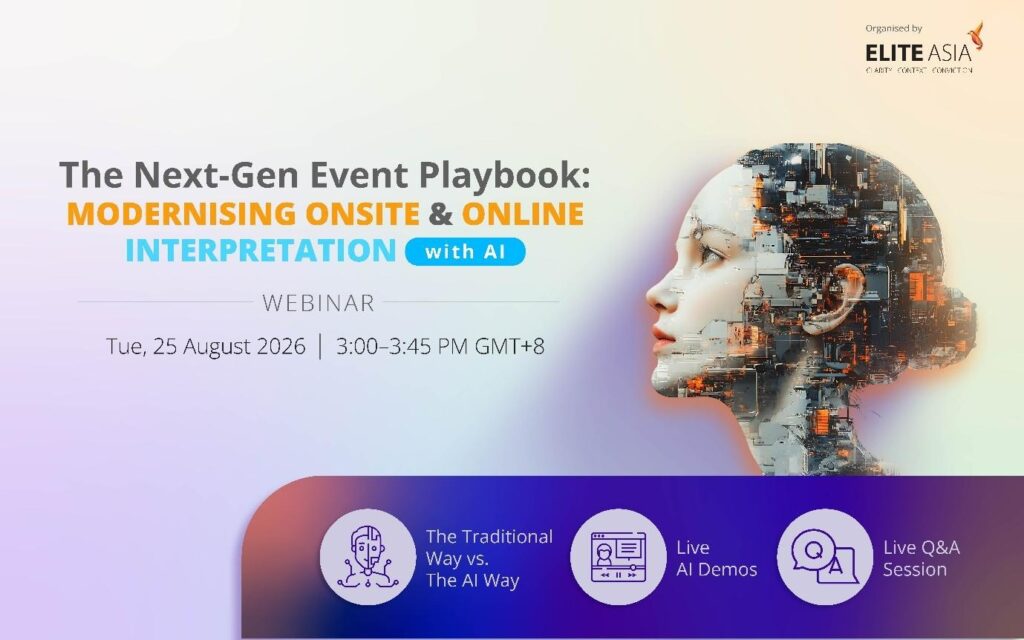
This shift from physical hardware to digital AI-powered access was the key focus of Elite Asia’s webinar on 25th August 2026, “The Next-Gen Event Playbook: Modernising Onsite & Online Interpretation with AI.” The session explored how AI Interpretation can simplify event operations, support different communication formats, and make multilingual events easier to scale. Attendees also experienced exclusive live demonstrations showcasing how AI Interpreting can be applied across different scenarios.
If you missed the webinar, no problem. We’ve summarised the key insights and practical considerations for organisations to help you explore whether AI interpretation is right for your next multilingual event.
Why Traditional Event Interpretation Can Be Costly and Complex
Providing simultaneous interpretation has long been a standard approach for multilingual conferences and corporate events. While effective, a traditional setup can require advanced planning, physical infrastructure, and coordination.
Organisers may need to coordinate interpreters for each target language, arrange soundproof booths, prepare interpretation equipment, and manage headsets for attendees. As the number of languages increases, so can the operational requirements.
Three challenges are common when hosting for multilingual audiences:
- Rising Costs: Each additional language can mean additional interpreters, equipment, and technical requirements. For events with multiple target languages, these costs can quickly add up.
- Limited Venue Space: Interpreter booths can occupy valuable floor space that could otherwise be used for seating, exhibition areas, sponsor activations, or networking.
- Complex Audio Setups: Receivers, transmitters, headsets, batteries, distribution systems, and audio feeds all need to work together. Issues such as interference, dead batteries, or missing equipment can create unnecessary stress for event teams.
AI Interpreting offers a different approach by shifting much of this infrastructure into the cloud.
Traditional Setup vs. AI-Powered Translation
The difference is not simply about replacing one technology with another. It is about changing how multilingual events are planned and delivered.
| Operational Metric | Traditional Approach | AI-Powered Approach |
|---|---|---|
| Physical Space | Requires interpreter’s booths and a dedicated equipment area. | Minimal onsite footprint with zero physical booths. |
| Audience Access to Translation | Attendees are provided headsets and receivers. Organisers need to rent and manage equipment. | Attendees scan a QR Code to access translated audio or captions. |
| Hardware Management | Requires managing transmitters, receivers, headsets, and batteries. | Attendees use their own personal devices and headsets. |
| Deployment Speed | Requires advance scheduling, interpreter coordination, and travel arrangements. | Instant deployment across target languages in minutes. |
| Cost Dynamics | Increasing cost per additional language. | Cost-effective event-based pricing model. |
AI Interpreting Across Different Event Scenarios
One of the key advantages of AI Interpreting is its flexibility. The same technology can support a range of event formats, from large conferences to interactive breakout sessions and online webinars.
- Main Stage Keynotes:
Mainly used for large conferences and corporate events, translated audio is available directly in attendees’ smartphones while real-time captions are displayed on main screens. - Virtual Webcasts & Summits:
AI Interpreting can also integrate with Zoom, Microsoft Teams, and webcast platforms without installing any plugins. - Multi-Track Breakout Rooms:
Multilingual access can be extended across multiple breakout rooms without requiring a separate booth and equipment setup. - Global Corporate Town Halls:
Streams real-time translated audio and captions to ensure international stakeholders, partners, and/or employees follow executive broadcasts in their native or preferred languages.
From One-Way Broadcasts to Two-Way Conversations
Multilingual communication is not always about listening. In business events, the real value comes from being able to ask questions, exchange ideas, and participate in the conversation.
The communication format can vary significantly from one event to another. A keynote presentation, product announcement, or executive town hall is primarily one-way communication, where a speaker delivers information to an audience. Breakout discussions, workshops, meetings, and Q&A sessions, however, are more interactive and require communication to flow in both directions.
AI Interpreting can support these different scenarios, depending on the event setup and technology being used.
- For one-way sessions, translated audio and real-time captions allow attendees to access presentations and announcements in their preferred language.
- For interactive sessions, two-way AI Interpreting can help participants communicate across languages, allowing them to speak in their preferred language while accessing translated content from other participants.
This opens up more possibilities for multilingual events. Instead of limiting language access to audiences listening to a presentation, organisations can create opportunities for international participants to ask questions, share ideas, collaborate, and participate in discussions.
For businesses hosting international meetings, workshops, breakout sessions, or networking activities, this can make multilingual communication more inclusive and enable participants to contribute rather than simply listen.
Beyond the Hype: Busting Common Myths About AI Interpreting
As AI Interpreting becomes more accessible, organisations naturally have questions about accuracy, terminology, and scalability. Here are some of the most common misconceptions about AI Interpreting and what businesses should know before adopting it.
- MYTH 1: “Adding 5 extra target languages means bringing in 5 times the equipment and tech staff.”
- FACT: False. Once your core audio feed connects to the software, adding additional languages happens instantly at the click of a button. Zero extra booths or physical hardware required.
- MYTH 2: “AI cannot understand specialised corporate jargon or company product names.”
- FACT: False. Pre-event Custom Glossaries train the AI model on your exact terminology prior to live broadcast. For businesses operating in specialised fields, requires preparation, which later can help improve consistency and contextual accuracy during live sessions.
Delivering a Smooth Real-Time Translation Experience for Multilingual Audiences
Timing of translation plays an important role in the quality of any live interpretation experience. The AI Interpreting operates with less than 3 seconds of latency, helping translated audio and captions keep pace with the speakers.
This is particularly important for fast-moving formats such as panel discussions, Q&A sessions, corporate town halls, and live presentations, where participants need to respond and engage without significant delays.
With the right combination of low-latency processing, clear audio input, and reliable connectivity, AI Interpreting can support a more fluid experience for multilingual audiences without adding complexity to the event setup.
What Does It Take to Run AI Interpreting Successfully?
AI can significantly reduce the physical infrastructure required for multilingual events, but successful implementation still depends on the right preparation. There are several practical factors to consider before your event goes live: connectivity, audio quality, terminology, and how attendees will access the service.
Stable Internet Connection
Because AI interpretation is delivered digitally, reliable connectivity is essential. Attendees access translated audio and captions through their own devices, making a stable network particularly important when many people are connected simultaneously.
For larger events, a dedicated, high-speed Wi-Fi network is recommended to support reliable audio streaming and caption delivery.
Clear, Consistent Audio
AI interpretation can only work with the audio it receives. Poor microphone quality, background noise, overlapping speakers, or an unstable audio feed can affect the quality of the translated output.
A clean audio source is key. Using reliable microphones and ensuring that speakers’ speeches are clearly captured can help the AI system process speech more effectively and deliver a smoother language interpreting experience.
Pre-Event Preparation
AI may handle the translation in real time, but preparation still matters.
Before the event, our dedicated team will work together with event organisers to prepare relevant terminology through custom glossaries, including but not limited to:
- Industry-specific terms
- Company and product names
- Speaker names
- Acronyms
- Technical terminology
- Frequently used phrases
Providing this information before the session gives the AI interpreting system greater context and can help maintain more consistent terminology throughout the event.
A Simple Way for Attendees to Access Translation
Even when the AI Interpreting technology is simple, attendees still need to know where and how to access it. Where not everyone may speak the event’s primary language, this initial information is very crucial.
Organisers can prepare multilingual digital signage, posters, presentation slides, and/or pre-event communications showing attendees how to access the interpretation service. A simple visual flow such as “Scan → Select Language → Listen” can make the process easy to understand without requiring lengthy instructions.
The QR code can be displayed at key touchpoints, including registration areas, venue entrances, meeting rooms, and presentation screens. For larger events, onsite staff can also be available to assist attendees who need help connecting.
The goal is to make language access feel like a natural part of the event experience, rather than another piece of technology attendees need to figure out.
Making Multilingual Events More Scalable
The value of AI interpretation goes beyond reducing the number of booths or headsets at an event. It can change how organisations approach multilingual communication from the planning stage onwards.
With translated audio and captions delivered digitally, organisers have greater flexibility to adapt language access to different event formats, audience sizes, and language requirements.
This can be particularly useful for organisations expanding into new markets or regularly hosting multilingual conferences, webinars, training sessions, and corporate events.
Rather than treating interpretation as a separate logistical layer, you can build multilingual accessibility into the overall event experience from the start.
Is AI Interpreting Right for Your Next Event?
AI Interpreting can be an incredibly practical and useful solution for organisations hosting multilingual conferences, corporate town halls, webinars, training sessions, regional meetings, and hybrid events.
The right setup will ultimately depend on factors such as the event format, number of attendees, target languages, venue infrastructure, content complexity, and whether the session involves one-way or two-way communication should all be considered.
If you are planning a multilingual event, Elite Asia can help you evaluate these requirements and determine how AI Interpreting could fit into your event setup. We help you to understand event translation needs by evaluating language requirements, audience profile, and technical setup.
The future of multilingual events may not require more booths, more headsets, or more complicated logistics. It may simply require a smarter way to connect people across languages
Contact Us
Working across languages? Our team can support your company’s translation and interpretation needs. For business enquiries, get in touch to explore what fits your requirements.
Request a Quote