![International SEO: Best Practices for Global SEO Strategy [2026]](https://www.eliteasia.co/wp-content/uploads/2026/03/International-SEO-Best-Practices-for-Global-SEO-Strategy-2026-1024x536.jpg)
International SEO: Best Practices for Global SEO Strategy [2026]
If you are interested in expanding your business to reach an international audience, you will be familiar with the two main growth strategies: paid and organic channels.
One of the most effective methods is search engine optimisation (SEO). SEO is the key to achieving cost-effective growth.
“Having a domestic market is no longer sufficient,” says Sara Chaya Presch, Argos Multilingual’s Director of International SEO.
“In the current business climate, characterised by the rise of the internet and globalisation, businesses are increasingly operating on a global scale. This necessitates a global mindset for companies aiming to maintain competitiveness and achieve success.”
Your website is already optimised for search engines in your native language. However, how should it be prepared for international SEO? Let’s explore the best localisation practices for SEO together.
What is International SEO?
International SEO is the process of enhancing your website’s visibility on search engine results pages (SERPs) for different languages and countries.
This involves techniques such as acquiring links from trusted sites in target regions, creating localised content, and structuring your site to effectively reach global audiences.
In contrast to conventional SEO and local SEO, which focus on ranking within a single market or region, international SEO targets multiple countries and potentially language groups.
The following are the key benefits of implementing international SEO.
- Your company will enjoy enhanced visibility in the search results of your target countries.
- Generate increased website traffic from international audiences.
- Secure a competitive advantage by entering markets earlier than your competitors.
However, it is important to consider whether international SEO is necessary for your business. Please continue reading to find out more.
A Brief Commentary on Search Engine Market Share
As you will be aware, Google accounts for the vast majority of the global search engine market share, with a 92.2% share. Its nearest competitor, Bing, has a 3.4% share.
Other search engines in the mix are:
- Yahoo (1.2% global market share) is a popular brand in Japan.
- Yandex (1% market share) is a popular brand in Russia.
- Baidu (0.8% market share) is a popular brand in China.
The latest significant contender in the search engine market, with a global market share of 0.6%, is Duckduckgo, a privacy-focused search engine.
Given Google’s global dominance as the leading search engine and its technological prowess in comprehending online content, it is the primary search engine that we focus our optimisation efforts on. If you can achieve a high ranking on Google, it is likely that you will also succeed with the other smaller search engines, unless you are targeting China or Russia.
In What Ways Might International SEO be of Benefit to Your Company?
Regardless of the quantity of content produced, a significant proportion will not achieve optimal rankings due to the substantial time and effort required, often in the form of financial investment.
However, there is positive news for those concerned.
While English content is abundant on the internet, there is a distinct lack of content in other languages. Despite the fact that English is not the primary language of the majority of people.
International SEO is one of the most effective strategies for organically growing your business online. Optimising and localising your website for search engines is an effective strategy to drive more traffic to your site.
In the context of competitive international industries, the process of ranking for keywords can present significant challenges. These best practices for SEO localisation will provide a solid foundation for achieving a leading position in your field.
How to Do International Seo: 9 Steps for Going Global Organically
International SEO is an essential strategy for businesses looking to expand into new markets and serve customers worldwide.
There are 9 key ways to determine whether your business is prepared for international expansion.
Firstly, It is Important to Understand Which Regions or Languages You Want to Target and Prioritise
The first step in creating an international SEO strategy is to determine the regions and languages to be targeted. This should also be defined in your market expansion strategy.
One of the most efficient ways to determine the starting point for this process is to review your brand search to identify any countries from which you are already receiving interest.
This can be accomplished via your Google Search Console account by following the steps outlined below:
- Please click on the ‘Search Results’ tab in the ‘Performance’ section.
- Please click on your top brand keyword.
- Please select the ‘Country’ tab and then use the ‘Sort by’ function to display the results in the desired order.
If your website does not yet have a GSC account set up, please find below a link to Google’s documentation on how to set this up.
This data will indicate which countries your brand has already established a presence in. What are the advantages of this approach? Should you be found in locations that you are not actively targeting, you will be well-positioned to expand your business in that country. This method can swiftly ascertain whether there is existing interest in your brand in other countries.
Should you discover that there are individuals searching for your brand in other countries, it is advisable to check the search results in those countries for your branded keyword, in order to ensure that there is no company with the same name as yours. This can be accomplished using this complimentary tool.
The next step is to assess search interest in your target countries using localised keyword research.
Please Carry Out an Analysis of Your Current Web Traffic
This will provide you with valuable information regarding the geographical origin of your visitors.
If a significant proportion of your site visitors are from a different country, it may be advisable to consider expanding your offerings (further details below) and implementing international SEO.
Please use Google Analytics 4 (GA4) to ascertain the geographical location of your site visitors.
Open your account and navigate to “Reports” > “User Attributes” > “Demographic details.”
![International SEO: Best Practices for Global SEO Strategy [2026]](https://www.eliteasia.co/wp-content/uploads/2026/03/image-5-1024x525.png)
The next step is to assess the manner in which international visitors engage with your website. Look at:
- Which service and/or product pages do they visit?
- How long do they spend on these pages?
- Do they take actions that support your business goals?
Let’s say you own a U.S. brand and notice visitors from France spend a significant amount of time on one of your product pages. Despite the fact that the website is exclusively in English, they still complete the forms.
These signals indicate that entering the French market may be advisable.
Assess Market Viability
Market viability is a term used to describe whether or not it is feasible, in a practical sense, to expand to a new region and whether this expansion is likely to be profitable.
The presence of multiple successful competitors in a market, as opposed to just one or two dominant players, can indicate the viability of that market and the existence of sufficient demand to support your business.
Semrush’s Market Explorer tool is designed to facilitate this assessment.
Please select the ‘Analyse Category‘ tab, choose your category from the drop-down menu, enter your desired location and click ‘Research a market‘.
![International SEO: Best Practices for Global SEO Strategy [2026]](https://www.eliteasia.co/wp-content/uploads/2026/03/image-6-1024x435.png)
Please refer to the “Overview” tab for a comprehensive overview of the market’s viability.
In this case, there is a significant number of potential buyers (Market Size), the market’s total monthly website traffic is almost 100 million visits (Market Traffic), and there is a low enough level of consolidation to suggest opportunities for newcomers (Market Consolidation).
![International SEO: Best Practices for Global SEO Strategy [2026]](https://www.eliteasia.co/wp-content/uploads/2026/03/image-8-1024x569.png)
In order to succeed in this market, the following steps are recommended:
- Please ensure that you are able to cover the costs of international shipping and logistics.
- Please familiarise yourself with country-specific regulations.
- Please ensure that you understand cultural preferences and buying habits.
Review of International SEO Resource Requirements
In order to expand into new markets via SEO, there are specific resources required to ensure success.
In order to implement international SEO, the following investments are required:
- We offer professional translation and content localisation (images, blog content, etc.).
- We also provide technical setup (regional URLs, hreflang attribute implementation, etc.).
- In addition, we can provide more content creation support (writers, editors, etc.).
Once you have evaluated these requirements, you can make an informed decision about international expansion.
Best Practices for Achieving International SEO Success
In order to create an effective international SEO strategy, it is essential to research target markets, optimise for local search behaviour, adapt content, and build regional authority.
Conduct Comprehensive Market Research for Target Regions
Thorough market research is essential for identifying competitors, understanding target audience needs, and assessing regional behaviours.
This approach enables you to customise your SEO international strategy for each region, ensuring maximum reach of your target audience.
Semrush’s Market Explorer is an invaluable tool for gaining a comprehensive understanding of new markets.
Please open the tool and select the “Find Competitors” tab.
Please enter your domain and target location, then click “Research a market.”
![International SEO: Best Practices for Global SEO Strategy [2026]](https://www.eliteasia.co/wp-content/uploads/2026/03/image-9-1024x436.png)
In the “Overview” tab, you will find key players, top and trending keywords, and more.
This data should provide you with a comprehensive overview of your new market and your competitors.
![International SEO: Best Practices for Global SEO Strategy [2026]](https://www.eliteasia.co/wp-content/uploads/2026/03/image-10-1024x570.png)
Please proceed to the ‘Audience‘ tab to access further information regarding the target audience’s demographics.
The data set includes information such as age, socioeconomics, interests, social media use, and domains visited.
![International SEO: Best Practices for Global SEO Strategy [2026]](https://www.eliteasia.co/wp-content/uploads/2026/03/image-11-1024x503.png)
Let us consider a scenario in which it is determined that the majority of your target audience in a new market falls within the high-income bracket. You can then concentrate your localised content on emphasising premium features and quality.
Please Identify the Keywords That Will Be Most Effective for Your Target Country
International keyword research is the process of identifying the search terms used by people in different countries and regions to find products, services, or information online.
In order to identify the most suitable keywords, it is important to consider cultural nuances, specific search behaviours and language variations.
For instance, if you sell glasses and are expanding to Mexico, it would be advisable to use the word “lentes” (which is used in Mexico) rather than “gafas” (which is used in Spain).
In order to initiate your research, it is recommended that you begin by conducting a thorough analysis of your competitors’ keywords. This will allow you to identify the search terms that are currently effective for them.
In order to gain a competitive advantage in your new market, you should use Semrush’s Keyword Gap tool to compare your current Google rankings with those of your competitors.
Please enter your domain, select up to four competitors, and specify your target location. Please click on the “Compare” button.
![International SEO: Best Practices for Global SEO Strategy [2026]](https://www.eliteasia.co/wp-content/uploads/2026/03/image-13-1024x616.png)
You will see the top opportunities for keywords you are not ranking for at all. And those in which your ranking is lower than that of your competitors (“Weak”).
![International SEO: Best Practices for Global SEO Strategy [2026]](https://www.eliteasia.co/wp-content/uploads/2026/03/image-15-1024x657.png)
Please scroll down to view a table containing the following details:
Keyword analysis provides detailed insights into the online visibility of a website, including
- The ranking of keywords against competitors
- The keywords for which a website is not ranking,
- The keywords for which competitors are ranking ahead of the website.
And more.
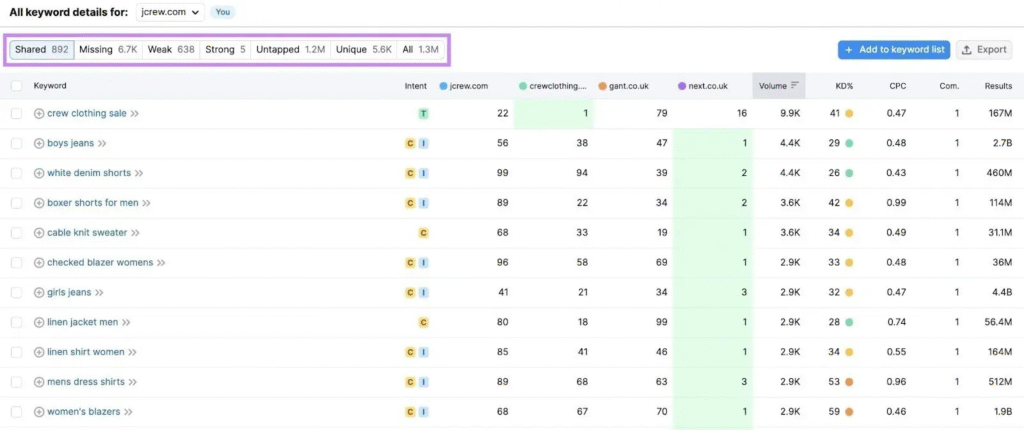
This keyword list can be filtered based on various criteria. As you will be aware, these metrics include average monthly search volume and keyword difficulty, which is a measure of how difficult it is to rank in the top 10 for a given keyword.
Once you have gathered a number of keyword ideas, we recommend running those terms through Semrush’s Keyword Magic Tool to identify even more relevant terms to target.
For instance, a U.S. company looking to expand to the U.K. could enter the broad keyword “uk clothing brands” to discover related terms that may be easier to rank for or more relevant.
Please open the Keyword Magic Tool, enter your keyword and your domain, choose the location, and click “Search.”
![International SEO: Best Practices for Global SEO Strategy [2026]](https://www.eliteasia.co/wp-content/uploads/2026/03/image-18-1024x392.png)
You’ll see thousands of potential keywords, but not all will be relevant.
Please use the filters to narrow down the list.
For instance, you can filter by “Questions” to find question-based search terms. Alternatively, select “Related” to access additional variations that may not be readily apparent.
![International SEO: Best Practices for Global SEO Strategy [2026]](https://www.eliteasia.co/wp-content/uploads/2026/03/image-20-1024x560.png)
You may find it useful to use the suggested groups and subgroups on the left in order to discover more niche keywords to target.
![International SEO: Best Practices for Global SEO Strategy [2026]](https://www.eliteasia.co/wp-content/uploads/2026/03/image-21-1024x561.png)
Please note that the keyword research options displayed above are specific to Google.
It is advisable to research which search engines your target market uses.
While Google is the leading search engine in most countries, there are some regions where other search engines are preferred. For instance, Yahoo has a market share of almost 10% in Japan. Baidu is a highly popular search engine in China. Yandex is a widely used search engine in Russia.
If you are entering a market where another search engine is prevalent, it is advisable to familiarise yourself with that specific search engine’s ranking signals.
Please Ensure That Your Content is Adapted So as to Take Into Account Cultural and Regional Preferences
Content localisation involves adapting all aspects of your website’s content to align with the cultural preferences and expectations of your target region.
This approach goes beyond mere translation.
Translation is the process of converting text from one language to another while maintaining its meaning.
Localisation involves adapting your entire messaging to match local preferences, values, and cultural context.
Please find below an example of a localised page by an American beauty brand.
They created region-specific content for their European audience, connecting their products with Europe’s most popular sport.
![International SEO: Best Practices for Global SEO Strategy [2026]](https://www.eliteasia.co/wp-content/uploads/2026/03/image-22-1024x438.png)
In order to localise your content, it is essential to research your target market’s preferences and adapt your messaging, visuals, and examples to reflect what resonates with that audience.
Please find below some ways in which you can adapt your content for your new target audience:
- When creating content for location-specific holidays, such as the Lunar New Year in China.
- It is essential to adhere to legal and regulatory compliance guidelines, including those stipulated by the GDPR for the EU.
- Accurate translation and localisation of content is paramount, ensuring that regional idioms, slang and expressions are accurately reflected.
- Addressing the specific needs, challenges or interests of the target audience through relevant topics is crucial for effective communication.
- Currency and pricing should be adjusted to match the local market.
- Links to trusted regional sources should be incorporated to build trust and signal relevance.
Localised Keyword Research
Conducting localised keyword research can provide valuable insights into the search interest levels for your product or service in various international markets.
This can present a significant challenge for non-native speakers of the target country’s language. In such cases, the most advisable course of action would be to hire an international SEO agency that possesses both the necessary SEO expertise and the required language skills to assist you. As an alternative solution, you may wish to consider using free AI translation tools to facilitate the initial stages of the process.
In order to assist you with this process, please find below the main steps involved in conducting localised keyword research.
Please be advised that this keyword research methodology will also be beneficial when localising your content into new languages. In order to signal to Google that your page is relevant for a specific keyword, you will need to include these keywords on the page.
Please list the most important keywords for your business.
To achieve this, please retrieve your non-branded keywords from the Google Search Console Performance Report. As an alternative option, you could create a list of keywords that your customers might use to find your product or service online. It is advisable to verify that these keywords are genuinely being searched for, which can be achieved by using a keyword research tool to assess their search volume.
Localising your keywords into the native language of the markets you wish to target will allow you to ascertain whether they are being searched for in those locations.
This is the challenging aspect. A literal translation of a keyword may not always result in a keyword with equivalent search intent. It is important to note that users in that country might be searching in a slightly different way, using different words and phrases. It is advisable to enlist the assistance of a native speaker when undertaking localisation projects, as they will possess an in-depth understanding of the nuances specific to the local culture.
In order to ascertain the search volume of your keywords in your target market, you should use a keyword research tool to check the localised versions of these keywords. Ahrefs, SEMrush and Google Keyword Planner are all tools that you can use for this purpose.
If a localised version of a keyword has no search volume, then variations of it can be tried to see if users are searching in a slightly different way. In such cases, the input of a native speaker can be invaluable.
Please note: if you are not a native speaker, one way to identify potential variations is to research the keywords that successful pages are already ranking for. In order to do this, please retrieve the URL for one of the pages that rank highly for your localised keyword and enter it into Ahrefs site explorer.
The next step is to enter the most significant keywords into Google Translate in order to ascertain whether they align with the search intent of your content.
Build Relevant Backlinks
Establishing a presence on reputable websites within your target market can assist search engines in comprehending the relevance of your content for that particular region.
Generating these local backlinks is an effective strategy for driving targeted traffic to your regional pages.
In order to attract backlinks from locally relevant sites, it is essential that your content is tailored to resonate with local audiences.
For instance, if you have created an infographic on hiring statistics in the U.S., translating it into Spanish will not provide any added value to your audience in Spain. Incorporating local hiring statistics and region-specific visuals will enhance the content’s capacity to attract backlinks.
The format is also important.
The following content formats are known to be effective in attracting backlinks:
We offer a range of professional services to help you develop your business, including:
- In-depth guides and tutorials that demonstrate your expertise
- Original data and research
- Infographics and other data visualisations
- Case studies and client success stories
- Interactive content like quizzes and calculators
Semrush’s Link Building Tool is an excellent resource for identifying potential backlink prospects and conducting outreach.
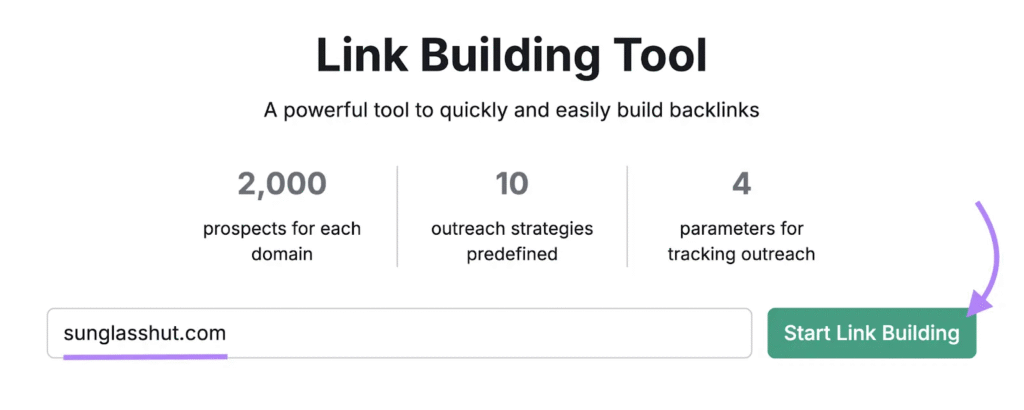
Please enter your domain’s URL into the tool. Then, click on the “Start Link Building” option.
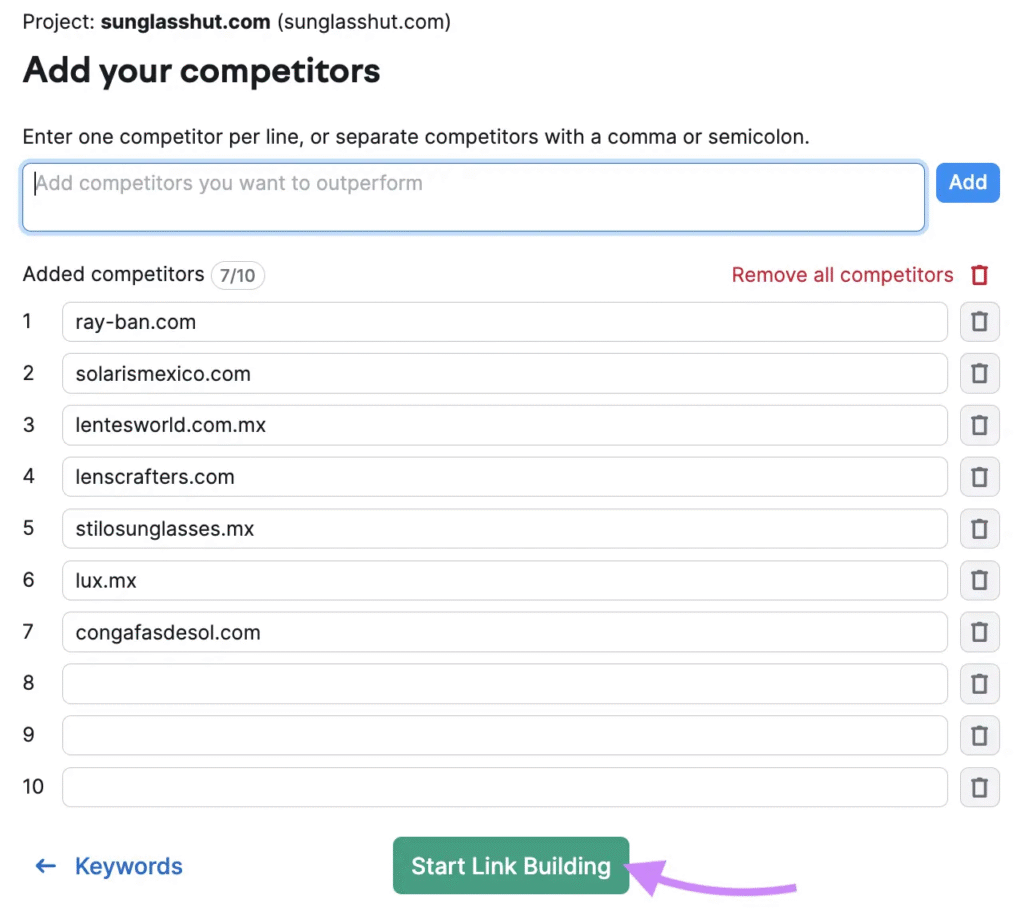
Please follow the prompts that appear in order to set up your project. It is essential to incorporate local keywords, select the target country based on the new market, and include regional competitors.
Please click on the option entitled ‘Start Link Building‘.
When the project is ready, go to the “Prospects” tab to access a list of websites that can be approached for the purpose of securing backlinks.
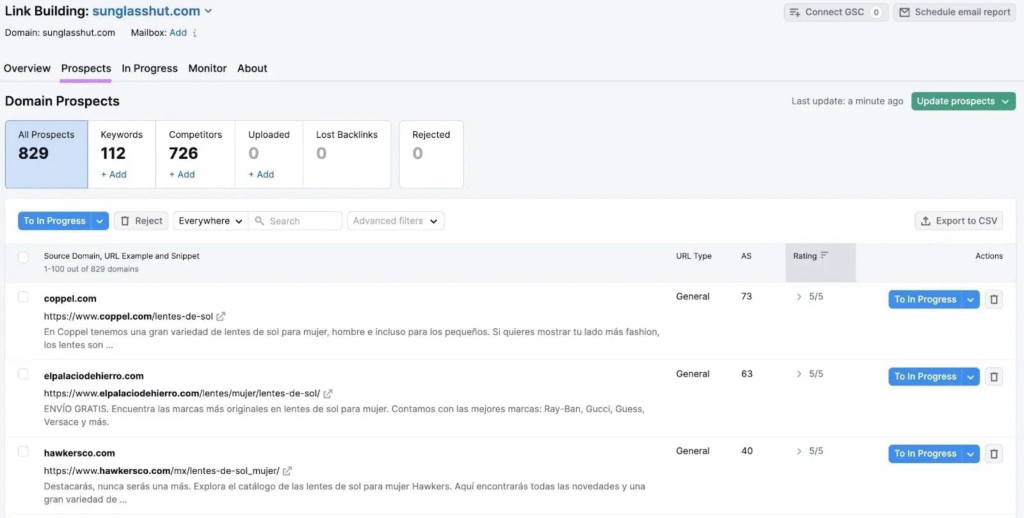
Please add the most promising prospects to your “In Progress” list. Following this, please create and send outreach messages.
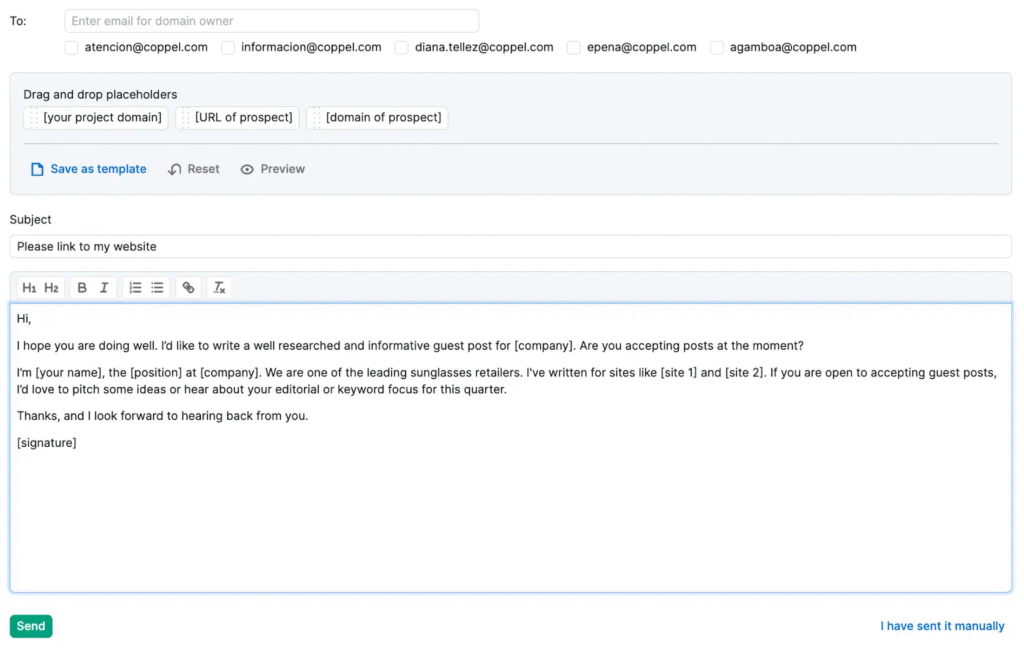
Please Find Below a List of the Technical Considerations for International SEO
Addressing technical elements for international SEO ensures search engines can properly find and understand your international content, which helps improve visibility in each target region.
There are three critical technical SEO elements that need to be executed correctly.
Please Use This Opportunity to Decide on the Site and Url Structure
In order to ensure that search engines can understand your intention to rank for additional languages or countries, it is necessary to have dedicated URLs (Uniform Resource Locators) that target these regions. This provides the search engine with a unique location for locating regional content.
It is insufficient to use the same URL and merely translate the content on the page, switching it in and out with a plugin when the user switches the language selector.
The most straightforward approach to adopt is one that involves the strategic use of language. This means that the focus is not on targeting a specific country, but rather on reaching all users worldwide who are using that language in their searches.
For example, if you were to target Spanish speakers (the second largest language in the world by number of native speakers), you could do so with just one localised Spanish website.
Language targeting is an effective strategy when the content of the site can be adapted to suit all countries where the same language is spoken. Websites that are particularly suited to this configuration are content-driven websites, where the primary objective is to drive traffic and generate revenue through advertising or referrals.
Websites or businesses that wish to refine their targeting of countries and exercise greater control over the content visible to users in each country should consider country targeting. Country targeting also allows you to localise content more effectively, ensuring it aligns closely with how users naturally speak or the dialect they use in a particular country, as opposed to the same language in a different country.
Country targeting allows you to localise all of the elements relevant to a particular country, including but not limited to pricing, currency, date and time formats, product or service features, and regulatory details. It is likely that businesses such as e-commerce, financial services and gambling would prefer to use country targeting.
Please note that it is advisable to avoid creating too many country versions that are identical to this one, as this can result in duplicate content issues for Google.
Please refer to the following advice from Google’s Search Relations Team Lead:
Once a targeting strategy has been determined, the next step is to decide on domain and URL structure.
Implement region-specific URLs
Region-specific URLs assist users and search engines in identifying the intended version of your website, whether for a specific country or language.
Google recommends implementing one of the following practices:
- It is recommended that a country-specific domain be used. In order to proceed, it is necessary to create a separate domain for each market (e.g. “www.yourwebsite.fr”). While this option is the most expensive and only works for a single country, it clearly signals to both users and search engines which country you’re targeting.
- Please ensure that subdomains are set up with a generic top-level domain (gTLD). This approach utilises distinct subdomains for each region (e.g., “fr.yourwebsite.com”) and is particularly effective for websites hosted on servers in multiple locations. Whilst it is less complex to establish than country-specific domains, users may not necessarily be able to ascertain whether a subdomain refers to a country or a language.
- Create subdirectories with a gTLD. This method employs distinct folders (subdirectories) for each region (e.g. “www.yourwebsite.com/es” for Spanish content) and is the most straightforward to configure. It should be noted that the location targeting is not as clear-cut as with country-specific domains.
Implement Hreflang Tags
Hreflang tags are HTML attributes that instruct search engines regarding the version of a page to be displayed to users based on their language and location.
These tags are an integral component of international SEO, as they ensure that users do not encounter the incorrect language version of your content in search results.
Please find below an explanation of how hreflang tags function:
For instance, if a U.S.-based company wanted to serve content in French to audiences in France, this would be a good solution. For this, you will need tags for both versions:
<link rel=”alternate” href=”https://www.example.com/page” hreflang=”en” />
<link rel=”alternate” href=”https://fr.example.com/page” hreflang=”fr” />
Each tag includes:
- The link rel=”alternate” indicates an alternate version of the webpage.
- The ‘href’ attribute includes the alternate page in the target language or region.
- The use of the hreflang attribute, specified by the [language code], serves to indicate the language and, in some cases, the region. For instance, the code “en-us” designates American English.
It is imperative that tags are always included for all language versions, including the original page. Google refers to this as a “self-referencing hreflang” and recommends its implementation.
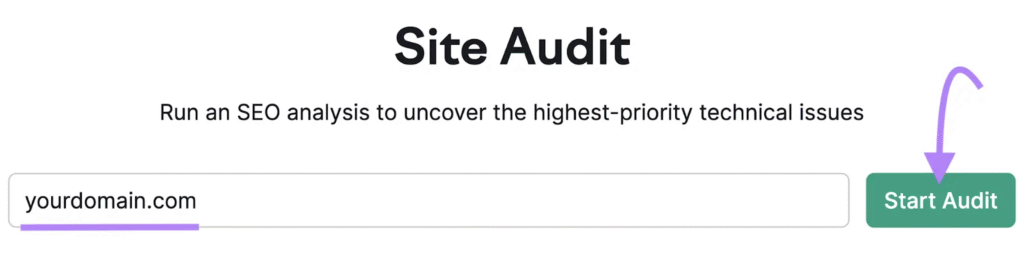
Please use the Site Audit tool to verify your hreflang implementation.
Please open the tool and enter your domain. Then, click “Start Audit.”
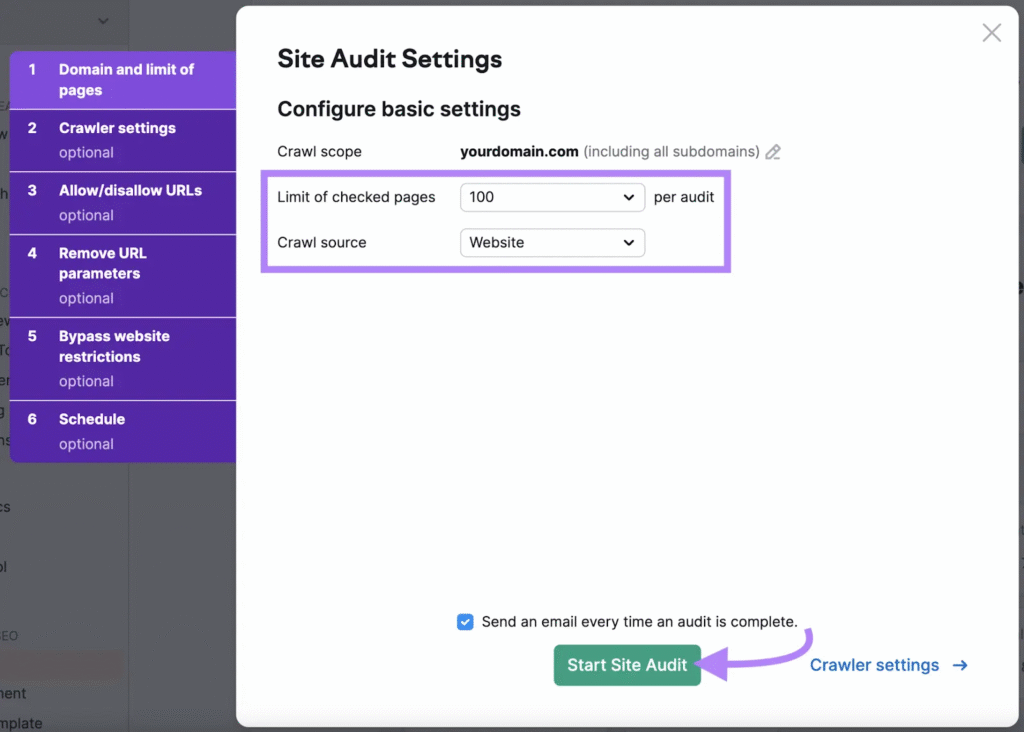
Please follow the steps to configure your settings. Then, click “Start Site Audit.”
Once the audit is completed, you will receive an “Overview” report that will look similar to this:
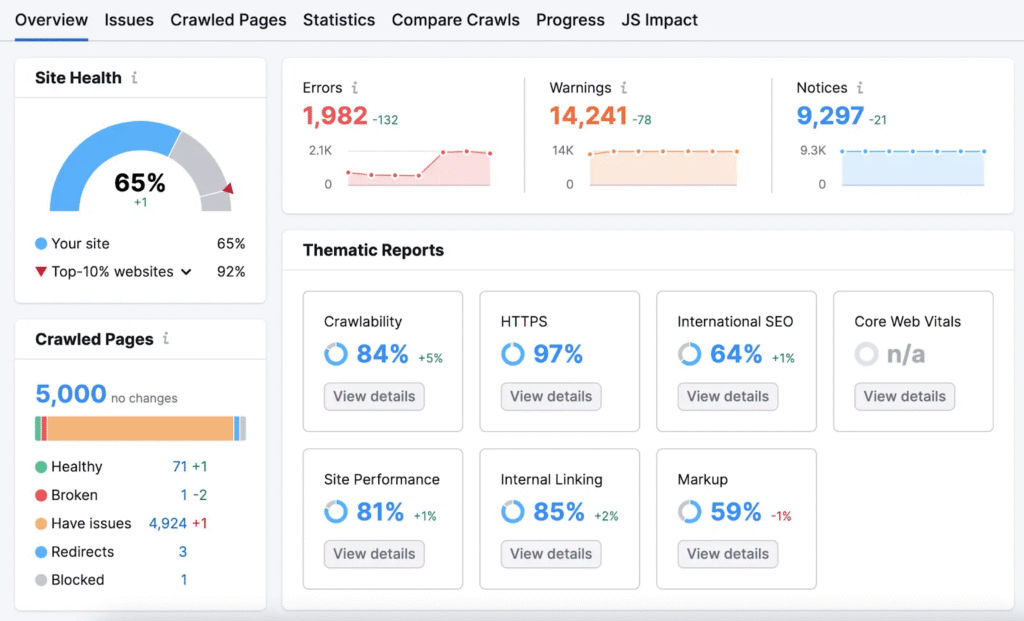
Please go to the “Issues” tab and click “Errors” to look for any potential hreflang implementation issues.
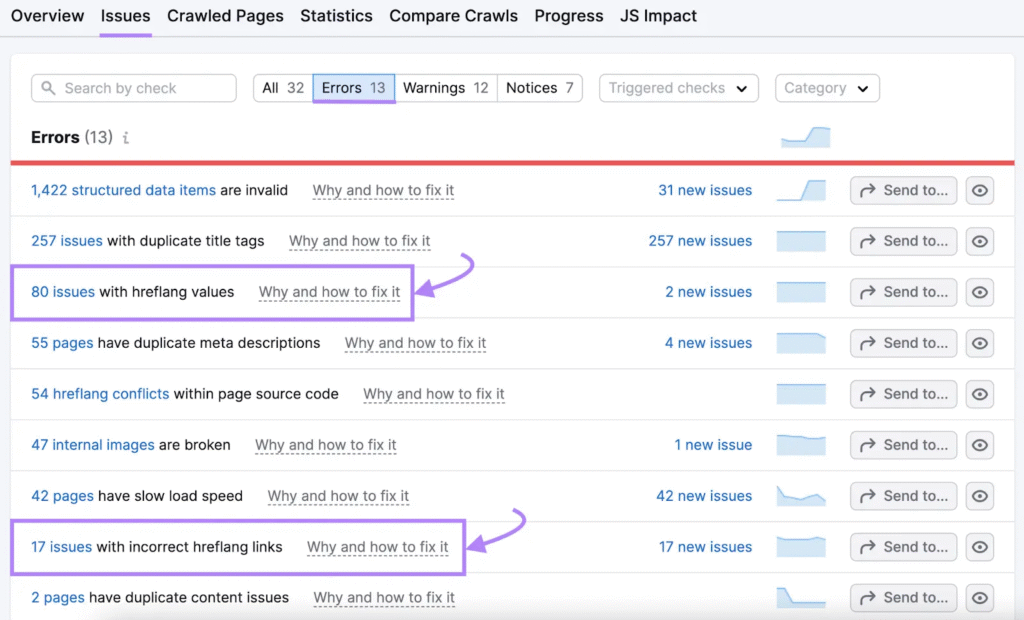
To find out more about the issue and how to resolve it, click on “Why and how to fix it”.
Handle Duplicate Content and CanonicaliSation Issues
When there is similar content across different regional versions of a website, search engines need help understanding which version is the main one to rank in each region.
Failure to adhere to this specification will result in duplicate content.
Duplicate content occurs when there is the same or very similar content on multiple pages. This is a common occurrence with international websites.
If you are a shoe retailer operating in both the U.S. and the U.K., for instance, your product descriptions are likely to be very similar.
In the event of duplicate content being identified by search engines, the pages concerned may compete with each other. This phenomenon is known as keyword cannibalisation.
Canonical tags are the solution to this problem. They inform search engines of the primary version for each language.
The following is an example of a canonical tag:
<link rel=”canonical”href=”https://yourwebsite.com/uk/product-category/product-name”/>
When utilising both hreflang tags (for language targeting) and canonical tags on international pages, it is essential to ensure they are synchronised.
For instance, if a product page is available in English and French, it is essential to ensure that the English version’s canonical tag directs users to the appropriate English page. The French version’s canonical tag directs users to the French page.
Tracking and Performance Measurement
Once new international websites with localised SEO have been launched, it is important to measure their performance. The following is a step-by-step guide:
Google Analytics can be used to analyse inbound traffic, identify the source of visitors, and determine the pages they are landing on. This can assist with troubleshooting any targeting issues.
If you are interested in learning about keyword rankings, I would recommend using Google Search Console, which is free of charge. This will show you clicks, impressions, click-through rate and rankings for each keyword by country.
If you are looking for a more advanced keyword tracking tool, I would recommend either Ahrefs or SEMrush, as they are both excellent ranking tracking tools. It is possible to set up a project for each country and add your localised target keywords from your keyword research.
Which Tools Should I Use to Get Started With International SEO?
There are three primary tools that SEOs generally use to attract international search traffic.
- Google Keyword Planner is Google’s own tool for keyword research, and it provides highly accurate search volumes. This is because the data is directly sourced from Google.
- According to the Ahrefs website, this SEO tool covers 10 search engines. There are 242 countries in the world.
- SEMRush is a tool that claims to provide keyword data for 120 countries and offers a range of features designed to assist digital marketers.
A Guide to Considerations When Localising Your Website
Now that you have established the necessary framework and strategy, it is time to move on to the enjoyable aspect of localising your content.
Quality of Translation
The quality of translation is a key factor in determining Google’s overall assessment of the quality of your website. It is important to note that machine translation is not yet perfect, and using content that has not been subject to quality assurance may result in a negative user experience, potentially damaging your brand’s reputation and hindering your website’s search engine rankings.
It is important to note that the language quality of the different versions of your site can affect each other. Therefore, if a single low-quality translated website is present, it has the potential to adversely impact the rankings of its international equivalents. This is due to Google’s site-level quality assessment.
Maintaining the quality and freshness of your content is important for SEO purposes. For example, if you update the original version of your page, you should also update the international versions to reflect these changes. A robust continuous localisation process can ensure that updates are consistently high-quality and seamlessly propagate across all versions.
Keyword Optimisation
In order to optimise your pages for search engines, there are a number of elements that you need to take into consideration. Firstly, it is important to localise your pages, and secondly, you should include the localised version of the main target keyword for that page.
In an effort to optimise the visibility of your website in search engine results, we make a conscious effort to incorporate the primary target keyword of the page in these specific locations. This serves to communicate to Google the relevance of your content for individuals utilising that particular keyword. This strategy has the potential to enhance the ranking of your website and increase the number of clicks it receives.
- URL
- Meta title
- H1
- Please find below the first paragraph of the copy.
It is important to avoid over-reliance on keywords, as this could be perceived as keyword stuffing. It is advisable to incorporate it seamlessly into these areas and the content. It is inadvisable to change the content to include the keyword in a way that sounds unnatural to the user.
With regard to images, it is not necessary to localise the file name. Please continue to use the existing file/URL and add localised ALT tags (if there is no text in your image).
Hreflang Tags
Hreflang tags provide search engines with information about international copies of a page, enabling them to consider ranking those copies in the relevant regions or for the corresponding languages. John Mueller, Google’s Search Advocate, has stated that hreflang is considered to be one of the most complex areas of SEO.
One tool that is essential for auditing your hreflang tags is ScreamingFrog. It acts as a web spider, visiting all the pages on your website and providing statistics on response codes, redirects and canonical tags. Screaming Frog is an essential tool for checking the technical health of your website. I would strongly encourage you to try it, as there is a free licence available.
Link Building
International SEO link building is a crucial aspect of online marketing, involving the creation of a web of internal and external links that demonstrate a website’s relevance and authority to search engines.
When carrying out internal link building, it is advisable to link your content to other related internal content and products, using anchor text that is rich in keywords. In order to ensure an optimal user experience, it is essential to link only to pages that have been translated into the same language as the target audience. It is important to remember that internal link building should be natural and relevant to the reader. This could mean citing a statistic from internal research or including links to product pages, help documentation, or related articles.
In order to build external links, it is important to identify key partners, media outlets and clients with enough reach in your target market to make it worthwhile approaching them. It is recommended that tools such as Ahrefs and SEMrush be used to assess the quality of different websites prior to making contact. When corresponding with these target websites via email, it is advisable to introduce yourself, your product, and to emphasise the merits of your content. It is important to remember that quality is more important than quantity when it comes to external link building.
Launching Your New International Websites
When launching new international websites, it is essential to inform Google of this fact, thus enabling them to visit and begin ranking your pages. To achieve this, it is necessary to submit a sitemap for your new localised website via Google Search Console.
It is also recommended that a Search Console profile be set up for each new site. When launching, please ensure that no index tags are present and that Google’s crawler has not been blocked in your robots.txt file, in order to facilitate access to the pages.